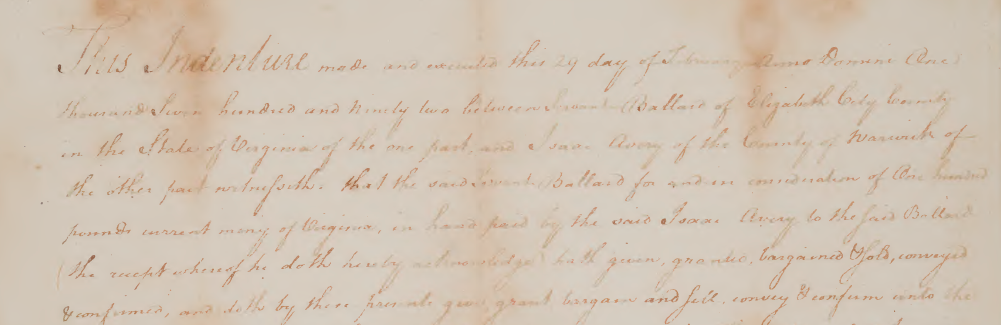
Obituary of Charles Thruston Ballard of Louisville, Kentucky (1850-1918).

Crypt of Charles T. Ballard, Cave Hill Cemetery, Louisville, Kentucky.

Charles Thruston Ballard, Ph.B. 1870
Born June 3, 1850, in Louisville, Ky.
Died May 8, 1918, in Glenview, Ky.

Charles Thruston Ballard was born in Louisville, Ky., on June 3, 1850, being one of the five children of Andrew Jackson and Frances Ann (Thruston) Ballard.  His father attended Transylvania University, practiced law in Louisville for many years, and at the outbreak of our Civil War in 1861 was appointed by President Lincoln clerk of the U.S. Circuit and District courts for the District of Kentucky.  He was the son of James and Susan (Cox) Ballard and the grandson of Bland Ballard, Jr, of Spotsylvania County, Va., who was a Corporal in Major George Slaughter’s battalion that came to Kentucky from Virginia in 1779 and who was killed in an Indian massacre in March, 1788, near the present site of Shelbyville.  James Ballard, his brother, Bland W. Ballard, a Private under his father in the American Revolution, one of the most celebrated of the Indian fighters in pioneer days in Kentucky, and later a Major in the War of 1812, and their half sister were the only members of the family who survived the massacre.

Frances Ann Thruston Ballard’s parents were Charles William and Mary Eliza (Churchill) Thruston.  Her grandfather, Charles Mynn Thruston, Jr, when less than twelve years of age, served as aide-de-camp to his father, then Captain, but later Colonel, Charles Mynn Thruston, at the battle of Piscataway in the Revolution, and later married Frances Eleanor, daughter of John and Anne Rogers Clark and sister of General Jonathan Clark, General George Rogers Clark, Captain John Clark, and Lieutenants Edmund and Raymond Clark, who served as officers in the Revolution.  One of them,—Captain John Clark,—Charles Thruston Ballard represented in the Virginia Society of the Cincinnati.   Another of her brothers, General William Clark, was too young to serve in the Revolution, but was an officer under General Wayne in 1794-95, and the Clark of the Lewis and Clark Expedition across the American continent in 1804-06.  Other Revolutionary ancestors of Charles Thruston Ballard were Lieutenant Armistead Churchill of the Fauquier County (Va) Militia and Lieutenant William Oldham, who served in Daniel Morgan’s company in the siege of Boston and in the Canadian campaign of 1775-76 and who, on November 4, 1791, lost his life as Lieutenant in command of the Kentucky Militia at the battle of St Clair’s Defeat.  Colonel Churchill came to Kentucky in 1779 and John Clark in 1785, and both settled and were buried on the present site of Camp Zachary Taylor, near Louisville.

Mr. Ballard was a member of the Society of Colonial Wars in the Commonwealth of Kentucky and of the Kentucky Society of the Sons of the American Revolution.  He was fitted for college at the Louisville Male High School and at General Russell’s Collegiate and Commercial Institute in New Haven, Conn.  At Yale he took the select course in the Sheffield Scientific School.  In Senior year he was captain of the Sheffield Boat Club, and in 1870 went on the first of Professor Othniel C. Marsh’s expeditions to the Western plains.  In the fall of that year he returned to Louisville and accepted a position in one of the banks, later becoming cashier in the office of the U.S. Collector of Internal Revenue.

In 1878 he organized the firm of Jones, Ballard & Ballard, and engaged in the milling business, using one of the first patent flour manufacturing processes which appeared on the market.  In 1884 they failed in business, were allowed to retain certain of their assets, were incorporated as the Ballard & Ballard Company, and later paid off all of their debts with interest.  They were among the first in the United States to establish profit sharing and welfare work among their employees.  Mr. Ballard remained as president of the company until his death, his brother, S. Thruston Ballard (B. S. Cornell 1878), succeeding him.  He had always taken an active part in the political, social, and civic life of Louisville. He was a Republican in politics, and was deeply interested in the affairs of that party. From 1907 to 1909 he was chairman of the Board of Aldermen.  He was president of the Louisville Board of Trade and of the Pendennis Club, and a director in the Fidelity & Columbia Trust Company, the Union National Bank, the Federal Chemical Company, and the Louisville Railway Company. He was senior warden of Christ Church Cathedral.  In March, 1916, he was elected a vice president of the Associated Western Yale Clubs.  He had traveled extensively in this country and Europe.

His death occurred very suddenly, May 8, 1918, at the family home, Bushy Park, Glenview, Ky, as the result of myocarditis.  He had not been in good health for some time, but his condition was not such as to affect his activities materially. Interment was in Cave Hill Cemetery, Louisville.

Mr Ballard was married April 24, 1878, in New Orleans, La., to Emelina Modest, daughter of Gustave Arvilien Breaux (B.A. Norwich 1847, LL.B. Harvard 1850) and Emile (Locke) Breaux. They had eight children: Abby Churchill, who was married June 1, 1899, to Jefferson Davis Stewart of Louisville; Emile Locke (born September 18, 1880; died December 10, 1886); Mary Thruston (born November 25, 1882; died February 5, 1884); Charles Thruston (PhB. 1907), who served as an Ensign in the U.S. Navy during the war; Gustave Breaux, a nongraduate member of the Class of 1909S., who held a Captain’s commission in the Coast Artillery Corps.; Fanny Thruston, who was married on August 31, 1912, to Charles Horner; Churchill (born April 30, 1890; died February 12, 1891); and Mina, who was married on June 6, 1914, to Warner LaValle Jones. His wife, five children, and four grandchildren survive.  He also leaves two brothers, one of whom, S. Thruston Ballard, was his associate in business, and the other, R. C. Ballard Thruston, graduated from Yale with the degree of Ph.B. in 1880.  His only sister, Abigail Churchill Ballard, was taken ill while in her Junior year at Vassar College and died of tuberculosis in April, 1874.

From Obituary Record of Yale Graduates, 1915-1920 (New Haven: Yale University, 1920) 16th Series, No. 11, pp. 733-36.

A Possible Welsh Origin of Lineage Group I & A Biography of Bland W. Ballard of Aquilla, Texas (1824-1904).

Below is a biography of Bland William Ballard of Aquilla, Texas that was published in A Memorial and Biographical History of Johnson and Hill Counties, Texas (Chicago: The Lewis Publishing Company, 1892), pp. 534-37.  This was thoughtfully provided by a fellow researcher and is transcribed here.  Bland William Ballard (1824-1904) descends from Bland Ballard of Spotsylvania County, Virginia, which places him in Lineage Group I.

We will note a curious bit of information that bears further study, namely that the subject — who no doubt was interviewed by the author for this publication — stated that his ancestor Bland “had emigrated to Virginia from Wales long before the war for independence, in which he took a part.”  He was referring to Bland Ballard (c.1735-1788), son of the first Bland, which suggests he conflated the two; an easy error, given the repetition of names, for Bland’s activities in Spotsylvania are fairly well documented from the date of his Spotsylvania land patent in 1734.  But one can’t help there is a kernel of truth to the assertion that the family is indeed from Wales, and that information was lost or forgotten over time.

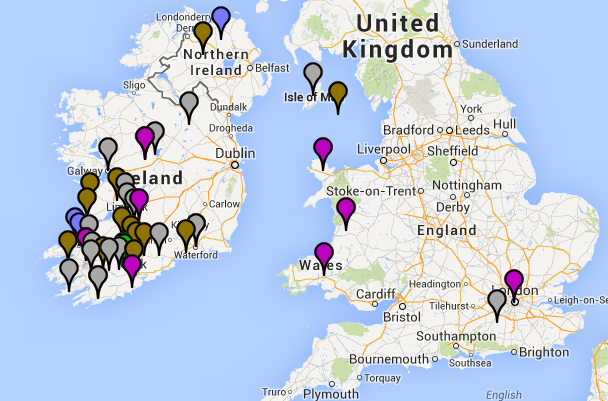
There has been another suggestion of a Welsh connection from another source, the administrator of the R1b-CTS446 Plus Project.  This Project includes several members of Lineage Group I.  We were invited to participate because we tested positive for at least one of the SNPs defining the Irish Type II subclade, which is found in the south of Ireland and other parts of Great Britain.

The stated objective of the project are as follows:

The R1b-CTS4466 Plus project will research the parameters of this major subclade which features strongly in the south of Ireland, but it is found as well in other areas of the Isles, including some in the west of Ireland, Wales, western England, an apparent branch in Northern Ireland and Scotland and a few continentals.  We hope to discover the ancient history of this subclade – where it may have originated, how old it might be, which groups within it share more recent ancestry and how different branches may have developed and migrated from the time of the common ancestor.

On 18 July 2015 we received this email from Elizabeth O’Donoghue-Ross, Group Administrator of the R1b-CTS446 Plus Project:

Hello, Everyone.

With so many CTS4466 SNP Pack results coming in together, the issues that have needed to be addressed and reported, plus some new BIG Ys in as well, I’ve been unable to contact each of you directly about your results.  Apologies for this delay.  I’ve decided that the most efficient way to contact you would be to include all of you who are in the same branch in one email to explain the results.  If some of you have already been contacted by me or Ed, please forgive the duplication.

Your result shows you in the FGC29280 branch, and you have been placed in the ‘ A1b1a S1121+ // Z16252+ // FGC29280+’ group in the spreadsheet.  Your surnames vary with origins in Clare and Cork for Reddin and Hurley, to an ostensibly Anglo-Norman surname in the Ballards, which in principle you would not expect to be Irish Type II at all.  The group of Ballards is relatively closely related, and though some indicate England as their country of origin, I can’t help but wonder if this group of Ballards might be Welsh, which is where many of the Anglo-Normans were based before coming to Ireland with Strongbow.  The force included a number of Welsh archers.  There may be a connection of interest to the CTS4466* group that appear to be of Welsh origin.  This could indicate the early origins of the whole subclade.  We are looking into this possibility.

The variety of surnames found in your branch indicates that there are probably more branches to be discovered, but it will need further tests through the BIG Y or the Y-Elite at FGC to identify them.  Ideally, two participants of each surname would test for comparison purposes to discover the SNPs that define their own surname-specific branch.

If you haven’t yet, you should join our Forum – https://groups.yahoo.com/neo/groups/R1b-CTS4466-Plus/info.  We were discussing the CTS4466 SNP Pack results and you can always look through the previous messages posted

Please feel free to contact me directly if you have any questions about the results.

Thank you for testing.  I hope you are pleased that you have discovered more of your heritage.

Best Wishes,

Elizabeth

Elizabeth is assuming Lineage Group I’s ancestor emigrated from Wales to Ireland (Strongbow came to Ireland in 1170), but note that the subclade is present throughout the United Kingdom, only strongly represented in Ireland.  We do know there was a William Ballard who was mayor of Cork, Ireland in 1690, and several streets in Cork bear the name “Ballard,” so possibly a Welsh branch of the family did settle there.  Assuming a Welsh origin, other branches could just as easily have gone in the other direction and settled in England.

The ever helpful Wikipedia has an interesting observation about the origin of the Ballard name, unfortunately without citations:

There are other sources for this name, besides the Anglo-Saxon. Not all people bearing the name are of English origins. It is common, with native etymology among several Celtic nations, although the British Celtic form is likely the original, and it may be that “Bald head” is a false etymology designed to give the name English roots. The earliest form is Ap Alard, meaning the “son of the fox” in Welsh, and it passed from Wales to Brittany as Aballard, whence it became popular in France under the form Aballaird, and thence to Spain.

In future we’ll keep an eye out for possible Welsh ties.  We find it interesting that the Welsh name Rhys is usually Anglicized as “Rice,” which was the name of one of Bland’s Virginia descendants, Rice Carter Ballard, the son of Benjamin Ballard of Spotsylvania County, Virginia (1768-1864).


Copied from Nell Cason

Bland W. Ballard, of the firm of Bland W. Ballard & Son, grocers of Aquilla, is a member of one of the best and most favorably known families in Hill county.  Emigrating from Missouri in the [18]’70s, we find them identified ever since with each step in the development of progress of the county.  Our subject is the son of James and Elizabeth (Shackelford) Ballard, an old Kentucky family.  The father, born in Shelby county, Kentucky, March 1, 1785, was a farmer by occupation, thrifty, well-informed, and alive to all that pertained to the welfare of his State and nation.  His grandfather, Bland, had emigrated to Virginia from Wales long before the war for independence, in which he took a part.  James’ father, also named Bland, emigrated to Kentucky in an early day, coming down the Ohio to the Falls, now Louisville.  Here he raised his family, being employed by the Government as a hunter for the army, and in scouting expeditions against the red men.  He was first given command of a company, then a battalion, and next a regiment.  He was elected to the Legislature several times from Shelby county, Kentucky.  He followed the business as long as the Indians were troublesome, when he moved to Shelby county, where he died at an advanced age.  Our subject remembers him as a most powerful man, six feet in height and weighing over 200 pounds, — a typical pioneer.  In 1800 James Ballard was married, in Shelby county, to Elizabeth Shackelford.  That family were originally from England, next settled in Virginia, then in Georgia (where Elizabeth was born, in 1785), thence, in 1792, on pack-horses through the wilderness, to Kentucky.  To this union was born four sons and three daughters, viz.: John, deceased in infancy; Benjamin H., a retired farmer of Missouri; Bland W., our subject; James T., deceased; Mary, deceased, was the wife of George Button, also deceases; Elizabeth A., deceased, was the wife of Bland Williamson; and Dorothy, who died at the age of twelve years. The father was a man of sterling integrity, and of strong influence for good in his county.  He was under Harrison in the famous Tippecanoe expedition, and our subject remembers well his vivid description of the destruction of the red men’s wigwams and stores by fires, and how each soldier, by the General’s order, loaded his horse with corn and tobacco for the homeward trip.  Mr. Ballard has a hickory cane in his possession, mounted with buck horn, which was cut on that battle-field and given to his father.  The latter died in 1841, and the mother in 1853.

The subject of this notice was born July 23, 1824, in Oldham county, Kentucky.  At seventeen years of age the death of the father threw the burden of the family upon his young shoulders, but it only nerved the boy to manhood’s strife.  He was married at the age of twenty-one, and continued with the family one year, when he bought land near Ballardsville, and for the first time rested under his own “vine and fig tree.”  Three years later we find him on a wild tract of land in Clark county, Missouri, undergoing all the privations of the Western pioneer, and at one time he traveled eighty miles before he got his grain ground and home again.  Six years of such life, and a large improved farm in Saline county bought, and for nine years our subject battled with the distressing times just preceding and during the Civil war.  The struggle ended with the loss of his farm and the $8,500 paid on it.  Nothing daunted, however, he moved to another community, five miles distant, and began again.  After fifteen years of successful farming here, the failing health of his wife demanded a change of climate, and he came to this county, landing at Aquilla November 16, 1879.   After some prospecting he built in Whitney, and engaged for six years in various kinds of light business, devoting a large amount of his time to the care of his invalid wife.  He moved to Aquilla, and for two years engaged in the stock business, in company with is son, Elijah.  In 1887 the firm of Ballard & Son was formed, which has since carried on a grocery and drug business.  The Aquilla post office is also under the charge of our subject.  Of him it may be said that as a father, kind and gentle, but firm, and as a citizen upright, honest and of undoubted integrity, he has the love due the one from the family, and the respect due to the other from the people.  He has been a consistent member of the Methodist Church for over forty-nine years, and expects to die in that faith.

July 15, 1845, Mr. Ballard married Parthena, daughter of Nathan and Rebecca Cull, another old Kentucky family.  The Culls were of Irish descent, having been banished from Ireland in the time of Cromwell.  The wife in this case was a helpmate, in deed as well as in word.  She was a woman of more than ordinary ability, had a remarkable taste and memory for history, and made the Bible her constant companion.  In early life she joined the Methodist Episcopal Church, which always found in her a great helper.  For fifteen years before her death, which occurred March 13, 1888, she was a confirmed invalid, but bore her illness cheerfully and with the greatest fortitude and patience.  Mr. and Mrs. Ballard have had eight childen, viz.: John E., born in Oldham county, Kentucky, in 1846, was married at the age of twenty-two years, in Missouri, to Armead L. Ingram, a sister of Mrs. E. R. Boyd, of Aquilla, now deceased.  After farming several years in that State, John E. moved, in 1875, to Garrett’s Mills, McLennan county, Texas, thence to Oak Valley, next to Aquilla, and then to Hillsboro, in each place engaged in merchandising.  Since his residence in teh latter palce his recognized ability has made him the servant of the people in various offices.  In 1887 he was elected Court Commissioner of District No. 1, and the fine new county jail is the monument of his work.  He has served several terms as Alderman in his city, the new schoolhouse attesting his interest here, and has served one term as Mayor, being elected over two popular candidates in an unprecedentedly hot contest.  Benjamin W. was born in Oldham county, Kentucky, in 1848, and married in Texas, in 1878, to Bina T. Neal.  They have two children: John N. and Nellie B.  Benjamin farmed a few years in Missouri, then came to Texas and engaged in business with his brother at White Rock, thence to Fort Graham, next to Whitney, where he is now enjoying a thriving grocery trade.  Bland A., born in Missouri, in 1852, visited Texas in 1873, and several years afterward engaged in business at White Rock, then went to Fort Graham, next to Whitney, where, at the age of twenty-eight years, in November, 1880, he succumbed to typhoid malaria.  He now rests by his mother in Hillsboro cemetery.  Bland was a most exemplary young man, and when cut off by the dread destroyer gave promise of more than ordinary business career.  Mary A., born in Missouri in 1855, was married in 1873 to James V. Hampton, a farmer of Saline county, Missouri.  In 1891 they moved to a farm five miles east of Whitney.  They have had five children: B. Wade, Thomas V., Marmaduke, and Velva and Zuma, twins.  James Thomas, born in Missouri in 1857, was married, in 1889, to Etta E. Swafford, of Limestone county, Texas.  James came to Texas at the age of twenty-one years, and engaged in business with his brother John, at Oak Valley, thence to Aquilla, and next to Hillsboro, where he continued with his brother until 1888, when he withdrew.  The next year he clerked for G. B. Brown, a grocer, next for B. K. Brockinton, when the firm of Gibson & Ballard, grocers, was formed.  James is a keen and reliable business man, and a credit to the city of Hillsboro.  Elijah N. was born in Saline county, Missouri, December 24, 1860; until ninteen years of age his life was that of the average farmer boy.  At this time the family came to Texas, and the winter of 1879-’80 was spent in clerking for his brothers at Aquilla and Oak Valley, and in the spring he went into the grocery business with his father in Whitney.  After two years Elijah went to Hillsboro, and three years were spent in clerking for his brothers, and one year for Grant & Armstrong.  For the next two years he was in the stock business with his father at Aquilla, when the cattle was disposed of, and the present firm of Ballard & Son, grocers, was formed.  During his residence in Whitney Elijah had taken up the study of telegraphy, but his attention was drawn from that by other business.  In the summer of 1888 he resumed that study, and in September, of the same year, was appointed operator and station agent at Ross, on the Texas Central.  So well did he perform his duties there that the company saw fit, after eleven months, to promote him to his home station at Aquilla, where he has since faithfully discharged his duties.  He is one of the most popular agents on the road, and in direct line for promotion.  In his political views he is a Democrat; and socially, a Master Mason.  Harriet L., born in Saline county, Misssouri, June 17, 1863, died of spinal complaint, August 5, 1868.  The family remember her as a patient little body, whom suffering only made more angelic.  Annie E., born in Saline county, Missouri, May 9, 1867, is the youngest of the family.  When but a child the mother’s health threw much of the burden of housekeeping on Anna, and since her death she finds it a pleasure to make glad the declining years of her father.

Is This the Father of Bland Ballard of Spotsylvania County?

We received an intriguing comment the other day about the Ballards who settled in Stafford , Richmond, Essex and other nearby counties in Virginia.  We’ve never been satisfied with our work there (there’s so much more to study), and fully intended to re-visit the records in that part of the Commonwealth, particularly the research as it relates to what we consider the “weakest link” in most genealogies that trace their lineage from that union — the assumption that the William Ballard who was married to Philadelphia _________ was a son of Thomas Ballard of James City County, which we believe to be in error.

The note below makes a credible case that the father of Bland Ballard of Spotslylvania County (and Thomas and John of Albemarle and Richard of Bedford County) is a Thomas Ballard who settled in Stafford County with connections to Maryland, and that Bland’s grandfather was the Thomas Ballard who built the house at Marlborough, and that his son, Thomas, married Mary, the widow of James Mann, and that Mary was the daughter of a Margaret Bland who settled in Maryland c. 1670.

This is a great article on Thomas Ballard. Thank you for writing it. I think I can add to it. If I’m not mistaken DNA testing shows the Ballards of York Co. Va. and Ballards of Stafford Co. Va. not kin.

According to Maryland immigration records by Skordas a number of Ballards, Elzeys, Blands and Manns came to MD in 1670’s and many crossed into VA. after end of Bacon’s Rebellion. A Thomas Ballard came to MD in 1676. No further record. Then a Thomas Ballard, “Junr.” and a William Ballard appear in Stafford Co. VA. by 1682 according to Sparacio’s abstracts. Research there has been problematic due to record destruction during Civil War. Plus the Overwharton Parish lost its founding records.

Some Stafford colonial record books somehow survived the Yankee sack on the courthouse. Thomas Ballard and William Ballard built the small house at Marlborough according to “The Cultural History of Marlborough, Virginia”, by Watkins. The Ballards who later migrated to nearby Richmond Co. VA. and Essex Co. VA. seem to come from this original Thomas & William.

I think there were two Thomas Ballards.

The later one, son of either Thomas or William, I think was born circa 1684. This younger Thomas Ballard was the second husband of the widow Mary Mann. I will give more on her in the following. This Thomas Ballard stated in the Rich. Co. court order book that he was “Thomas Ballard of Stafford County” in 1707. He was involved in much litigation in Essex Co. His second wife was a Sarah and they later moved to Spotsylvania Co. VA. The elder Thomas Ballard, it would seem, stayed in Stafford Co. His apparent sons had moved to adjacent counties. He bequeathed the little house to his godson David Waugh and Waugh later conveyed it to Mason, as you well-know.

Thomas Ballard, Sr. moved to the part of Stafford Co. on Neabsco Creek that is today Prince William Co. According to the tax list he died there at Neabsco about 1722. This area bordered Spotsylvania Co. so kin were never that far away. The Thomas Ballard who married Mary I think is son of Thomas who moved to Neabsco Creek. In 1705 Thomas Ballard, Mary Ballard, Jos. Waugh and Thomas Elzey and others were at the house of James Mann, deceased, to appraise his estate in Stafford Co. Also there was a John Gowry.

That Mary’s maiden name was Elzey seems logical but I have another suggestion. Thomas Ballard and Mary named their first son Bland Ballard. Bland later owned land in Spotsylvania Co. VA. I will show an indirect connection to Blands who lived nearby. Let me summarize what I believe is Mary’s origin.

In 1670 a Margaret Bland came to MD. Then by 1674 an Ursulah Bland came to MD. James Mann also owned land in MD before moving over the river to VA. James Mann was born 1649 according to a deposition. His first wife was a daughter of Henry Thompson who left a will in 1691 in Stafford Co. VA. He married second Mary. James Mann was a judge in Stafford Co. Bear with me as I will try to tie all of this chaos together. James Mann also served on a jury with Theodorick Bland in Stafford Co.

James Mann had only two known children by Mary. The girls named in his will in 1705 were Margaret and Ursulah. When Mary later married Thomas Ballard they named their first son Bland Ballard. James Mann also owned land on Neabsco Creek, coincidentally the same place where Thomas Ballard, Sr. would move to after leaving Marlborough. This tract on Neabsco was willed to his daughters Margaret and Ursulah. Their mother Mary appears to have been the illegitimate daughter of Margaret Bland who came to MD in 1670—but that’s another story.

Thomas Ballard, II, moved from Essex Co. to Spotsylvania Co. Thomas Elzey also owned land in Spotsylvania. Thomas Ballard died there by 1755. I descend through Thomas son John Ballard who moved to bordering Albemarle Co. Va. leaving a will there in 1780. John also named a son Bland Ballard.

Let’s look at what we can find about this.  References are as found in various Internet sites such as Rootsweb.

Mann Immigrants to Virginia.

A Henry Man appears in a certificate filed 12 June 1665, who may have been the father of James Mann.  This may be more than a coincidence, because James named a son Henry (which we will get to in due course).

Lancaster County Court 12th of June 1665
– Certificate accordinge to Acte is granted unto William Neasum for the transportacon of Margery, his Wife. Michaell Willington, Richard Stephens, Will: Parr. Susan Furnell, Edward Tisoo, Roger Sidwell, Robert Scissen, Will: Percifull, Jo: Ashford, Hen: Man, Eliz: Killinghorne, Susan Loatt & Philip Sutton into this Country.  Lancaster County Deeds & Wills 1661-1666; Antient Press; Page 345.

We have much more research to do here.

Mann Immigrants in Maryland.

A list of Mann (Man) immigrants can easily be viewed using a database maintained by the Archives of Maryland that lists individual settlers named in the Maryland land patent volumes from 1633 to 1683, and a land warrant volume from 1681 to 1685.  It combines Gust Skordas’ Early Settlers of Maryland and Dr. Carson Gibb’s The New Early Settlers of Maryland (references are omitted; please consult the database).

  • Edward Man (Mann) of Talbot County, by 1676 transported himself, Jno., his son, & Jno. Shanck, Jno. Sharpe,* Jno. Roberts, Jno. Tossall; & by 1679 transported Luce, his wife, Elizabeth, his daughter and Jane Whitle.
  • Ann Mann, transported by Capt. Ford, in 1663
  • Jno. Mann, by 1676 transported by Edward Mann of Talbott County, his father.
  • John Mann, of Talbot County, transported himself and John, his son, in 1676

*Note that a Sharpe family was an allied family with the Ballards in King George County, Virginia.

James Mann of Stafford County, Virginia.

James Mann was born c. 1649, according to a deposition recorded in Stafford County on 12 February 1691/2.

The Deposition of James Mann aged about forty & two yeares in a Suite depen dinge between Mr, John Waugh Executr. to ye Estate of Henry Thompson deced and Capa. William Downinge in an action of Debt due by Accompt from ye said Capa. Downinge to ye Estate of ye said Henry Thompson who deposeth & saith that not longe before ye death of ye said Henry Thompson yor Depont beinge an his house when hee desired to come to Accompt wth Mr. Downinge and there did appeare to bee due to him upon ye ballance from ye said summe of foure thousand four hundred & eight pounds of Tobacco wch ye said Mr. Downinge did then not disowne and further saith not as Wittness my hande.  Juratt in Curia Febry 12th 1691/2 James Mann
then recorded further the Depont deposeth that Capa. Downinge went away immediately because that Henry Thompson would not allow him for a year accommodacion.  Stafford County Va Deed & Will Book 1689 – 1693; The Antient Press, p. 227a

He is believed to have been the owner of a plantation in Charles County, Maryland (in what is now Prince George’s County, which was organized 1696) called Fortune, acquired by patent dated 2 April 1685, Recorded Liber 22, folio 266.  Additional work is needed to determine if we can find a record of its sale.

If this is the same James Mann, he may have been living in Stafford County by 1690, when on 13 November 1690 he was ordered to pay eighty pounds of Tobacco to John Toney and Eleanor Fletcher for two days attendance for a lawsuit between him and John Mathews.

Court held 13th November 1690. Ordered that James Mann shall make payment of the sum of eighty pounds of Tobacco to John Toney and Eleanor Fletcher the wife of James Fletcher the sum of eighty pounds of Tobacco per peece for their attendance two days at Court in a suit depending between him and John Mathews with costs.  Stafford County, Virginia Order Book, Page 111.

We know James had three children: Henry, Margaret and Ursula.  We know of Henry from the 23 October 1691 will of Henry Thompson leaves a bequest to Henry Man (Mann), son of James Mann.   Margaret and Ursula are named in James’ will dated 11 April 1705; since Henry is not named, presumably Henry pre-deceased him.  Note that the will of Henry Thompson names Thomas Elzey, Snr and Thomas Elzey, Jr, who are close associates of Thomas Ballard of Stafford County.

Will of Henry Thompson

In the name of God Amen. I Henry Thompson of Stafford County Gentl, beinge sicke of body but of sounde & pfect memory the Lord & praise be to Allmighty God doe make & nominate this my last Will and Testament in manner & forme followinge

Impmis. I committ my body to ye Earth to be buried in a decent Christian manner & my Soull to God Allmighty who gave it in certaine hope of a joy-full resurreccon to eternall life, first of all my worldly Estate be it whatsoever may bee found I hereby appoint my trustie friende John Waugh Clarke, my whole & sole Executor to this my last Will and Testament

Imprimis I devise & bequeath three hundred acres of land lyeinge & beinge upon Pohicke Creeke to bee equallie divided between Rich: & Alexr. Waugh, Sons of John Waugh abovesaid to them and their heires for ever.

Also I give bequeath that plantacon & tract of land at Cock Pitt Poynt to Ann Waugh Daughter to John Waugh abovesaid & to ye heires of her body begott & for want of such to Richd. & Alexr.  Waugh abovesaid & to ye heires of their bodies, I alsoe give & bequeath that tract & Evident of land Iyeinge upon Powells Run containinge about three hundred acres unto ye three Eldest Sonns now liveinge of John Simpson in Ocouia [Aquia] Creeke Scotchman to them & their heires for ever.

I Will and bequeath two Rings a Mourninge Ringeh wth ye posie (prepare as follow), & ye other wth ye posie (My love to ye shall Endless bee) these two abovesaid I devise and give to Eliza, Wife of John Waugh abovesaid, Likewise I will and Bequeath to Mary Williams now resideinge upon this Plantacon my horse Turk wth bridle & Saddle & two thousand poundes of good Tobacco to bee instantley & conveniently paid her after my decease.

I give & Will to Henry Man Son of James Man two young Heifers two yeares old

Item l give to Mr. Robert Colle one barren Cow and what Sows 1 have now pastureinge upon this Plaantacon.

Item I give to Mr, Colles one Cow Mare & one Steal- of three yeares old runninge on Edward Holmes Plantacon next Springe

Item I give & bequeath to William Hurdy my gunne & small chest

Item 1 give will &devise to ye Church of Stafford Church ten £1 pounds Sterl to bee by ye Minister & Church Wardens laid out in plate for ye Blessed Sacramt & other necessaries for ye Service of God & ornament of ye abovesaid Church att ye head of Potomack Creeke

Item l give and bequeath to Thomas Kemp what Tobacco he is indebted to me & one pott & one fryinge pan

Item I give & bequeath to Patrick Hume my Horse named Tobie branded “DM”

Item I give and devise to John Gowry one beaver hatt light colored stuffe mans coate & pr of plush breeches

Item unto John Simpson Scotchman abovesaid one Broad Cloth co ate darke coloured, one pair of frieze breeches

Item I give to Thomas Elzey Junr one halfe of my bookes and ye other halfe I give to ye Wife of Mr. Robert Colles,

Item I give to WM. (blank) one serge Coate, one prof leather drawers, one prof shoes, one prof stockings seven yards of blew linnen.

I further give to John Simpson abovesd one Horse named Spete branded wth ye figure upon ye shoulder

Item I will & bequeath to Joseph Henson one Semiter with a black hilt

Item I give & bequeath to Thomas Elzey Senr. one case of Pistolls & holsters & one semiter wth a place hilt & heft belongings to it wth plate buckles

Item I give & Will to Capa. George Mason my Cane with a Silver head

Item I will & desire that one large Seale ringe off twentie shillings price be delivered to Joseph ye Son of John Waugh abovesaid

item I give to Richard Martyne one Mare wch I bought of James Gallaway branded with three brands

In Wittness whereof I sett my hande & Seale this twenty third day of October 1691 In presence of Robert Colles, Hen. Thompson, John Gowry, Mary Williams

The above said Will of ye aforesaid Henry Thompson was sufficiently proved in Court by Mr John Waugh Clerke Exror appointed & nominated in ye said Will on ye oathes of Robert Colles, John Gowry & Mary Williams Wittnesses to ye said Will Subscribed on ye 13th day of November 1691 and was then recorded

Stafford County Va Deed & Will Book 1689 – 1693; The Antient Press, pp. 219A-220

James Mann obtained a land grant of 203 acres between the lines of Col. William Fitzhugh, David Anderson, and Mr. Motts on 4 March 1699/1700.  Northern Neck Grants No. 2, 1694-1700, p. 310-311 (Reel 288).  James Mann acquired 150 acres at the head of Potomac Creek on 10 December 1703, and on his death he devised this land to his two daughters, Margaret and Ursula.  We learn of its disposition years later, when in 1741 his daughter Ursula is joined by her husband William Gregsby to sell her 75 acres to John Foley, Jr., who was married to Ursula’s sister Margaret.  In 1741 the land was in Prince William County.

To all Christian People .. this 10th day Decr. 1703 .. Now Know ye I George Monk of St.. Pauls Parish in Stafford County for consideration of 10,000 pounds of everyway well conditioned Tobo. in cask in hand paid by James Mann of Overwharton Parish in the county aforesaid .. do sell unto James Mann a parcel of land contd. 150 acres lying the head of Potomack Creek & being one half of 300 acres George Lilles {Lyles} purchased of Mr. Robert Alexander Son & heir of John Alexander & by my Father James Monk purchased of said Lilies by deed dated 1683 and acknowledged in Stafford Court the 30th day October 1683 & descending unto me by being Son & heir to my Father .. Presence Joseph Sumner, George Monk, Joshua Davis.  At a Court held 14th Decr 1704, George Monk in person acknowledged this safe of land to James Mann and the same ordered to be recorded & truly recorded.  Stafford County Va Deed & Will Book 1699 – 1709; The Antient Press pp. 251-252

This Indenture made the tenth and eleventh day of December in the year of our Lord one thousand Seven hundred & forty between William Gregsby of the Parish of Overwharton in the County of Stafford Planter & Ursley his Wife of one part and John Foley Junr. of the same Parish & County Planter of other part Witnesseth that the said William Gregsby & Ursley his Wife for sum of Ten pound:, of Current money have sold unto the said John Foley in his actual possession now being by vertue of Bargain & Sale to him made for one year and by force of the Statute for transferring uses into possession all that parcel of land being upon the Branches of Neapsco in the County of Prince William containing in the whole seventy five acres of land being part of a Patent of one hundred & fifty acres of land granted unto John Wallis bearing date the ninth day of November in the year of our Lord one thousand six hundred ninety & eight and by the said John Wallis sold unto James Mann by an Assignment endorsed on the back of the said Patent bearing date the eleventh day of November 1695, as in & by the same duly Recorded on the Records of Stafford County which said one hundred & fifty acres of land the said James Mann by his last Will & Testament in Writing did give & bequeath unto his Daughters Margaret & Ursley Mann which said Ursley is now wife of the said William Gregsby party to these presents as in & by the said Will now remaining amongst the Records of Stafford County, Beginning at a white Oak on a Ridge in Thomas Gregs line & so runing along according to the several courses of the said Patent, Together with all houses & privileges To Have and To Hold the said land and premises aforsd unto said John Foley his heirs and assignes for ever In Witness whereof the said William Grigsby and Ursley his Wife have set their hands & Seals, in presence of Val, Peyton, William Grigsby, John Peyton Ursley V. Grigsby.
At a Court held for Prince William County May the 25th 1741, William Gregsby & Ursley his Wife, she being first privately Examined. acknowledged this Lease and Release to be their act and deed and it was admitted to Record.  Prince William County, Virginia Deeds, The Antient Press: Liber E; 1740 – 1741; pp 263-267

James Mann left a will dated 2 April 1705 and recorded 11 April 1705 in Stafford County, Virginia (Stafford Co. Va. Will Book 1699-1709, pp. 260-61) in which he devises his estate to his children Margaret and Ursula and his wife Mary, who was appointed his sole Executrix.  It appears his son Henry pre-deceased him.

Will of James Mann.

I James Mann of Overwharton Parish of Stafford County in the Colony of Virga. being sick & weak of body .. do hereby devise and bequeath all and singular my Estate to be equally divided between my wife & children & to the heirs of Margaret and Urusula Mann and to the performauce of that devise touching all my lands Tenements & hereditament.

I freely devise & bequeath the same to them to the only proper use benefit & behoof of the said Margt. & Ursula Mann in as full large & ample manner as Joint Tenants by the Laws of England ought to have hold & enjoy the some and 1 do hereby make my loving wife Mary my sole Executrx. .. this 2d day April 1705.  Presence Jos. Sumner, Arthur Jackson, John Waugh Junr., Edward Turberville, James Mann John Waugh
At a Court held 11th April 1705 This Will was proved ., and order for pro-bate thereof granted to Mary Mann Executrix mentioned in said will & the will ordered to be recorded & was recorded.

Within the year, Mary (____________) Mann married Thomas Ballard, as evidenced by these records in the Richmond County, Virginia Order Books.

Richmond County Court 3d of April 1706.

– The action brought by Thomas Ballard and Mary his Wife, Exrx. of James Man, late of Stafford County, deced, vs. Danll. McCarty is dismist the Plts. not prosecuting
– The sumons by Scire Facias brought by Thomas Ballard and Mary his Wife, Exrx. of James Man, late of Stafford County, deced., vs. Danll. McCarty is dismist, the Plts. not prosecuting

1705-1706 Richmond Co Va. Order Book 4; The Antient Press: (Page 151)

James Mann and Mary _________ had issue:

Margaret, who is believed to have married John Foley (based on the records above) and had issue: 1. Catherine; 2. James; 3. John; 4. Mary.

Henry, who likely died before 1705.

Ursula, who is believed to have married (1) John Allen and (2) William Grigsby, and had issue (Grigsby): 1. John; 2. Richard; 3. Alice; 4. William; 5. Margaret Ursula; 6. Letitia; 7. Anne.

Know all men .. I Ursula Allen wife of John Allen of county Stafford have assigned & in my stead constituted my trusty and well beloved friend Nathl. Pope Clerk of Stafford County to be my true & lawfull attorney to acknowledge in Stafford County Court a certain tract of land granted by sale by my Husband to Lewis Renoe of same county 9th day March 1705 .. to acknowledge in Court my right of dower of said land 7th day June 1707.  Presence John Harr, Wm. Allen Ursula x Allen  At a Court held 11th day June 1707 The within power of attorney was proved .. ordered to be recorded is recorded.  Stafford County Va Deed & Will Book 1699 – 1709; The Antient Press pp. 372-373

An Inventory of the Estate of John Allen March the 30th 1709 .. items listed valued and totalled 6420 .. signed by Ursula Allen .. appraised by George Mason Junr., James X Butler his mark.
This was Exhibited into Court the 13th day of April 1709 .. by oath of Ursula Allen wch is ordered to be recorded and is recorded.  Stafford County Va Deed & Will Book 1699 – 1709; The Antient Press pp. 464-465

The Elzey Family

Who was the Thomas Elzey who witnessed several transactions with Thomas and Mary Ballard, and was an associate of James Mann?

Elzey is a name closely associated with the Ballard family in Somerset County, Maryland.  That Elzey family is believed to descend from a John Ellzey who left a will dated 23 September 1633 and proven 12 November 1633 in Southampton County, England.  The will names his wife Joan, his sons Arnold, Thomas and the “undutiful and ungracious son Henrie”; his daughter Elizabeth Bennett, and his grandchildren John and Arnold, the sons of his son Arnold.  Curiously, though stated to be underage, his grandson John is named the executor.

Will of John Ellzey, 23 September 1633, Prerogative Court of Canterbury, 12 November 1633, PROB 11/164/568.

In the name of God Amen I John Ellzey of the towne and countie of Southampton merchant being at this present through infirmities not well in my bodie but sound and perfect in my understanding senses and mynd doe first and chiefly bequeath my soule unto Allmyghty God beseeching his divine mercy to be mercifull unto mee for all my offenses committed in my whole life tyme which I trust assured he to obtaynee onelie by the death and passion of my Saviour and Redeemer Jesus Christ wholly relying upon his merritts and ———- all deeds or thoughts that in all my sinfull life may clayme any interest towards my salvation ffurther renouncing all other interssions or Advocates but onely by Jesus Christ the righteous acknowledgeing before God and the world that I am fully and absolutely settled in the religion now professed within the kingdome of England and France by the Saviour in good order established in the church within the said kingdome If it shall please God in this my sicknes to take mee out of this case of misery I committ my bodie unto the earth to be interred within the Chancell or Church of Holy Crosse and for personall Estate I doe bequeath in manner and forme following

To pay my funerall and debts Imprimis my ffunerall and debts being paid and defrayed to by a note left and Sealed up together with this my last will and Testament I doe find that by my estimate and envalued by my self my said personall estate to amount unto sixteene hundred fortie two pounds eleaven shillings all debts and charges being paid defussed and I doe ordayne constitute and appoint my welbeloved and deere grandchild John Ellzey now the younger to bee absolutely and intirely my Executor and if it ——- the said child to dye during his minority then I doe ordaine and Constitue Arnold Ellzey his ffather and Arnold Ellzey his sonne to bee I—- Executors or the Survivor of the elder of them to see this my last Will and Testament performed

Item I doe bequeath unto my wife Joane the sume of three score and six pounds thirteene shillings and fourteen pence and to have her maintenance of dress lodgeing and house—ing during her naturall life and for apparell I think shee hath inough during her life provided shee give a just and true inventorie of all her household stuffe to which are under her charge To say —— plate bedding ——- woolings rings and other small things of gold brasse copper pewter and all other utensills whatsoever which I have truly rated in grosse and undervalued at two hundred and ffourtie seven pounds or thereabouts

Item I bequeath unto my sonne Thomas Ellzey who although hee hath beene disobedient and —— and other ———- in marrying without my consent and s—- the ——ing of this my last will and by a peremptory letter of threatening especially of a certayne house or tenement which I sould and which paid for the same passing it in a legall manner by –aye and recovery before Sir Thomas ffleming knight and Richard Dryton gent being nominated and appoynted for that purpose notwithstanding I give him the some of ffortie pounds and also a lycence for keeping of a taverne within the towne and countie of Southampton which legacy in money to bee paid him soe soone as my debts to Treble that value shall be recovered in

Item I bequeath unto my undutifull and ungracious sonne henrie the some of tenne pounds.

I bequeath unto my sonne Arnold Ellzey the some of one hundred pounds and unto his sonne the child Arnold the some of ffiftie pounds if neither of them prove Executors within the terme of two years after my death.

Item I bequeath unto Elizabeth Benett daughter unto Elizabeth Bennett my daughter a diamond ring cutt Lo-ingay wise

And to my sonne Thomas Ellzey a great —— ring.

And unto my wife a paire of Brace letts of gold which are in my said wifes custodie.

Item and bequeath unto the poore of Hollinwood parish the someof fortie shillings. And unto the poore of St. Lawerence where I was borne the some of twentie shillings. Item I bequeath unto the four ministers within this township some of twentie shillings apeece and unto the preacher that shall make my funerall Sermon the some of twentie shillings. Item my intent and desire is that if it shall please Allmightie God to take mee to his mercy in this my languishing desease that the merchandise remayning now in my warehouse and sellers that they bee forthwith or be speedily as may bee sould unto some goodmen that will give most for them with the consent of my Executors in trust they affording reasonable and rather than —— to give three five moneths for the payment and that the debts now oweing unto mee whych where for the most part allready due bee called in if possible without suites of law.

Item that all the legacies comprehended in this my will bee with and duely paid & performed the debts oweing by mee be not first paid and discharged and the debts oweing unto mee being recovered or soe much as will discharge the said legacies except such particulars as are formerly mentioned as that of my sonne Thomas my sonne Henrie the poore of Hollinwood and St Lawerence parish and the Ministers All which are most convenient to bee presently paid

And in the interim my desire is that my poore family vizt my wife if shee live unmaryed my sonne Arnold his wife and two children with a servant or two ———— to attend remayne and keepe together att a proportionable expenses according unto their legacies every one abateing his charge in the recoverery of the said legacies which principally the highest burdhen will light upon my Executors it is meant that this contynuance shall remayne until the childs minority bee expired and that my sonne Arnold become guardian unto his children provyded they give good security that all such monies as by reason thereof shall come unto his hands bee lett forth either to the towne and Corporation of Southampton at the rate of six per centum or unto such men as the Executors in trust shall find to bee sufficient men and that my said sonne Arnold give such sufficient sureties into the Court of Arches where the will must bee saved that the Executor when hee shall come to age may find his right

And further that if any of the Legaties shall repine threaten or not give a generall acquittance in full satisfaction of such legacies as are hereby given by the Testator for pleasing of the Executors from ——- and all suites of law That then the said legacies soe given shall remayne in the Executors hands And if my expense shall wrise and afterwards the partie conform himself notwithstanding it shall be deducted out of his portion. Item I doe earnestly intreate my worthie good ffriends Mr George Gallop and Mr Edward Exton to undertake the Executorship in trust for performance of this my last will and Testament being a matter of Charity and may hereafter have occaision to make use of thyer friends in the like case

And in token of a remembrance of of my love I doe give unto each of them a peece of Twentie shillings to make them a ring.John Ellzey now whose names are underwritten doe testifie that the twenty third day of September Anno one thousand six hundred thirtie three wee were present at the signing and sealing of this my will. Jas Courtney Mr ? King.

The Maryland Elzey Family

The Elzey genealogy contained in Delmarva Genealogies begins with the John Ellzey who left the will transcribed above.  We’ll provide the first few generations to put them in context.  To see the descent of Charles Ballard, see this link.  The genealogy below presents only the first three generations in America.

1 JOHN ELZEY, merchant of Southampton, England, died 1633, married Joan, widow of _________ Barlow.  She died after 1653, Accomack County, Virginia.  John and Joan were the parents of Arnold.  British Roots of Maryland Families 1799, Old Somerset on the Eastern Shore (OSES): 444.

Second Generation

2 ARNOLD ELZEY, son of John (1) Elzey.  Arnold was father of the following children: 3 JOHN; 4 PETER, born c. 1640.

Third Generation

3 JOHN ELZEY, son of Arnold (2) Elzey, settled in Somerset Co., Md. sometime between 1658 and 1663, died in Somerset Co. May 1663; married Sarah ___________.  Sarah married 1st John Elzey; married 2nd Thomas Jordan, married 3rd Charles Ballard; married 4th Stephen Lufte.  OSES, citing deeds of Somerset Co. 03:192, 07: 121, 08:77.

In 1653 Ralph Barlowe of Accomack Co. Va. Left his plantation to an unborn child but if the child did not live, it was to go to his kinsman John Ellsey.  He also mentioned his mother Joane Ellsey.  Whitelaw, Virginia’s Eastern Shore: 655.

In 1658 John and Sarah Elzey sold his inheritance in Accomack Co. Va. To William Waters and not long after the Elzey family moved up to Somerset Co. Md.  Whitelaw: 657.  In 1660 1,200 acres in Accomack was patented by John Ellsey which he and his wife Sarah assigned to Thomas Leatherbury three years later.  Whitelaw: 831.

Erlindy was patented on 20 May 1663 by John Elzey for 350 acres.  In 1693 John Elzey gave it to his wife Sarah Elzey.  In 1704 Sarah Elzey sold it to Charles Ballard and Eleanor Ballard.  Land Records of Somerset County, Maryland (SOLR): 151.

John Elzey died at Monakin and was buried at his plantation here May 1663.  Somerset County Land Records, Liber IKL.  John Elzey, Jr., son of John Elzie died and was buried at Manokin 1667.  IKL.

Almodington was patented on 10 November 1663 by John Elzie for 1,000 acres.  It was re-surveyed in 1672 and found to be 1,200 acres.  In 1667 John Elzey devised it to his son Arnold Elzey.  The 1666-1723 rent rolls show it possessed by Capt Arnold Elzey, 1000 acres.  On 17 June 1681 Arnold Elzey sold to Sarah Ballard 300 acres.  On 6 February 1705 Arnold Elzey deeded for the use of Somerset Parish 1 acre.  In 1729/33 will of Arnold Elzey he devised to son John Elzey all lands, and to daughters Sarah Elzey and Elizabeth Elzey, land on Manokin River.  Sarah Elzey died unmarried in 1747.  Elizabeth died without issue 1777/81.  John Elzey died 1777.  Plantation to wife Ann Elzey and son Robert Elzey.  On 3 October 1734 John Elzey sold to Jarvis Ballard or 5 shillings, 300 acres now called Exchange.  On 3 October 1734 Jarvis Ballard sold to John Elzey 300 acres that Arnold Elzey deeded on 17 June 1681 to his mother Sarah Ballard.  After her death land to Jarvis Ballard called Recovery, 300 acres on Goose Creek, being part of a 1,000 acre patent to John Elzey.  SOLR:16

At a court held in Somerset Co. on 3 July 1666, it was determined that there was due unto Peter Elzey by Jno. Elzey, dece’d, 2 cows with calves and one heifer from Charles Ballard, now husband of Sarah the relict and admix. of John Elzey.  Archives of Maryland (ARMD) LIV:625.

At Chancery Court, 12 February 1720/21, Arnold Elzey, age c. 60, stated that before his mother, Sarah Ballard, would give consent that her daughter Sarah Ballard should be married to Randall Revell, Jr., Randall Revell (his father) should alienate and make over to the said Randall, his son, and Sarah Ballard, and their heirs, 500 acres of land which Revell’s father promised to do.  Maryland Chancery Court Records (MCHR) CL:590.

John and Sarah had issue: ARNOLD, born c. 1661; John, died without issue 1667.

4 PETER ELZEY, born c. 1640, died 1716, son of Arnold (2) Elzey, married Mry Bell.  OSES:444.

Peter Elzey and Mary Bell were married by Robert Maddock Clarke 11 November 1672.  IKL.

Arnold Elzey, son of Peter and Mary Elzey, born at Manokin 7 December 1674, died and buried 10 January 1674.  IKL.

Arnold Elzey, the second of that name, son of Peter and Mary Elzey, born at Manokin 2 April 1676.  IKL.

Peter Elzey, son of Peter and Mary Elzey, born 14 February 1678.  IKL.

St. Peters Neck was patented on 2 May 1663 by Peter Elzey for 400 acres.  The rent rolls, 1666-1723, show Peter Elzey owning 750 aces with resurvey lines.  In 1715 Peter Elzey willed to daughters Frances Elzey and Elizabeth Elzey.  On 18 January 1721 William Wallace sold to William Stoughton.  SOLR:359.

Peter Elzey recorded his cattle marks in Somerset Co. in 1666.  Citizens of the Eastern Shore of Maryland (COES): 34.

Chance was patented in 1683 by Peter Elzey for 50 acres.  In 1715 Peter Elzey willed to friend William Wallace.  On 11 September 1779 John Elzey of Sussex Co., Delaware sold to Samuel Smith 50 acres.  SOLR:74.

On 17 September 1687 Peter Elsie patented 150 acres in Somerset Co. called Gladstones’ Adventure and 150 acres called Gladstones’ Choice.  Maryland Land Patents (MPL) 25:300, 301; 33:599, 601.

At Chancery Court, 29 November 1710, Peter Elzey, age c. 71, made a deposition regarding the tract called Almodington.  MCHR PC:699.

Peter Elzey died leaving a will dated 8 October 1715, proved 26 September 1716.  To friend Wm. Wallis of Manokin, Somerset Co., 50 acres, Chance, on Jenkins Creek and tract joining the said 50 acres.  To 2 daughters Frances and Elizabeth, remainder of land in St. Peter’s Neck and 150 acres on Nanticoke River.  Witnessed by John Bosman, Sr., John Talbot, Geo. Feabus, Wm. Merer.  Maryland Will Book (MWB) 14:293.

The inventory of the estate was approved on 28 November 1716.  Signed as next of kin: Arnold Elzey, Charles Ballard.  Maryland Inventories (MINV) 37B:204.

Levin Gale, Judge of the Land Office patented 300 acres in Somerset Co., called Elzey’s Care.  It was surveyed in 1716 by Levin Denwood who conveyed the tract to Frances and Elizabeth Elzey who married respectively Francis Crowder and Lewis Rigby who assigned the same in 1734 to the said Levin Gale.  MPL E13:308.

Peter and Mary were parents of the following children (OSES:444): John; Arnold, died 1674; Arnold, born 1676, died 1716 (left issue); Peter, born 1678; Frances, married Francis Crowder; Elizabeth, married Lewis Rigby (left issue)

***

The Archives of Maryland Early Settler database lists the following members of the Elzey family.  Some entries appear to refer to the same person(s).

  • Arnold Elzey, son of John and Sarah Elzey, a minor in 1671
  • John Elzey, transported by 1665.
  • John Elzey, son of John and Sarah Elzey, died in 1671
  • Mr. John Elzey, in Maryland by 1662
  • Peter Elzey, brother of John, in Maryland by 1671, when he was 30 years old
  • Sarah Elzey, by 1664 relict, first of John Elzey and second of Thomas Jordain; by 1671 wife of Charles Ballard of Somerset County.

***

Virginia Elzey Family

Given that the Thomas Elzey named in the 1633 will of John Ellzey was married at the time of its writing, and assuming he was at least 21 years of age when married, that would put his birthdate circa 1612 – more than 100 years prior to a patent taken by Thomas Elzey in Essex County on 22 January 1717 for 484 acres “on the South side of a branch of the Mattapony River against the head of the hunting run in St. Mary’s Parish.”  Land Office Patents No. 10, 1710-1719, p. 353 (Reel 10).

We need to research the family in Stafford, Essex, Richmond, King George to develop a fuller picture of Thomas’ activities and relationships.  We have already identified those transactions in Stafford that involve his connection with Thomas Ballard, and they appear here.  In each instance where Mary Ballard appears in a record, so too does Thomas Elzey/Ellzie, who we assumed was a likely family member.  He very well could be, but he could equally be a relation of Thomas Ballard as well.

Thomas Elzey left a will dated 19 May 1698, proved 11 November 1698, printed in Tyler’s Quarterly, Vol. 24, pp. 275-276.  Online sources fail to transcribe it; an abstract found online states that it names his wife Jane, sons Thomas, Jr., William and John; daughter Sarah Elzey.

The will of his son Thomas Elzey Jr. dated 10 March 1719/20, proved 10 May 1721 also appears in Tyler’s Quarterly, Vol. 24, pp. 276-77.  Thomas married Isabelle Thomasin, the daughter of Simon Thomasin and Patience ________.  Thomas’ brother William is said to have married Isabelle’s sister Margaret Thomasin.

Bland Family in Maryland and Virginia.

Connections with members of the Bland family in Maryland are, at best, tenuous – but compelling.  Our correspondent noted that James Mann and Mary Ballard named their daughters Margaret and Ursula, which corresponds with a stunning coincidence – that a Margaret Bland arrived in Maryland circa 1671, and an Ursula Bland arrived in Maryland in 1674.

  • Henry Bland, transported by 1665.
  • Susan Bland, transported 1661
  • Thomas Bland, of Calvert County, Gent., transported himself 1672
  • Thomas Bland, of Anne Arundel County, rights 1680
  • Ursulah Bland, transported 1674
  • Margaret Bland (Blan), transported by 1671.

This observation is compounded by a pedigree of the Bland family found in Familiae Minorum Gentium, Vol. II (London: Harleian Society, 1895).  At the top is the following note:

This fine pedigree is compiled from three sources : —

1. Dale’s pedigree inserted in the ‘ Duc. Leod.,’ p. 208 & 584.

2. A pedigree compiled on the basis of Dale with additions to the year 1759. Supposed to be the work of Richard Bland of Scarborough.

3. The information of Mrs. Anna Bland of Sion Hill, by which I was enabled to continue the English part of the family to the year 1820.

The pedigree begins with “Roger Bland of Orton, co. Westmorland, temp. Hen. VIII” and a few pages in includes the Virginia lines, including “Theodorick, eldest son, b. at Westover in Feb. 1663; d. there in Nov. 1700” who married: “Margaret, relict of …. Man.”  Two sons are listed: John, who in turn had two sons, but both died without issue, and Theodorick, who died young.  The father of the Theodorick born at Westover was also Theodorick, died 1671, and married Anna Bennett; her second husband was St. Leger Codd; they removed to Cecil County, Maryland c. 1688.

Pedigrees like these are, at times, notoriously inaccurate.  Given the sources, it is conceivable that children have been left out.  It’s entirely possible that Theodorick Bland (1663-1700) and Margaret _______ Man had a daughter Mary, who married (1) James Mann (a cousin by marriage?), then (2) Thomas Ballard of Stafford County, but if this theory is correct, the compiler of that pedigree across the sea in England did not know anything about her, or didn’t care enough to include her.  Clearly women gained short shrift; all that they knew of Margaret, for example, was that she was the widow (relict) of ________ Man.

Our correspondent’s  argument that Mary _______ Mann, the widow of James Mann is a Bland descendant, relies upon coincidences of name and place, which unfortunately, at times, is all we have to go by in genealogical research.  Considering all the evidence as a whole, the conclusion is plausible.  With the occurrence of the name Margaret and Ursula among two Bland immigrants who arrived in Maryland in the 1670s, and the fact that James Mann gave his daughters the same names is compelling, though we would be more comfortable with this conclusion if we knew more about these two women and if they were, indeed, related, but to date we have found no documentation whatsoever about them.  Our correspondent mentioned rather coyly that Mary was the illegitimate daughter of Margaret Bland, but gave no indication of the source of this information, which we have not yet been able to discover.

Two compelling wills recently came to our attention that were published in The New England Historical and Genealogical Register, Vol. XLVIII (January 1894) pp. 111-14.

Thomas Bland, died 1674.

Thomas Bland of London, gen’ 26 August 1674, with a codicil dated 30 October, 1674, proved 29 January 1674. To my grand children Jane and Sarah Moyser two hundred and fifty pounds apiece, to be employed at interest or laid out in buying of several annuities for them. To my grand son Joseph Day fifty pounds, to be employed to put him out to some decent calling when he shall attain to fifteen years of age. To my daughter Sarah Day the wife of Joseph Day one annuity or yearly rent charge of ten pounds by the year during her natural life, issuable and payable out of my lands and tenements at Mildenhall in Suffolk. I give to my son in law Joseph Day and Sarah his wife ten pounds apiece to buy them mourning. I appoint my son Richard Bland and my son in law Joseph Day and Sarah his wife to be executors and do appoint them to give all my linen to my grandchildren. In the codicil he speaks of his grandson Joseph Day as ” now deceased.” Dycer, 2.

Thomas Bland, died 1700.

Thomas Bland, of London, merchant, 25 November 1700, proved 13 January 1700. To my sister Sarah Day ten pounds every year during her natural life, she was living with my executors. Ten pounds to Mary Keemish if she shall live to be lawfully married. Ten pounds to Keenish, my sister’s grandson, at one and twenty. Twenty pounds each to Sarah and Margaret Bland, my brother’s two daughters if they live to be lawfully married. My cousin Lawrance Pendrill. To Ann the servant in my cousin Pendrill’s house forty shillings. To my said sister Sarah Day ten pounds for her mourning cloths at my funeral. To every person whose name is inserted on the back of this will one gold ring of the value about ten shillings. To my cousin Sarah Pindrell the wife of Mr. Lawrance Pindrell all my lands, plantations mortgages, houses, tobacco houses &c, in Ann Arundell County in the Province of Maryland, and also (after the payment or other accomplishment of the said contingent legacies) all my negroes, cattle, horses, mares, household stuff, debts in money and tobacco, ready money, plate, goods and chattels whatsoever, either in England or Maryland or elsewhere. And I make my cousin Lawrance Pindrell and Sarah his wife my sole executors. Dyer, 2. July 1652.

It’s clear from the second will that this Thomas is the son of the elder Thomas Bland, who was probably omitted from the will because he was living overseas in Anne Arundel county, Maryland.  It’s likely that the Margaret and Ursula who came to Maryland in the 1670s are of the same line.

Could the Thomas Ballard of Stafford County who married Mary _________ Mann be the son of the Thomas Ballard who arrived in Maryland in 1676?  Yes, though we would prefer to have additional data that would support this conclusion.  We do know from the records that this Thomas associated with the leading families of Stafford County — among them Fitzhugh, Waugh, Gowry, Elzey, which suggests descent from a prominent, well connected family, which points to descent from the Ballards of York county.

Looking at other Ballard lines — namely the Ballards who settled in Albemarle who were closely allied with the Mills and Clopton families — supports that idea if this was indeed the father of Bland Ballard, and then by extension the closeness of the Mills family with the Ballards of York and Albemarle extends to Bland, which would mean that this Thomas Ballard would be more closely allied with other descendants of Thomas Ballard of James City County.  If true, then it suggests that Bland Ballard of Spotsylvania and his brothers really are descendants of Thomas Ballard of James City County, and that Mary, the widow of James Mann, is a descendant of the Blands who settled in Maryland and Stafford county, Virginia.


Ballard v. Ballard in Chancery, Isle of Wight County, Virginia (1798).

Below is the transcription of selected records from a Chancery file among the records of Isle of Wight County and made available by the Chancery Records Project at the Library of Virginia.

Ballard v. Ballard, a suit brought by Robert, Elisha, Augustus and Ellen Ballard by John Eley, their next friend, against Joseph Ballard, represented by Mills Eley, his guardian, appointed by the Court.

The last will and testament of Elisha L. Ballard appears to have not survived, though it is referenced below and names his children, and his intentions summarized in the complaint — that is, a life estate in all the real and personal property conveyed to Sally unless she married, in which case she would receive only a life estate in her third of the estate, then on her death the real property divided among all of male heirs, and all of the personal property divided among all of the children (male and female).  We have seen notes online ascribing many more children to him than are named here; those efforts are clearly in error.  The will of his wife Sally Ballard is indexed in the Isle of Wight records; we have not yet seen it.

It appears the lawsuit was filed in the November Session, 1798 and continued into August 1800, when this decree was entered. Sally Ballard’s will was entered into probate 4 December 1798, so she likely died around October 1798.  The plaintiffs were the infant children of Elisha and Sally; the defendant for purposes of the complaint was their elder brother, who was represented by his guardian, Mills Eley.  Under common law, a person under the age of 21 was legally an infant, which means all of these children were born between 1777 and 1796.

It seems peculiar that the “infants” would bring suit against their eldest brother, but it was likely a legal expediency to claim their share of the estate and enable the eldest, Joseph, to obtain title to his property and get on with his life.

To the Justices of Isle of Wight County sitting in Chancery respectfully complaining show unto your worships your Orators and Oratrix Robert, Elisha, Augustus and Ellen Ballard by John Eley, their next friend.

That Elisha L. Ballard of the county aforesaid departed this world after having duly made and executed his last will and testament in writing dated the twenty-fifth day of January in the year of Christ one thousand seven hundred and ninety-six and recorded in the District Court holden in the town of Suffolk.

That he left Sally Ballard his widow and Robert, Elisha, Augustus and Ellen Ballard with a certain Joseph Ballard his children.

That in his lifetime and at the time of his decease he was legally seized and possessed of a considerable estate both real and personal.

That by his will aforesaid, he gave the use of his estate to Sally Ballard his wife so long as she lived single, and then bequeathed to her the loan only of one third in case of her marrying.  He afterwards devised to his said wife the whole of his land should be equally divided among his sons which should be now living, and finally willed that all his personal property should be equally divided among his children generally.

That Sally Ballard the widow of the testator remained single and unmarried until her death, which lately took place [note: her will was probated 4 December 1798, Isle of Wight Co. Va. Will Book Vol. 11, 1798-1804 (Reel 27), pp. 141-42; Inventory & Appraisal, p. 259], and that she enjoyed the total emoluments of her said husband’s estate during her short life agreeable to the tenor and meaning of his will.

And your orators further state that they and Joseph Ballard are the only persons entitled to the aforesaid estate, and that a distribution of the same among them cannot be legally and effectively accomplished without the interference of this court, according to the intention of the said Elisha L. Ballard dec’d on account of the infancy of the children.

In further consideration whereof, and for as much as your complainants are without remedy at law, they solicit the interposition of your worships.

To the end therefore they pray, that the said Joseph Ballard may be made defendant to this bill, and that he make true and proper answer to all and singular the allegations herein contained, and that as fully as if the same were here again represented and more especially that he discover whether Sally Ballard the widow of Elisha Ballard is not dead, and whether the complainants are not infants, and they lastly pray that your worships will decide that a distribution of the estate of the said testator be made among them and the aforesaid Joseph Ballard according to his will, and that a fit and qualified person may be appointed to fulfill the same, or make such other or further decree in the circumstances as shall be consistent with justice and equity.

May it please, etc.  Richard W. Byrd.

***

The Answer of Joseph Ballard by Mills Eley, his guardian appointed by the court.  To the bill of complaint exhibited against him in the Court of Isle of Wight County by Robert, Elisha, Augustus and Ellen Ballard through James Wills their next friend.

The respondent being convinced of the truth of all the allegations contained in the bill of the complainants, and being advised that a legal distribution cannot be effected on account of the infancy of the children, without an order of this court is perfectly willing to submit to the same.  And he hopes that your worships will not only decree such a division as is asked for in their bill, but also nominate a guardian so appointed to the same on behalf of the infant complainants.  And he finally prays the case dismissed with his costs in his behalf necessarily suspended. [January 1800].

***

In pursuant to the above decree hereunto annexed we the commissioners named in said decree have made a division of the lands and tenements of Elisha L. Ballard, dec’d, between his four sons, to wit, Joseph W. Ballard, Elisha L. Ballard, Robert M. Ballard & Henry Augustus Ballard & also made partition of the slaves of said dec’d between the said four sons and a daughter by the name of Ellen Ballard agreeable to the bill and last will & testament of said dec’d as will appear hereafter stated, viz:

The manor plantation on Blackwater valued at £351.15

The land in Currywaugh £453.0.0

The land in [a long “S”, perhaps indicating ditto] £236.10.5

This is followed by a list of the names of slaves and their division among the children along with the land.  Written on the rear of the page: August 1799.

Who Were the Richard Ballards (Bullards) Active in Virginia Trade in the 17th Century?

To our knowledge, no one has tried to place the various Richard Ballards (Buller, Bullerd) who appear in the earliest Virginia records.  We’ve looked at the problem occasionally, and felt it worthwhile to have another look.  The records are scant.  Unfortunately, rather than reaching a conclusion, what follows is a collection of records that name individuals who may be related, and with further study perhaps relationships might be teased out.  Or not.  The records below span a great period of time and we are not suggesting that they are the same person, or even related.  We present this because a name or place might suggest a connection or an avenue to explore, and a reader may notice something that escaped this compiler.  So if you recognize something, do share the information.

First we turn to the land patents, which most researchers know should be looked at with care, because of the abuses that accompanied their issue.

***

Richard Bullerd and a Thomas Bullerd are listed in a patent taken 20 September 1654 by Col. Humphrey Higginson and Abraham Moone.

Col. Hump. Higgenson & Abraham Moone, 2,000 Westmoreland Co., on S. side of Petomeck Riv. & S.W. side of a N.W. branch knows Ohoquin Riv., 20 Sept. 1654, p. 302.  Beg. at a swamp dividing this & land of Col. Thomas Burbage.  Trans. of 40 per: Mrs. Hegginson, Susan Russell, Tho. Own, Do. Hanerly, Robt. Ornery, Wm. Price, Duntan (or Duncan) Grey, John Wooles, Eliz. Hutton, Tho. Riley, Wm. Whetstone, Ja. Wmson. (Williamson), Lucy Philips, Tho. Potbellied, Tho. Clear, Peter Hargrove, John Meares, And. Buttler, John Orton, Nich. Limbos, Rich. Sarson, Eliz. Jury, Dan Rouse, Eliz. Barne, Rich. Bullerd, Tho. Bullerd, Wm. Furbusher, Negroes: John, Kate, Thom., Jeny, Betty, Ann, Humphry, Franke, Mow., Sugar, Mihill, John & Madge.   Nell Marion Nugent, Cavaliers and Pioneers, Vol. I (Baltimore: Genealogical Publishing Co., 1983), p. 298.

The most interesting thing about this particular patent is it may show a couple of headrights claimed from one of the rare surviving passenger ship lists enumerated in John Camden Hotten’s The Original Lists of Persons of Quality, 1600-1700 (London, 1874).  One of the lists is for a voyage by the ship George dated 21 August 1635, commanded by Jo: Severne that departed Gravesend.  Among the names enumerated (and their ages) are Humfrey Higginson (age 28), Tho: Bullard (age 32), and Ann Higginson (age 25).  This is likely an example of an immigrant stockpiling headrights and using them at a later date to assemble a large parcel of land, assuming the headrights awarded in 1635 were not used until 1654 — 19 years later.

Abraham Moone had dealings with Thomas Ballard of James City County, when on 15 October 1657, he obtained a patent for 600 acres “on South Peanketanke”, which was assigned to Ballard by Abraham Moon (who had patented the land on 1 November 1634).  This transaction was further acknowledged in the York records, where by an instrument dated 24 August 1655 and recorded 20 December 1655, Abraham Moone assigns 600 acres (“lying & being in Pyanketanke & on the head of Pyanketanke River, granted by Edward Diggs, Esq., Gov.”) To Tho: Ballard. “Acknowledged by Abraham Moone at the Court House before Major Wm. Barber, Mr Jerom Ham & Mr Gyles Moody, & afterwards re-acknowledged the same day before several other persons August the 24th 1655 being the same day wherein itt was assigned to me. Test: Tho: Ballard, Cl. Curia.” Ballard appears to have taken pains to avoid the appearance of impropriety. York Co. Va. Deeds, Orders, Wills No. 1, p. 275.

Some researchers have speculated that this Thomas Bullard was the father of Thomas Ballard of James City County, but there simply is no proof to support it.  Thomas Ballard of James City County, given his family connections (being a member of the Governor’s Council and an intimate of Sir William Berkeley, for example), and the fact that he arrives on the scene in 1652 in the lucrative position of Clerk of York County, a position he held for 11 years., among others.

***

A Richard Ballard is listed as a headlight in a patent issued to a Thomas Busbie (Busby) on 14 January 1656.

Thomas Busbie (Busbie), 400 acs. Surrey Co., 14 Jan. 1656, p. 49, (73): On S. Side of the Western branch of the head of upper Chippoakes Cr., beg. on Mr. Moseleys line near the path that goes to Mr. Barkers &c. to John Barrows line.  Trans of 8 per: Peeter Spicer, Eliza. Paine, Wm. Gray, Jane Barker, Anth. Hellbent, Tho. Busby, Rich. Ballard, Cicely More.  Nugent, Vol. I, p. 335.

***

On 25 September 1663, a Mr. Richard Buller patented 1,200 acres.  The location of the patent is uncertain, nor is it clear if the land was ever seated.

Mr. Richard Buller, 1200 [acres] lie in in New begin Creeke, beg. at the mouth of Doctors Cr., running up the first mentioned Cr. &c., together with a small Island against the mouth of Doctors Cr.  25 Sept. 1663, p. 101 (595).  Trans. of 24 per: Math. Smith, Artick Slatter, Joane Risding, Richard Ward, John Carey, Hester Sarkese, Robt. Mason, James Cranedge, Thomas Horne (or Herne), Robt. Mason, Henry Warner, Thomas Turvor, John Mathews, John Pargetor, Sense Johnson, And. Armstrong, Dorothy Bankes, Tho. Rich, Edward Mosby, Tho. Read, Mary Memorish, Sarah Read, John Tapt, Wm. Sacum.  Nugent, Vol. I, pp. 428-9.

***

On 3 February 1670, a Mr. Richard Buller took a patent in Henrico County.  Again, it is unclear if the land was ever seated.

Mr. Richard Buller & Mr. Tho. Batts (Batt).  378 A., 1 R., 24 Po., Henrico Co., N. side of Appomattock Riv., against the middle of the Indian towne; beg. at a Spring bottom. adj. George’s field at the river. &c; 3 Feb. 1670, p. 343.  Trans. of 8 per: Jno. Stephens, Ann Williams, Margaret Bumpas, Joan Bishop, Hen. Bennett, Robt. Luddington, Jno. Ellis, Jno. Rosser.  Nugent, Vol. II, p. 89.

***

Virginia Colonial Records Project – Survey Report No. 10996 – Public Records Office, Class C 24/697 – Court of Chancery

Case of William Holliday v. Joseph Saunders

Interrogatories: Sale of tobacco at Rotterdam

p. 5-14.   Deposition of Richard Ballard – January 23, 1646/7

After his arrest, Holliday asked this deponent to speak to the defendant so that they might come to some sort of arrangement  Saunders maintained that the plaintiff owed him £3,000 but the plaintiff denied this and said he was owed £1,000 by Saunders.  They finally agreed to put the matter to arbitration and before Holliday was discharged he agreed to give a warrant in King’s Bench for £2,500.  Stresses this was not in respect of any money due to the defendant from the complainant.  But the defendant now maintains that it was for a real debt which was false.  Plaintiff then filed a bill in Chancery against the defendant’s opinion and the defendant put in an answer in which he acknowledged that the £2,500 was not given for any real debt.  He later amended it to say that the money was indeed for a just debt.  He now refuses to change his answer.

***

Virginia Colonial Records Project – Survey Report No. 5868

Port Books; Port of London; Surveyor General of the Subsidy of Tonnage and Poundage; exports of Merchants Indigens and Denizens.  “All goods entered in this Report were destined for Virginia.”

Survey Report p. 4

22 Jan. 1675/6.

In REBECCA: Thos. Larrimore.

5. Rich. Bullard; 2 barrels qt. 1 3/4 cwt. gunpowder; 1 cwt. wro. iron; 4 cwt. birding shot. 8 shillings.

***

Survey Report p. 5

13 July 1676.

In RICHARD AND ELIZABETH: Mich. Prynn.

16. Rich. Bullard; 22 pieces qt. 200 goads cottons; 12 series qt. 144 lbs; 6 doz. men’s swollen, 4 doz. men’s worsted hose; 1/2 cwt. haberdashery; 6 bed rugs; 4 doz. felt hats; 12 doz. shoes qt. 120 lbs; 12 small saddles; 2 cwt. hard soap; 1 1/2 cwt. wrk. brass; 6 cwt. wrk. iron; 2 cwt. cheese; 5 cwt. nails; 4 cwt. sugar; 4 bush. salt.  £2.10.1.

***

Virginia Colonial Records Project – Survey Report No. 6044,

Port of London. English merchant’s imports to London; record made by the Controller of Tunnage and Poundage.  29 Dec. 1677 – 28 Dec. 1678.  “Each entry gave the name of the merchant that of the ship’s master, together with the place where the goods were freighted….The great majority of goods shown in this report were freighted in Virginia, and it is not repeated here. If they come from other places, this is shown.”

Survey Report p. 62 – 8 August 1678

Merchant: Richard Ballard

Ship’s Master: Anthony Gester

Shipped 5,991 pds. tobacco, Subsidy 23.14.3 1/2, Add’l Duty 21.14.8 1/2.

***

Survey Report p. 69 – 25 August 1678

Merchant: Richard Ballard

Ship’s Master: Anthony Gester

Shipped 2,110 pds. tobacco, Subsidy £8.7.1/2, addl. duty £7.14.6.

***

What’s to be made of this?  Without additional evidence, it is not prudent to assume that the vagaries of 17th century spelling may mean that these records pertain to the same person.  “Buller,” for example, while possibly a mangled spelling of “Bullard” or “Ballard” must also be acknowledged as a distinct family name.  Without proof that this was simply a mis-spelling, the names must stand as they appear on the page.  For example, we have found instances of road orders in Caroline County, Virginia, where an order lists the property owners along the road and in one instance the name appears, for example, as “George Bullard” in one order, then “George Ballard” in a later one.

***

There does appear among the records of the Prerogative Court of Canterbury two wills: one of Richard Ballard, a Merchant in London in 1688, and his son, Robert Ballard, in 1707.  This is not to say that this Richard is the Richard who had dealings in Virginia, or the Richard related to a Thomas, but having the names of associates can help sort all of this out.  Many thanks to Paul Ballard for finding, transcribing and publishing these wills on his Ballard Genealogy & Heraldry website.  For ease of comprehension, each will is broken up into paragraphs.

Please note that we have found no proof that this particular Richard Ballard had dealings in Virginia, or any connection to Virginia.

Will of Richard Ballard, London

Public Record Office, PROB11/392 folio 132 r, Prerogative Court of Canterbury

Dated 8 June 1688, probated 4 August 1688.

This is the last will and testament of me Richard Ballard of London, Merchant.

First and principally I commend my soul into the hands of Almighty God my Creator assuredly believing that through the death and passion of Jesus Christ my Saviour and Redeemer I shall have eternal life. As for my body I commit it to the earth to be decently buried at the discretion of my executrixes hereafter named.

And as for and concerning the disposal of such worldly estate as God of his goodness hath given me I give and bequeath the same as followeth.

Imprimis  my will and mind is my personal estate shall be divided into three equal parts one third part whereof I give and bequeath unto my loving wife Mary Ballard in full of all claims and demands due to her out of my estate by any law usage or customs whatsoever.

One other third part thereof I give and bequeath unto my loving children George Ballard Katherine Ballard Robert Ballard and Benjamin Ballard equally to be divided betwixt them in full of all claims or demands which they can or may at any time hereafter have claims or demands out of my personal estate by any law usage or custom whatsoever

[a]nd the other third part of my personal estate after my funeral expenses discharged I will and bequeath unto my said loving wife Mary Ballard to her own proper use

And I make constitute ordain and appoint my said loving wife Mary Ballard and my loving sister Alice Stanford widow executorixes of this my last will and testament.

And lastly I do hereby revoke and make void all former wills by me made at any time heretofore made publishing and declaring this to be my only last will witness my hand and seal this eighth day of June Anno Dmi One thousand six hundred eighty eight and in the fourth year of the reign of King James the second of England etc. Richard Ballard, signed sealed published and declared by the said testator for and as his last will and testament in the presence of William Gittins Anne Watts Hugh Hunt serv.

Probate London 4th August 1688 to Mary Ballard and Alice Stanford

***

Will of Robert Ballard, Shoreham, Kent

Public Record Office, PROB11/499/337, Prerogative Court of Canterbury

Dated 17 January 1707, probated 5 February 1707.

In the name of God Amen. I Robert Ballard of Shoreham in the county of Kent gentleman being sick and weak in body but of sound and perfect mind and memory (praised be God) do make this my last will and testament in manner following

Imprimis my soul I recommend to Almighty God my body I commit to the earth to be decently but privately buried according to the discretion of my executors hereinafter named and as touching such worldly estate wherewith it hath pleased God to bless me my will and mind is and I do <hereby> dispose thereof in manner following.

I will that all such debts as shall be owing from and at the time of my decease shall be well and truly paid and satisfied.

Item I do hereby give and bequeath unto my loving sister Catherine Akehurst wife of Alexander Akehurst of London merchant[i] the sum of  £128 to be paid to her out of the first monies that shall arise or begotten in of my said estate.

Item all my wearing apparel whatsoever and my horse with the saddle bridle and furniture I do hereby give and bequeath unto my loving brother George Ballard of Shoreham aforesaid gentleman.

Item all the rest and residue of my said estate (not before hereby bequeathed) both real and personal whatsoever and wheresoever I do hereby give devise and bequeath unto my said loving brother and sister the said George Ballard and Catherine Akehurst equally share and share alike but my will is touching the personal part of the said last mentioned legacy and bequest that the part and share thereof so by me given and bequeath to my said sister shall be paid and delivered into hands of Mr Nathaniel Maidstone of London merchant and my said brother George Ballard in trust for my said sister to be by them laid out in purchasing an estate to such uses <and> she shall direct and appoint or put out at interest by and with her consent liking and approbation and that her said husband shall not anyways informed or have to do therewith without her consent and I do hereby make and appoint my said brother and sister the said George Ballard and Katherine Akehurst jointly and severally executors of this my last will and testament and do hereby revoke countermand and make void all other wills testaments bequests and legacies by me at anytime heretofore made bequeathed or given and do hereby declare this and no other to be my last will and testament.

In witness whereof I have hereunto set my hand and seal the 17th day of January in the sixth year of the reign of our sovereign Lady by the grace of God of Great Britain France and Ireland Queen defender of the faith etc. Anno Dmi 1707 – Robert Ballard signed sealed published and declared by the testator Robert Ballard for and as his last will and testament in the presence of – John Gillott– Joseph Sanson – Joseph Skinner

Probate granted in London on the 5th February 1707 to George Ballard and Katherine Akehurst.

[i] Robert had a sister Catherine married to Alexander Akehurst. There is a marriage between Catherine Ballard and Alexander Akehurst 07 AUG 1705 at Lincolns Inn Chapel, Holborn, London, England

***

Could this Alexander Akehurst be a relation of Daniel Akehurst, a prominent Quaker who divided his time between Virginia and North Carolina?  That’s a connection certainly worth exploring.  What follows below is taken from NCPedia.org.

Daniel Akehurst (c.1653-c.1699)

Daniel Akehurst (Ackhust, Acorst, Akust), colonial official, was born in England, probably in Sussex. He settled in North Carolina in the early 1680s. Akehurst was a devout Quaker and served as a minister much of his life. In 1671 he was seized at a Quaker meeting in Hastings, Sussex, and was fined and imprisoned in “a nasty hole called the Darkhouse” for participating in the meeting. In 1675 he made a missionary trip to New England. Akehurst’s permanent removal to America was associated with his appointment to the North Carolina council as proprietor’s deputy by a fellow Quaker, John Archdale, who had recently bought a proprietorship in Carolina. The appointment was made 26 Mar. 1681. Akehurst arrived in North Carolina at some date before December 1684, by which time he owned a plantation in Pasquotank Precinct. His official position was then only nominal, for John Archdale also had come to the colony and was himself performing the governmental duties he had delegated to Akehurst. It is not certain that Akehurst actively served as council member at any time in the 1680s, although Archdale returned to England in 1686. Of the sparse surviving records of that decade, only one, a will proved before him in 1688, indicates that Akehurst held an office of any sort. His earliest service on the council for which there is clear evidence was in January 1693/94.

At some time after 1 Sept. 1688, Akehurst moved to Warwick County, Va., probably because of the disorders attending the banishment of Governor Seth Sothel. Although Akehurst subsequently returned to North Carolina in active official service, he claimed Warwick County as his residence the remainder of his life.

In early December 1693 Akehurst was at his Virginia plantation preparing to return to North Carolina. By that time the Carolina proprietors were reorganizing the government of their colonies and making other reforms to alleviate the grievances that had led to the earlier disorders. Akehurst was to be secretary of the colony as well as council member in the reorganized government.

By January 1693/94 Akehurst was in North Carolina serving as secretary and council member, positions in which he was active until his death. There is indication, but no clear evidence, that he also served as acting chief executive for brief intervals in early 1694, when Philip Ludwell, then acting governor, was frequently absent from the colony.

As member of the council, Akehurst was ex officio justice of the general court until the fall of 1697, when the composition of the court was changed. He was ex officio justice of the court of chancery throughout his tenure as council member. In 1695 he was appointed deputy collector of customs for Pasquotank and Little River District. In 1696, and probably other years, he was escheator for the colony. In the spring of 1699, he and Henderson Walker were sent to Virginia to settle the long-standing boundary dispute, but the mission failed, when Virginia officials refused to recognize the commissions held by the North Carolina agents. Later that year Akehurst served on a commission to investigate a charge of murder, subsequently found false, brought against a group of Indians.

In private life Akehurst was a planter and attorney. He owned plantations in both Virginia and North Carolina. In the 1690s, however, he did not live on his Pasquotank property but made his North Carolina home on a plantation, leased from John Archdale, on New Begun Creek.

Akehurst was John Archdale’s personal attorney as well as his governmental deputy. He not only handled legal matters for Archdale but also managed the proprietor’s North Carolina properties. Other clients included residents of Virginia, Pennsylvania, and Bermuda as well as North Carolinians.

Akehurst was active in Quaker affairs in both Virginia and North Carolina. He was associated with the Little River Monthly Meeting in North Carolina and with the Warwick River meetings in Virginia. In 1698 and 1699 he entertained Thomas Story, the English missionary, in his Virginia home, where Story preached several times. He accompanied Story on visits to other Virginia meetings, to a number of which Akehurst himself had preached. North Carolina Quakers, in recording Akehurst’s death, paid tribute to the fervor of his ministry among them.

There are minor discrepancies in the records about the date of Akehurst’s death, but it seems clear that he died in Virginia in November or December 1699 or January 1700. Akehurst was survived by his wife, Ann, and a daughter, Philochrista (Filiachristy, Filia). There are indications that Ann was Akehurst’s second wife, but the records are not clear. His first wife may have been a Mary Akehurst who, like Philochrista, was listed without identification among Akehurst’s “transports” when he proved his headrights. No other reference to Mary Akehurst has been found in North Carolina records. Ann, whose name does not appear among the “transports,” seems to have lived chiefly on the Virginia plantation, which appears to have been her own property before her marriage to Akehurst. Philochrista was in North Carolina with her father much of the time. By July 1699 she had married a North Carolinian, Joseph Jordan.

Akehurst bequeathed his North Carolina property to Philochrista and his Virginia property to his wife. For some years after her father’s death, Philochrista and her husband lived on the plantation that Akehurst had rented from John Archdale. Ann continued to live on her Warwick River plantation.


Re-visiting the Descent of Francis Ballard of Elizabeth City County, Virginia (c.1675-1719/20).

The descendants of Francis Ballard, the son of Thomas Ballard of James City County, Virginia, are a difficult lot to understand.  They resided in the Hampton Roads area, in Elizabeth City County and Warwick County, both extinct and now known as Hampton and Newport News.

The discovery of a news story out of Philadelphia describing the murder of a Mr William Ballard of Hampton piqued our interest in discovering where he fit in.  One thing led to another, and the result is a complete re-working of this line, which appears below.

No doubt there are errors in what follows, and any information to help clarify these relationships would be welcome.  And there are still loose ands to attend to, such as the ancestry and descent of an Edward Ballard of Elizabeth City County (c.1694-1728), who does not fit within what is outlined here, even though the name crops up in later generations, and other items that simply cannot be resolved for lack of data, such as the reference to the estate of a William Ballard in Warwick in a land tax list of 1788.

Francis Ballard Sr of Elizabeth City County, Virginia (c.1676-1719/20).

Francis Ballard, son of Thomas Ballard of James City County, Virginia, was born probably c. 1675 in James City County.  In 1693 and 1694 was sub-Sheriff of York County,1 and sheriff of Elizabeth City County in 1705.2

He appeared on the Quit Rent Roll of 1704 with 460 acres in Elizabeth City County (with the notation next to his name, “per Selden”).  He may have lived in Hampton, Elizabeth City county, for on 18 September 1718 he sold a lot in the town.3  On 2 December 1718 he purchased another lot in Hampton that he had previously purchased, but probably failed to build on.4  In 1704 he served as justice of the peace and again in 1716, and in 1705 Sheriff of Elizabeth City County; in 1710 to 1712 he was a Burgess for Elizabeth City County.  He was appointed with Henry Irvine and Joseph Curle to dispose of several lots in Hampton.5

He married c. 25 December 1699 Mary Servant (Elizabeth City Co. Va. Deeds, Wills, Misc., 1688-1702, p. 218 (133)), who died before 10 March 1719/20.6

Besides the marriage record, we have found mention of Mary Ballard in one other document, when on 19 March 1713, she witnessed the will of Sarah Curle, which named her daughter Mary Jenkins; son-in-law Captain Henry Jenkins; daughter Sarah, wife of Joshua Curle; daughter Judith Bayley; son Joshua; son John; son Nicholas.  Other witnesses were: Elizabeth Jenings and Euphan Roscow.  Recorded before 15 September 1715, Elizabeth City Co. Va Book 1715-21, p. 13.

Mary (Servant) Ballard was the daughter of Bertrand Servant, who was born c. 1632 in France.  He died between 1 November 1707 and 18 November 1707, when his will was recorded in Elizabeth City county.7

In the Name of God Amen, the first day of November in the year of our Lord God 1707

I Bertrond Servant in Elizabeth City County in Virginia gentlemen being very sick & weak in Body but of perfect mind & memory Thanks be given to God therefore calling unto mind the mortality of my Body & Knowing That appointed for all men once to Die do make and ordain This my Last will and testament principally and first of all I give and recommend my Soul unto the hands of God that gave it and for my Body I recommend to the earth to be Buried in a Christian like manner at the discretion of Executors nothing doubting but at the General Resurrection I shall receive the same again by the Mighty Power of God and as Touching such worldly Estate wherewith it hath pleased God to bless me in this life I give devise and dispose of the same in the following manner and form.

Imprimis, I give and bequeath to my Dearly Beloved Daughter Frances George the sum of one hundred Pounds sterling to be raised & levied out of my Estate.

Item I give and bequeath to my Dearly beloved Daughter Mary Ballard the sum of 100 pounds to be Raised & levyed out of my estate and the benefit of half the stock upon the plantation and to Enjoy the plantation peaceably between Mary & my beloved son James till he becomes of age at 20 years and that if Francis Ballard my son in law will go to the charge of Runing the Plantation That Sam Selden has called the Strawberry Banks to Keep it and enjoy it for himself & his Heirs and in case That the goods come in Safe from England which are mine to be divided between my Three children Frances George, Mary Ballard and son James Servant but my grand children to have fifty pounds more.

Item To my Daughter Mary Ballard I give Mortenique, Hannah & Sue for her and her Heirs.

Item I give an bequeath to Elizabeth Marinburgh my cow Browing & a feather bead with Bolster pillow & Blankets belonging. Item I give and Bequeath each of my grand children the sum of 50 pounds a piece an in case my goods arrive safe from England here I give and bequeath to each of them 50 pounds more.

To Peter Proby 50 pounds, Rebecca Long 50 pounds onely and to my grand children Servant Ballard & Francis Ballard 50 pounds each but in case the goods come safe 50 pounds more Rebecca Long Excepted I give my grand daughter Frances George the sum of 50 pounds & 50 pounds more in case the goods come safe.

Item I give and bequeath to my dearly Beloved son James Servant all my lands and houses in Town and my plantation and houses in Town to him and his Heirs and Tony Judy Emmanual, Jack Samson & Toffe these negroes to him forever. I likewise make and appoint and constitute and ordained my Executors of this my will and Testament my friend and loving Son James Servant and Frances Ballard and my loving friend James Burtell and John George my sole Executors of this my last will and Testament by them to do justice and I doe hereby utterly disallow Revoke and disannull all every other former Testament Wills and Executions. Desire James Burtell to manage my sons Business for him till he comes of age. I disallow my Executors By me any ways before this Testament Willed and Bequeathed Ratifying and confirming this and no other to be my last will and Testament. Witness hereof set my hand and seal the day and year above written. Signed Sealed Published and Provened and Delivered by the said Bertrond Servant as his Last Will and Testament in the Presence of us the Subscribers. Joshua Curle, James Howard, Thos Faulkner (seal) Elizabeth City County. Proved in Cur. the 18 day of November 1707 by the oaths of Joseph Curle, Thos Faulkner two of the Witnesses and admitted to Record. Tests. Charles Jennings cl Cur.

On 24 December 1716, F. Ballard, with Thomas Howard and William Bossell appraised the estate of James Burtell.  Elizabeth City Co. Va. Book 1715-1721, p. 86.  On 17 May 1718 he was an appraiser of the estate of Major William Armistead, Sr, with John King and Joseph Banister (Elizabeth City Co. Va. Book 1715-21, p.113).  On 1 September 1718 he appraised the estate of James Gilbert, with James Ricketts and William Smelt.  Elizabeth City Co. Va. Book 1715-21, p. 225 [interestingly, Mary Gilbert was qualified as security with Joseph Wragg and William Winterton; Mary Gilbert’s bond was signed by Henry Robinson and William Sorrell on 18 June 1719, Elizabeth City Co. Va. Book 1715-21, p. 206 and 285 — could this be a connection to a progenitor of the William Sorrell Ballard who resided Southside?].  Francis Ballard was appraiser of the estate of Captain Henry Jenkins, again with John King and Joseph Banister on 17 August 1719.  Recorded Elizabeth City Co. Va. Book 1715-1721, p. 208.

Francis Ballard was dead after 10 March 1719/20, when his will was written in Elizabeth City county (some sources give a date of 12 March 1719/20) and recorded in Elizabeth City County on 16 March 1719/20.

Francis Ballard of Elizabeth City County, Lawful Debts and funeral charges paid.   Son, Servant Ballard one Silver Tankard, My silver hilted sword and my silver watch.

Daughter Frances Ballard six silver spoons a cordial silver cup and the cover six silver guilt tea spoons the choyce of feather beds one pair holland sheets one boulster 2 pillows a silk guilt and calecow curtains & c.

Daughter Mary one silver Paringer and one silver spoon one silver Salner The second best feather bed boulster and 2 pillows one pr of holland sheets.

Daughter Lucy one silver Porringer one silver spoon and a dram silver Tumbler one feather bed one boulder 2 pillows one Rugg two blankets one pair sheets.

Daughter Ann one silver porringer and one silver spoon and one small silver spoon.

Son Francis one Point silver tumbler and a silver Tobacco box and ½ peut tumblers.

Remainder of plate to be equally Divided betwix 2 sons Servant and Francis.

Daughter Mary one rugg and one pair of Blankets one new black hood.

Daughter Ann one feather bed one boulster two new pillows one Rugg and Pr Sheets Two blankets.

Daughter Francis a silke Scarfe and the best black hood.

Daughters Mary and Ann a Remnant of Callico to be equally divided and all the Remnant of stuff to be divided between my daughters Lucy and Ann.   Rest of personal Estate sold at Public auction.

Son, Servant Ballard all my land upon James River side joining on Mr. Jennings Containing 100 acres to him and to The male heirs of his body lawfully begotten for ever.

Son Francis Ballard the remainder of my land being 84 acres being the remainder of my pattent be it more or less to him and to the male heirs of his body lawfully begotten forever.  Should Servant and Francis dye without male issue said land to be equally Divided betwix my four daughters Frances, Mary, Lucy and Ann.

54 pounds to be paid to Mr. Perry out of my personal Estate. Mr. John Curle Senior, Mr. Alexander McKenzie, and Son Servant Ballard Executors.8

Francis’ will fails to name his wife; presumably she pre-deceased him.

A word should be included on the death of a number of members of the family in 1719 and 1720.  Francis Ballard, his nephews Matthew Ballard and William Ballard of York county all died in 1719; Francis and Matthew just days after writing their wills and William dying intestate.  Given that two of the three had the wherewithal to write their wills during their last days, most likely their lives were claimed by a virulent respiratory disease, such as influenza or pneumonia, for the Boston News-Letter reported that in 1720 it was a “sickly” time in Virginia and that many persons were dying “of a Fever with a pain in their Side and Breast.”9

The children of Francis Ballard and Mary Servant were:

SERVANT, born before 1707 (having been named in the will of Bertrand Servant), likely c. 1700.

Frances, likely born c. 1701; was living 10 March 1719/20.  She may have married Charles Bailey.  See James Ballard of Warwick County, Virginia.

Mary, likely born c. 1702; was living 10 March 1719/20.  She may have married Carter Tarrant.  See James Ballard of Warwick County, Virginia.

Lucy, likely born c. 1703; married Samuel Galt (1700-1761).  She is probably the Lucy Ballard who witnessed the will of Ann Wallace on 14 March 1739, with John Selden.  Ann Wallace devised property to her granddaughter Mary Westwood; grandson James Westwood; the children of her daughter Ann Armistead; grandson Matthew Ballard [the son of Matthew Ballard of York County]; grandson George Wythe; granddaughter Mary Wallace; daughter-in-law Martha Wallace; son James Wallace.  The executor was her son, James Wallace.  Recorded 18 February 1740, Elizabeth City Co. Va. Book 1737-1749, p. 99.

Anne, likely born c. 1704.  Many researchers have assumed that this Anne married Captain Henry Talman, but this is probably incorrect.  The will of Elizabeth Ballard of Charles City County (contained in the page for her likely husband, William Ballard of Charles City County) specifically names her daughter Anna Talman; Cabell names an Anne Elizabeth Ballard, the daughter of Thomas Ballard of Charles City County as the wife of Henry Talman.

FRANCIS, likely born. c. 1705.  Born before 1707, like his brother Servant received a bequest from his father’s will of land that was located in Warwick County, Virginia. His was a smaller allotment (and named second in order of succession), so we assume that he was the younger son.

Endnotes:

1. “25 June 1694. Mr Francis Ballard, an appointee of his brother Thomas Ballard, High Sheriff of this county, was sworn to the performance of office as under sheriff.” York Co. Va. Records Book 10, p. 4.

2. Cabell, p. 101.

3. Deed from Francis Ballard, Gent., Parish & Co. Of Elizabeth City, to [George?] Sweny, Gent., Town of Hampton, Parish & Co. Aforesaid, Lot in Hampton.” Recorded 15 October 1718, Elizabeth City Co. Deeds & Wills, 1715-21, p. 151.

4. “Francis Ballard of Parish & Co. Of Elizabeth City, 5 shillings current. Lot in Town of Hampton, co. Elizabeth City (which said Lott was by the said Francis Ballard purchased of Nick Carter, Gent., one of the feoffees of the co. Aforesaid, by deed dated 18 May 1708.” Elizabeth City Co. Deeds & Wills, 1715-21, p. 184.

5. “Francis Ballard, Henry Irvine & Jos. Curle feofees appointed by order of Elizabeth City Co. To dispose of the several half acres of Lotts of town land to the purchasers or takers up thereof.” Elizabeth City Co. Deeds & Wills, 1715-21, p. 154.

6. The William & Mary College Quarterly, Volume 5 (1897) p. 57.  Cabell writes that the date is 12 March 1719.

7. Recorded Elizabeth City Deeds & Wills, 1704-30.

8. Recorded 16 March 1719, Elizabeth City Co. Deeds & Wills, 1715-21, p. 244.

9. Boston News-Letter, No. 830, March 7-14, 1720, cited by John Duffy, Epidemics in Colonial America (Baton Rouge: Louisiana State University Press, 1971) p. 190. There were no newspapers published at that time in Virginia; The Virginia Gazette did not begin publication until 1736.

A. Servant Ballard of Warwick County, Virginia (c.1700-1748).

Servant Ballard, the son of Francis Ballard of Elizabeth City County, Virginia, was born between 1700 and 1707; certainly no later than 1719/20.  He appears in very few records, which are listed below.

A Virginia Colonial Records Project Survey Report notes among the records of the Board of Trade is found the following endorsement: “Memorial of Loss, sustained by Samuel Smith of Virginia Owner of the Sloop Catherine (Servant Ballard Master) taken in February 1728.”  Survey Report No. 1376, Public Record Office Class C.O. 388/92, 1728-1730, Lists and Indexes No. XXXVI (List of Colonial Office Records preserved in the P.R.O.) p. 334.

Servant Ballard appraised the estate of Joshua Curle, Jr., with Anthony Tucker, John Moore and Richard Hawkins, on 21 February 1732. Recorded Elizabeth City Co. Va. Order Book 1731-1747, p. 46.

In May 1732, “Servant Ballard negro Boy Hampton is adjudged to be eleven years of age.”  Elizabeth City Co. Va. Order Book 1731-1747, p. 22.

Servant Ballard witnessed the will of Bertrand Proby dated 4 November 1736 (in which Proby devised to his wife Sidwell; son Servant John Proby, with reversion to son Minson Turner Proby; son Bertrand; son Thomas; son Peter; daughter Mary Gilbert; daughter Rebecca; daughter Elizabeth; daughter Jane. Executors wife Sidwell and son Servant John Proby. Dated 4 November 1736, recorded 18 May 1737. Witnesses James Gilbert and Servant Ballard. Recorded Elizabeth City Co. Va. Book 1737-1749, p. 12. Original Will.

In 1738, the following notice appeared in The Virginia Gazette: “Clear’d out.  Scooner Darby, of North Carolina, Sarvent Ballard, Master, for James River, with Pork, Corn, Wax, Tallow, &c.  The Virginia Gazette, 25 August 1738, p. 3.

Servant Ballard, David Meredith & Thos. Faulkner witnesses to the Indenture of John Batts, which was recorded 21 May 1748.  Elizabeth City Co. Va. Deeds & Wills, 1736-1753, p. 79.  We need, however, to verify the date this document was executed.

The name of his wife is unknown.  We suspect, however, that she may have been Mary Roe, the daughter of Ann Roe, because of connections between the Meredith and Tarrant families.  Unfortunately she just as easily could have been the wife of Servant’s brother, Francis.

Ann Roe’s will dated 31 October 1747 names her daughter Mary Ballard.

Will of Ann Roe (abstract).  To daughter Grisel; daughter Mary Ballard; daughter Ann Moore; daughter Sarah Cooper; daughter Elizabeth Merriday; daughter Cathrin Boutwell; daughter Margaret Merriday [likely Meredith]; daughter Ellenner Mitchell; daughter Luce Loyal.  Exs. Mr. John Moore and Abraham Cooper.  Recorded 8 June 1748.  Witnesses Robert Brough, John Bennett.  Abraham Cooper qualified security, Samuel Jones and Adam Boutwell.  Recorded Elizabeth City Co. Va. Book 1737-1749, p. 292.

But note in the Order Book 1747-1755, there is a suit in Chancery that includes Mary Ballard, Jno. Moore and Ann, his wife, Sarah Cooper, Eliza Meredith, Adam Boutwell and Catherine his wife, Margaret Meredith, Grissell Roe, William Loyal and Lucy his wife, complainants against Ann Roe and Eliza Roe, Respondents in Chancery.  “It is ordered & Desired that the Heirs at Law pay unto the complainants £5, 14, 8, Each as their proportionate part of the appraised value of the slaves of Edward Roe Senior deceased & that the costs of this Suit be equally born by all the compet & the Defts.  Elizabeth City Co. Va. Order Book 1747-1755, p. 172.  This entry tells us that Mary Ballard was a widow; had she been married, her husband would have been named in this suit.  Her husband probably died c. 1748.

Given that the 100 acres in Warwick County devised to him by his father was later sold by a Servant Ballard in 1792, we have proof that he had at least one son, James Ballard, whose name is recorded in the Order Books of Elizabeth City County.

Servant Ballard and ______________ had issue:

JAMES, born before 1748.

A.1 James Ballard of Warwick County, Virginia (c.1748-c.1773).

James Ballard of Warwick County, Virginia, the son of Servant Ballard of Elizabeth City County, was likely born c. 1748.  He resided in Warwick County, Virginia on property that passed to him from his father, Servant, that was devised to Servant by his father, Francis Ballard of Elizabeth City County, and later passed to James’ son Servant.  Unfortunately (for us) he must have lived the bulk of his life in Warwick whose records are now lost, for the only mention of him we have found is in the Elizabeth City County Order Books, for on 26 January 1785 we see that Servant Ballard “came into court and made choice of George Hope for his guardian who is approved of by the Court with Bagley his security.”  Elizabeth City Co. Va. Order Book 1784-1788, p. 781.  That fall, another order dated 24 November 1785 states that “George Hope guardian to Servant Ballard orphan of James Ballard deceased being summoned to render an act. of the said orphans Estate.”  Elizabeth City Co. Va. Order Book 1784-1788, p. 201.  George Hope was again called to render an accounting 2 December 1785.  Elizabeth City Co. Va. Order Book 1784-1788, p. 204.

His wife was likely Rebecca Meredith, who survived him.  Confirmation of this remains elusive, but we have evidence from secondary sources that a Rebecca (Meredith) Ballard, a widow, married George Hope c. 1774.

Servant’s choice of George Hope as his guardian is a valuable clue.  Who was George Hope?  According to notes published in The William and Mary Quarterly, Vol. 8, No. 4 (Apr., 1900), pp. 257-258:

George Hope, of Hampton, Va., was born in Cumberland, England, March 28, 1749. He came to Virginia from White Haven about 1771, and married Rebecca Meredith Ballard, sister to Capt. Joseph Meredith, who served in the Revolution as captain of the privateer La Fayette.  George Hope superintended the construction of gunboats for the Virginia navy during the Revolutionary war at Warwick on the James, “thus assisting in establishing the independence of our country.”

George Hope married Rebecca (Meredith) Ballard March 5, 1774. Children: 1 George, born June 5, 1775; 2 Sarah, born July 25, 1777; 3 Meredith, born October 5, 1780; 4 Isaac, born April 5, 1782; 5 John, born January 25, 1786; 6 Isaac, born August 3, 1787 ; 7 Joseph, born March 31, 1789 ; 8 Thomas, born November 27, 1790; 9 William, born November 30, 1792; 10 Wilton, born January 1, 1795.

A young male upon reaching 14 years of age, by law, could select their own guardian.  Servant Ballard would have been 14 years of age or older in 1785, putting his birth year at 1771, which corresponds with his sale of the 100 acres in Warwick in 1792, something he could legally do upon reaching the age of 21.

The other important corroborating evidence is the Will of Mary Tarrant that was recorded 22 April 1796, which devises the proceeds of a prospective judgment to her nephews Servant and John Ballard.

Will of Mary Tarrant (abstract).  Dated 1790.  Legatees: Frances Bayley; nephew William Bayley, a bond due me from James Latimer; nephew Charles Bayley, a bond due me from Miles King, Esq., nephew Thomas Bayley; if a claim due me from the United States Government be recovered to be divided between my nephews Servant and John Ballard and niece Rebecca Baker.  Executors: George Wray and John Ashton Wray.  Witnesses: Pascow Herbert, William King, Samuel Healey.  Recorded 22 April 1796, Book 1787-1800, p. 297.  Original Will.

She was probably the widow of Carter Tarrant, whose own will mentions that “my friend William Ballard has died.”

Will of Carter Tarrant (abstract). Dated 28 July 1783. Legatees: wife Mary; son Leonard; son Francis; daughter Jane Talbot; daughter Mary Carlton; daughter Kitty, debt due me from the estate of John Riddlehurst. Executors friend William Ballard and son Francis Tarrant. Witnesses: Elizabeth Brough, Ann Brough, Robert Brough. Codicil dated 15 October 1784: Whereas my friend William Ballard has died, executors wife Mary, friend Robert Brough and son Francis Tarrant. Witnesses: Elizabeth Brough, Ann Brough, Sally Wilson. Recorded 28 October 1784. Original Will. Blanch Adams Chapman, Wills and Administrations of Elizabeth City County, Virginia 1688-1800 (Baltimore: Genealogical Publishing Company, 2008) p. 92.

We know Mary Tarrant was a widow because she appears holding real property in a real property tax list of 1787 — the same list that includes Servant Ballard as an “orphan.”  Please note that at the time, an orphan was an individual who lost their father; their mother could still be living.  See Bob’s Genealogy Cabinet, Orphans & Guardians.  The will of Charles Bailey, dated 8 March 1794, names his wife Frances and his sons William, Charles and Thomas, confirming that Mary Tarrant’s maiden name was not Bayley/Bailey.  Mary Tarrant and Frances Bayley may very well have been sisters of James Ballard; these were the names of two of the sisters of the elder Servant Ballard and his brother Francis Ballard.

Excursus: Mary Tarrant’s Claim from the United States Government Referenced in the Will

Mary Tarrant was possessed of a slave named Caesar, who during the American Revolution served as a pilot of the schooner Patriot and captured the British brig called Fanny.  After the war, Carter Tarrant re-claimed Caesar as his slave, who was devised to his widow Mary Tarrant in his will of 1784.  The General Assembly, however, wished to reward Caesar with his freedom and appointed a mediator.  Tarrant agreed to his emancipation, and she was given a certificate stating the amount she was to receive for Caesar’s freedom, which she presented to the state auditor of accounts.  In return, she received a warrant to the treasurer who was to pay her from the legislative fund.  Caesar was “manumitted and set free to all intents and purposes” on 14 November 1789.  Oscar Reiss, Blacks in Colonial America (McFarland: Jefferson, N.C., 1997, p. 250).  Apparently at the time of the drafting of the will, Mary Tarrant had not yet been paid.

From Hening’s Statutes at Large, Chapter 13, p. 102.

CHAP. LXXXIV.

An act for the purchase and manumitting negro Cæsar.

(Passed the 14th of November, 1789.)
WHEREAS it is represented to this Assembly, that Mary Tarrant of the county of Elizabeth City, hath her life in a negro named Cæsar, who entered very early into the service of his country, and continued to pilot the armed vessels of this state during the late war; in consideration of which meritorious services it is judged expedient to purchase the freedom of the said Cæsar; Be it enacted by the General Assembly, that the executive shall appoint a proper person to contract with the said Mary Tarrant for the purchase of the said Cæsar, and if they should agree, the person so appointed by the executive shall deliver to the said Mary Tarrant a certificate expressing such purchase and the sum, and upon producing such certificate to the auditor of accounts, he shall issue a warrant for the same to the treasurer, to be by him paid out of the lighthouse fund. And be it further enacted, that from and after the execution of a certificate aforesaid, the said Cæsar shall be manumitted and set free to all intents and purposes.

A biography of Caesar Tarrant (given below) gives additional insight into the Tarrant family.  According to this biography, Caesar Tarrant was devised by Carter Tarrant to his wife Mary for life, and after her death to his son Francis.  It is not clear from the abstracts consulted whether the Mary Tarrant who left a will dated 1790 is indeed Carter Tarrant’s widow; had she named the same children in her will as Carter had, there would be no question, but in her will she devised what are essentially unpaid debts to her sister and nephews and niece.  It could be that Carter’s will was fairly comprehensive and she had no property to dispose of herself apart from the bonds and the claim against the United States Government (perhaps she received a life estate for all personal property).  Given that the action to manumit Caesar Tarrant originated with the Commonwealth of Virginia and not the United States Government, it is not clear what the subject of the claim might be.  Additional research is warranted.

Caesar Tarrant (c. 1740-1797), patriot, was born into slavery, probably at Hampton, Virginia. The identity of his parents is unknown. In his early adulthood, Caesar was sold to Carter Tarrant upon the death of his master Robert Hundley. His purchase price exceeded the normal price for male slaves because Tarrant had a particular skill, that of a river pilot. Just how Tarrant acquired the skill is unclear. Typically, the Tidewater area river pilot was white and passed the skill on to his son. In any case, Tarrant would eventually use this skill to parlay his freedom.

Sometime prior to the American Revolution, Tarrant married Lucy, the slave of neighbor John Rogers. This so-called “broad”marriage of slaves who resided apart from one another produced three children.

Throughout his life, Tarrant longed for his family’s freedom. The American Revolution provided Tarrant with the opportunity to secure his own freedom. As a pilot his knowledge of the waterways could have been valuable to either side. John Murray, Lord Dunmore, the last royal governor of Virginia, promised in his 1775 Proclamation freedom to all runaway slaves who would join his “Ethiopian Regiment.”

Many African Americans decided to do just that. Indeed, many more African Americans actively supported the British than the patriots. Tarrant, however, for reasons that are not known, chose to support the patriot cause. This was fortunate for the patriots, as Tarrant quickly demonstrated his abilities. His skill induced the Virginia Navy Board to appoint him a pilot in the Virginia State Navy, one of seven such appointments. For three years Tarrant successfully piloted a number of vessels, enhancing his reputation as a skilled and valiant pilot.

Among the several ships Tarrant piloted was the tender Patriot. In 1777 a group of ships commanded by Commodore Richard Taylor encountered the British naval vessel Lord Howe. When it appeared that the British privateer would escape, Taylor personally took command of the Patriot, piloted by Tarrant. Tarrant skillfully maneuvered the faster ship, which succeeded in ramming the larger and better-armed British vessel. Fierce fighting resulted in numerous deaths and injuries on both sides, including Taylor, who was shot. Nevertheless, Tarrant’s skill and bravery in the face of enemy fire earned him praise from his captain, who stated he had “behaved gallantly.”

In addition to this engagement, Tarrant piloted the vessel when the Americans captured the British ship Fanny, which was attempting to bring supplies to British troops in Boston. Although the Patriot was later itself captured, no record indicates that Tarrant was on board at the time.

Following the Revolution, Tarrant returned to the status of slave despite the heroism he had displayed. His master Carter Tarrant continued to make money from his slave’s important skills. When Carter Tarrant died in 1784, Caesar Tarrant was willed to Mary Tarrant, Carter Tarrant’s wife. The will stipulated that Caesar Tarrant was to remain her slave for her natural life and, further, he was to be given to Francis Tarrant, their son, upon the death of Mary. If it had not been for the intervention of the Virginia General Assembly, Caesar Tarrant might not have seen freedom for himself.

In 1789 the Virginia General Assembly moved to secure Tarrant’s freedom. The reason for this action is not clear, though numerous possibilities exist. Other pilots who were his friends may have petitioned in his behalf, the navy board may have taken some action, or Tarrant may have petitioned. What is clear, however, is that Tarrant was finally free by 1789.

By the act of the assembly, “in consideration of which meritorious services it is judged expedient to purchase the freedom” of Tarrant, a representative contacted Mary Tarrant and expressed the assembly’s intention to manumit Caesar Tarrant. After the purchase price was agreed upon, a certificate manumitting Caesar Tarrant was issued to Mary Tarrant. Having become a free man, Caesar Tarrant, infected with what Benjamin Quarles termed blacks’ “contagion of liberty,” then worked to secure the freedom of his family.

At the time of Tarrant’s manumission, his wife and children were held in bondage by John Rogers. In 1793 Rogers manumitted Lucy and their fifteen-month-old daughter Nancy. The other children, Sampson and Lydia, remained enslaved, presumably because of their high value. What prompted the manumissions is not clear. It is not known if Caesar Tarrant worked for Rogers, Tarrant raised the money through his own efforts, or Rogers felt some need to liberate the mother and young child. The “Reason for Manumission” expressed in the records of Elizabeth City County simply state that Lucy was the “wife of Caesar Tarrant” and Nancy was the “daughter of Caesar Tarrant.” Payment of some specified amount or “faithful service” as indicated for others manumitted were not listed as reasons for Lucy or Nancy’s freedom.

With part of his family free, Tarrant purchased a lot in Hampton in a section where white river pilots lived. This further indicated how highly regarded Tarrant was among this closed brotherhood of river pilots. Indeed, these white river pilots petitioned the legislature in 1791 to include skilled black river pilots among those granted licenses. They more than likely thought of Tarrant as they fashioned this request.

Yet freedom proved ephemeral. Although Tarrant had the respect of his peers, was now a property holder, and apparently continued to pilot the rivers, he, like other free African Americans, could not fully enjoy the benefits of liberty. As an African American he could not vote or hold public office, neither could he testify against any white person nor serve on a jury. Full citizenship was reserved for others; “freedom” for African Americans was limited. Robert Francis Engs has argued that Hampton may have been something of an anomaly among southern communities as there appeared to be a strong “cordiality between” the races. Yet even there Tarrant’s dream for his family went unrealized.

Tarrant died in Hampton, Virginia, only eight years after receiving his freedom, while his two older children remained in bondage. The thirst for freedom–Tarrant’s legacy–was not abandoned by his descendants and heirs. His will specified that all his property be given to his wife and upon her death the proceeds from the sale of that property be used to purchase his eldest daughter’s freedom. Whatever remained was to be given to Tarrant’s son, Sampson. In a concluding comment, Tarrant asked the county court to “see justice done my children.”

After another twenty-five years, Lydia obtained her freedom. Prior to that, she was sold to a Norfolk resident for the sum of $250. When in 1822 her mother was able to purchase her freedom, Lydia herself left a child in bondage. The fate of Sampson is unclear, because his name disappears from the records. It is possible that he died still enslaved. What is clear, however, is that despite Tarrant’s contributions to American freedom, he, like so many antebellum African Americans, was unable to secure justice for his children.

From American National Biography, published by Oxford University Press, Inc., copyright 2000 American Council of Learned Societies.

Servant Ballard’s Guardian, George Hope

George Hope left a will dated 1818, which indicates that his wife Rebecca was still living  Unverified sources online state that she died in 1821.

Will of George Hope, 1818

In the name of God, amen, I George Hope of the Town of Hampton and County of Elizabeth City, being of sound mind and perfect memory, praised be God, but calling to mind the shorting of life and certainty of death, do make and ordain this my last will and testament and thereby dispose of such worldly estate as God of his great mercy has been pleased to bestore upon me in the manner following:

I give unto my son George Hope one hundred and twenty nine acres of land bought of William Cary and Mary Smallwood, adjoining the land of Thomas Jones.

I give unto my daughter Sarah Wills, the plantation known by the name of Round Ponds.

I give unto my son John Hope, one hundred and fifteen acres of land adjoining Capt. William Armestead. Known by the name of Gustwoods, which I bought of Worledge (?) Westwood and Thomas Latimer. I also give him Isaac and Charlotte and at his mother’s death give him George Washington.

I give unto my son Thomas Hope, one hundred and fifteen acres of land known by the name of the Gustwoods being the other half of the tract which I gave my son John Hope and adjoining him on the East. I also give him at his mother’s death Abraham and a part of the plantation known by the name of Bethel, extending from the southwest end of the barn and running from thence along the road to the line between Thomas Jones and myself, from hence down the line as far as Back River and bounded on the North by a ditch being the line between him and his brother Wilton Hope.

I give unto my son William Hope he Academy and lot whereon it stands, bounded by my son George Hope on the east and the upper falls in the Mill Garden, which said falls is the line between William and George Hope, from thence extending Westward until it joins by son Thomas Hope on the South by Charles M. Collier and on the North by a line leading to the Academy. I also give him one hundred and nineteen and a half acres of land known by the name of Sawyer’s Swamp together with the houses and orchards thereon. I also give him Peter and at his mother’s death I give him Poimu and Mary.

I give up to my son Wilton Hope a lot in the shipyard bounded on the East by John Hope, on the South by Hampton River, on the West by William Hope and on the North by the street with a reservation between him and John Hope of seven feet for a road to the shipyard and at his mother’s death I give him the other part of the plantation known by the name of Bethel, including all the houses thereon with an apple and peach orchard adjoining his brother Thomas Hope on the South and Thomas Watts and Henry on the North and Back River on the West. I also give him the house on the shipyard which was formerly occupied as a schoolhouse and at his mother’s death I give him Merica, Caesar and Lucy.

I give unto my daughter-in-law Ann Pool [the widow of his son, Joseph Pope] sixty acres of land adjoining Robert Armestead on the East and William Hope on the West being a part of the same tract.

I give up to my beloved wife Rebecca Hope, Jinny. I also lend her during her natural life the plantation known by the name of Bethel. Also Merica, Pincus, Caesar, George Washington, Abraham and Lucy. Also the choice of two rooms in the house of her son William Hope. I giver all the stock of a cattle of every description with all my books and furniture of every kind. At the death of my beloved wife that part of the plantation known by the name of Bethel, with Merica, Caesar and Lucy returns to my son Wilton Hope. The other part of said plantation with Abraham to be possessed by my son Thomas Hope. Primus and Mary to be possessed by my son William Hope. George Washington to be possessed by my son John Hope. I do hereby nomate and appoint my sons George and William Hope joint executers of this my last will and testament in witness there of I have hereunto put my hand and seal, this twenty-third day of November in the year of our Lord eighteen hundred and eighteen.

George Hope

Test; William B. Armistead, William Skinner, James Thomas

George Hope Will, 1819 July, proved by the oath of Mr. Skinner, one of the witnesses. Proved on the twenty-sixth day of Augest 1819 by the oath of James Thomas and William B. Armistead. Recorded and examined by W. Armistead, Clerk.  Recorded Elizabeth City Co. Va. Will Book 4, 1701-1859, p. 490.

James Ballard and Rebecca Meredith had issue:

Servant, born c. 1771, died after 1794.  A “Servant Ballard (orphan)” appears on a property tax list for Elizabeth City County dated 1787.  If he were an “orphan” that year, this indicates that he was younger than 21 years of age, but by 1792, by a deed dated 29 February 1792, he conveyed 100 acres in Warwick County to Isaac Avery. If he was able to sell land in 1792 (note that the land had been entailed in the devise from Francis Ballard, but entails were abolished after the American Revolution), that would put his birth date at approximately 1770.  Lost Records Localities Digital Collection, Warwick Co., (Va.) Records, Servant Ballard to Isaac Avery, Deed 1792, Library of Virginia, Richmond, Virginia 23219.

This last record is the conveyance of the land that was devised to an elder Servant by his father, Francis Ballard in 1719/20.  We find in the Elizabeth City County Order Books that on 26 January 1785 that Servant Ballard “came into court and made choice of George Hope for his guardian who is approved of by the Court with Bagley his security.”  Elizabeth City Co. Va. Order Book 1784-1788, p. 781.  That fall, another order dated 24 November 1785 states that “George Hope guardian to Servant Ballard orphan of James Ballard deceased being summoned to render an act. of the said orphans Estate.”  Elizabeth City Co. Va. Order Book 1784-1788, p. 201.  George Hope was again called to render an accounting 2 December 1785.  Elizabeth City Co. Va. Order Book 1784-1788, p. 204.  A child age 14 could select their own guardian, which dovetails with our other observations about Servant.

We know from the will of Mary Tarrant that she had two nephews, Servant and John, so absent proof to the contrary (for now) we are assuming that James Ballard had sons Servant and John, and possibly William Ballard, a pilot who met an untimely end in 1784.

This indenture made and executed this 29 day of February anno domini one thousand seven hundred and ninety two between Servant Ballard of Elizabeth City County in the State of Virginia of the one part, and Isaac Avery of the County of Warwick of the other part …

That the said Servant Ballard for and in consideration of one hundred pounds current money of Virginia, in hand paid by the said Isaac Avery to the said Ballard, the receipt whereof he doth hereby acknowledge hath given, granted, bargained, sold, conveyed, confirmed and doth by these present give, grant, bargain and sell, convey and confirm unto the said Isaac Avery and his heirs and assigns forever, a certain tract or parcel of land in the said County of Warwick containing one hundred acres, bounded northwesterly on the lands of the said Isaac Avery, Southwesterly on the lands of Miles Carey, and Westwardly on James River.

To have and to hold (etc.) … [signed] Servant Ballard

Signed and sealed in the presence of Samuel Thomas, Snr., Samuel Dubroe (sp?), Saml. Selden, Nancy, Dalley, John Flax (his mark); Jacob _________ (his mark). Proved at Warwick Court July 12, 1792 by oaths of Samuel Thomas and John Flax; at a Court held Sept. 13, 1792 the same were further proved by oath of Samuel Dubroe (sp?) and ordered to be recorded. Signed: Miles Carey, Cl. Cur.

Other records from Elizabeth City County follow:

In February 1789 his name appeared among a list of persons who purchased items from the sale of the estate of Col. Francis Mallory and Mary Mallory; the accounting was not recorded until 25 October 1798.  Elizabeth City Co. Va. Deed Book 1787-1800, pp. 436-37.

Servant was witness to an indenture between Francis Ross and Miles King on 10 March 1791, for 50 acres on Back River, three slaves, 12 head of cattle, 10 head of sheep.  With John Hunter, Edward Face, David Saunders and John Bean, recorded 22 September 1791.  Elizabeth City Co. Va. Deed Book 1787-1800, pp. 46-47.

On 4 December 1791, he witnessed a deed for the sale of slaves bequeathed by their father, William Parish by Elizabeth Parish, John Parish Jr, William Parish and Mark Parish to Grace Elizabeth Bowery.  The other witnesses were Henry Dunn, Rob. Brough and James Baker.  Recorded 23 February 1792, Elizabeth City Co. Va. Deed Book 1787-1800, p. 62.

On 2 January 1792, Servant Ballard witnessed an Indenture for a lot in Hampton between David Pierce of Norfolk and Warren Hopkins.  The other witnesses were George Hope, J. Smith, Robert Brough, William J. Hunger and John rogers.  The deed was not recorded until 23 January 1793.  Elizabeth City Co. Va. Deed Book 1787-1800, pp. 423-24.

On 17 April 1792, Servant Ballard witnessed an Indenture for 50 acres between Thomas Hatton and Wilson Miles Cary, with Miles King, Thomas Jones, John Perry, George Minson, and Robert Elliott.  Recorded  Elizabeth City Co. Va. Deed Book 1787-1800, pp. 66-67.

On 25 May 1792, he witnessed an Indenture for the sale of slaves and livestock between John Applewhaite and Miles King, with William Kerby.  Recorded 24 January 1793, Elizabeth City Co. Va. Deed Book 1787-1800, pp. 112-13.

On 1 January 1793, he witnessed an Indenture for a lot in Hampton between Warren Hopkin and George Hope for a lot bounded by Wilson Wallace, westerly by William Hunt, northerly by a street commonly known by the name of the Poack Street, and southerly by a branch of the Hampton River.  The other witnesses were T. Smith and Jno. Banks.  Recorded 24 January 1793, Elizabeth City Co. Va. Deed Book 1787-1800, pp. 113-14.

***

A curious record appears in an unexpected place — the diary of one Thomas Lloyd (1756-1827), who was an American Revolutionary and is best known as the creator of American Shorthand.  The diary has been preserved at Villanova University.  Lloyd was incarcerated in London for seditious libel and sentenced to three years in Newgate Prison (from 1794 to 1796).  While in prison he kept a diary with near-daily entries on topics ranging from prison life to recipes for medicines, shipping manifests and the prices of goods.  One such entry in May of 1794 mentions a Servant Ballard:

Ship Ann Servant Ballard at Iron gate mooring ties 2 deck measures 203 tons per Register 9 years dd sails fast to be sold … May at 1/2 past 2 at New Lloyds.

It was common for entries published about shipping to name the ship and its’ commander.  It’s likely this younger Servant Ballard, like many of his cousins, was also a pilot.  This last record from 1794 is the last this compiler has found; perhaps he met his end at sea, or chose to remain in England or some other place he encountered during his travels.

John, who was named a devisee with Servant Ballard in the 1790 will of Mary Tarrant. Mary Tarrant’s will named her sister Frances Bayley; nephew William Bayley, “a bond due me from James Laitmer”; nephew Charles Bayley, “a bond due me from Miles King, Esq.”; nephew Thomas Bayley; “if a claim due me from the United States Government be recovered to be divided between my nephews Servant and John Ballard and niece Rebecca Baker.”  Executors: George Wray and John Ashton Wray.  Witnesses were Pascow Herbert, William King and Samuel Healy.  Recorded 22 April 1796, Elizabeth City Co. Va. D.B. 1787-1800 (No. 34), pp. 297-98.  Note that the will of William Ballard mentions John Ballard and his daughter Mary Ballard, but fails to state their relationship.

There is preserved in the Library of Virginia an undated petition (though it appears, according to the cataloging, to date from 1817) of a Mary Ballard, widow of John Ballard, seeking permission to sell a Lot in Hampton that her husband John Ballard died seized of for the benefit of their infant daughters, Mary Ann and Sally — and please note: anyone under age 21 at the time was legally an “infant”:

Petition of Mary Ballard Widow Etc. Index No. 1817-004

To the worshipfull the justices of Elizabeth City sitting in Chancery humbly complaining unto your Worship your ??.

Mary Ballard widow of John Ballard. Mary Ann & Sally Ballard infant children of said John Ballard departed this life some time in the year seized & possessed of a lot in the town of Hampton with a house thereon. intestate leaving your ??? Mary his widow & your ??? Mary Ann & Sally his only children. Your ??? are informed that whatever lands descend to two or more any of whom is an invent or femme cours, and the of each will not amount to more than one hundred dollars if sold that the court designated by the law shall have power to sell said land and divide the proceeds between those entitled. Your ??? have to show that from the small size of the lot being a fourth only of an acre, and from the ??? of the house being almost in a state of ruin, they are of an opinion that the shares of each will not amount to more than $100. They therefore pray your worship to decree a sale of the house & lot mentioned and a division of the money among your overseers in their proportion as the law requires. And your order is in duty bound will ever pray –

On the petition of Mary Ballard & others praying for the sale of a house & lot in the Town of Hampton of which John Ballard died seized, it is ordered adjudged and decreed that Bagwell W. Pryor & John L. Westwood be and they are hereby appointed commissioners who are hereby directed after advertising twenty days publicly to sell the said lot & house on a credit of six months taking bond with security & a lien on the premises for the payment of the purchase money – After selling the house & lot aforesaid the said commissioners are directed to assign to Mary Ballard in right of her dower one fifth of said sale and to each of the other parties the remaining four fifths in equal portion, to be paid to the guardians of said Mary Ann & Sally Ballard.

Possibly William.  He was probably the William Ballard who proved the nuncupative will of John Riddlehurst, in which he leaves his entire estate to his brother Francis Riddlehurst, November 1761.  Original Will.  (Blanche Adams Chapman, Wills and Administrations of Elizabeth City County Virginia, 1688-1800 (Baltimore: Genealogical Publishing Company, p. 74).

He may be the William Ballard who appeared on list of tithables for Elizabeth City County for 1782, which notes “paid for by Charles Baylis” (Chapman, p. 147).   One may assume that he was likely at sea, and so the tax was paid by a friend or family member.  “Charles Baylis” may be the Charles Bayley named in the will of Mary Tarrant.

William Ballard was named executor with Francis Tarrant of the will of Carter Tarrant, dated 28 July 1783, but a codicil notes that “Whereas my friend William Ballard has died …” and so he names an another executor: wife Mary, friend Robert Brough and son Francis Tarrant.  Original Will. (the will names wife Mary; son Leonard; son Francis; daughter Jane Talbot; daughter Mary Carlton; daughter Kitty, “debt due me from the estate of John Riddlehurst.”)  (Chapman, p. 92).  Given that the will was drafted after the death of William Ballard of Elizabeth City in 1782, we know this does not refer to him.

A news story describing the untimely demise of a Mr. William Ballard of Hampton, Virginia, appearing in The Philadelphia Packet of Thursday, 11 March 1784 (p. 2), which, for ease of reading, given the antiquated typeface, we have transcribed below. The paragraph has been broken into several parts for ease of reading. A link at the end takes you to an image of the original.

By a gentleman from Northampton county, we are informed, that several vessels have been wrecked on the coast during this intense weather, amongst which he mentions a brig from Dublin, with goods and servants, intended for Philadelphia; several of the people died with the severity of the weather, but they had got great part of the goods on shore, which were to be sold at public sale. A schooner from Martinique was likewise lost, and some of her people perished.

A large French ship from the same port, was drove ashore in the snow storm which happened on Monday the 19th of January last, and ten of the people were frozen to death. On board of this ship was Mr. William Ballard, a noted pilot belonging to Hampton; he piloted out a French ship some considerable time since, and the wind blowing very hard, could not be put on shore, and was carried to France, from whence he got to Martinique, where he was recommended to the captain of this ship as a good pilot, and shipped himself in her to come home; but on being off our capes when the snow storm came on, the ship struck on the Middle Ground and sprung a leak; he advised the captain to run her ashore, which was done, but the captain feeling himself and crew in danger of being drowned, he struck Mr. Ballard on the head with a spy glass, and afterwards had him stripped naked and killed him with the pump brake.

This is reported by a young Scotch sailor who was on board, and brought over Mr. Ballard’s watch to Norfolk with him, which his relations knew. They have taken the young Scottish sailor over to the Eastern shore, to enquire more particularly about the murder, that it may be brought to light.

See The Pennsylvania Packet, 11 March 1784, p. 2

William Ballard may have been administrator of the estate of Francis Leanis, but having died, was obviously unable to attend to his duties so alternates were appointed to complete the work on 22 July 1784.  “Ordered that John Hunter, Roe Cooper, Wm. Brough and Robert Brough or any three of them examine state & settle William Ballard’s administration of the estate of Francis Leanis deceased and they are to make report thereof to the next Court. ”  Elizabeth City Co. Va. Order Book 1784-1788, p. 1.

We do not know if William had a will, but none survives, and his estate was probated in 1785, when “An Inventory and appraisement of the estate of Wm. Ballard deceased was returned & by the Court ordered to be recorded.”  Elizabeth City Co. Va. Order Book 1784-1788, p. 781.

B. Francis Ballard, Jr of Warwick County, Virginia (c.1705-c.1748).

Francis Ballard, Jr, son of Francis Ballard Sr of Elizabeth City County, like his brother Servant received a bequest of land located in Warwick County, Virginia from his father’s will.  His was a smaller allotment (and named second in order of succession), so we assume that he was the younger son.

Given that he likely resided in Warwick, there is little record of him due to catastrophic record losses.  We do not find the name in Elizabeth City County until 1758, so we cannot say definitively whether this is the same Francis, or another (his son or a son of his brother Servant or some other relation).  For now we assume those later records belong to the Francis Ballard, son of William Ballard, who we believe is the son of Francis Ballard, brother of Servant.  Here are the connections to support this assumption:

William Ballard appraised the estate of Edward Roe, with Robert Brough and Angus McKay, recorded 20 July 1738, Elizabeth City Co. Va. Deeds & Wills 1737-1749, p.55. The will of Edward Roe mentions his mother, Ann Roe, whose own will names her daughter Mary Ballard.

On 7 October 1755 William Ballard is appointed appraiser of the estate of John Ryland, with Charles Pasteur, Willis Scott and George Johnson. The Administratrix is Grissel Ryland, Security William Naylor and Philip Cowper. Elizabeth City Co. Va. Order Book 1755-1760, p. 26.

The name “Grissel” is an important clue, for a Grissel is named as the daughter of Ann Roe, who left a will dated 31 October 1747 that also names Ann’s daughter Mary Ballard.

Will of Ann Roe (abstract). To daughter Grisel; daughter Mary Ballard; daughter Ann Moore; daughter Sarah Cooper; daughter Elizabeth Merriday; daughter Cathrin Boutwell; daughter Margaret Merriday [likely Meredith]; daughter Ellenner Mitchell; daughter Luce Loyal. Exs. Mr. John Moore and Abraham Cooper. Recorded 8 June 1748. Witnesses Robert Brough, John Bennett. Abraham Cooper qualified security, Samuel Jones and Adam Boutwell. Recorded Elizabeth City Co. Va. Book 1737-1749, p. 292.

But note in the Order Book 1747-1755, there is a suit in Chancery that includes Mary Ballard, Jno. Moore and Ann, his wife, Sarah Cooper, Eliza Meredith, Adam Boutwell and Catherine his wife, Margaret Meredith, Grissell Roe, William Loyal and Lucy his wife, complainants against Ann Roe and Eliza Roe, Respondents in Chancery. “It is ordered & Desired that the Heirs at Law pay unto the complainants £5, 14, 8, Each as their proportionate part of the appraised value of the slaves of Edward Roe Senior deceased & that the costs of this Suit be equally born by all the compet & the Defts. Elizabeth City Co. Va. Order Book 1747-1755, p. 172.

This last entry tells us that Mary Ballard was a widow; had she been married, her husband would have been named in this suit. Her husband probably died c. 1746, so therefore she was not the wife of this William Ballard (son of Francis), and probably the wife of his likely father, Francis Ballard of Warwick County.  Though she could also be the wife of Francis’ brother, Servant Ballard of Hampton, Virginia.

(Likely) Issue:

WILLIAM.

B.1 William Ballard Sr of Hampton, Virginia (c.1721-1782).

Having lived in one of the maritime counties that were oriented toward the sea, William Ballard, the likely son of Francis Ballard Jr of Elizabeth City County, Virginia, is known to have been a pilot.  We believe this William Ballard was a son of Francis Ballard because the property devised to Francis’ son Servant descended to a son named James, then to James’ son Servant; and (2) this William Ballard was of age to appraise an estate, that is, older than age 17 in 1738).

William Ballard appraised the estate of Edward Roe, with Robert Brough and Angus McKay, recorded 20 July 1738, Elizabeth City Co. Va. Deeds & Wills 1737-1749, p.55.  The will of Edward Roe mentions his mother, Ann Roe, whose own will names her daughter Mary Ballard.

On 7 October 1755 William Ballard is appointed appraiser of the estate of John Ryland, with Charles Pasteur, Willis Scott and George Johnson.  The Administratrix is Grissel Ryland, Security William Naylor and Philip Cowper.  Elizabeth City Co. Va. Order Book 1755-1760, p. 26.

The name “Grissel” is an important clue, for a Grissel is named as the daughter of Ann Roe, who left a will dated 31 October 1747 that also names Ann’s daughter Mary Ballard.

Will of Ann Roe (abstract).  To daughter Grisel; daughter Mary Ballard; daughter Ann Moore; daughter Sarah Cooper; daughter Elizabeth Merriday; daughter Cathrin Boutwell; daughter Margaret Merriday [likely Meredith]; daughter Ellenner Mitchell; daughter Luce Loyal.  Exs. Mr. John Moore and Abraham Cooper.  Recorded 8 June 1748.  Witnesses Robert Brough, John Bennett.  Abraham Cooper qualified security, Samuel Jones and Adam Boutwell.  Recorded Elizabeth City Co. Va. Book 1737-1749, p. 292.

But note in the Order Book 1747-1755, there is a suit in Chancery that includes Mary Ballard, Jno. Moore and Ann, his wife, Sarah Cooper, Eliza Meredith, Adam Boutwell and Catherine his wife, Margaret Meredith, Grissell Roe, William Loyal and Lucy his wife, complainants against Ann Roe and Eliza Roe, Respondents in Chancery.  “It is ordered & Desired that the Heirs at Law pay unto the complainants £5, 14, 8, Each as their proportionate part of the appraised value of the slaves of Edward Roe Senior deceased & that the costs of this Suit be equally born by all the compet & the Defts.  Elizabeth City Co. Va. Order Book 1747-1755, p. 172.  This entry tells us that Mary Ballard was a widow; had she been married, her husband would have been named in this suit.  Her husband probably died c. 1746, so therefore she was not the wife of this William Ballard, and probably the wife of his likely father, Francis Ballard of Warwick County.

The Order Books contain a few additional entries for William Ballard.  on 6 October 1762, Wm Ballard served as a Juryman.  Elizabeth City Co. Va. Order Book 1760, p. 108.  On 7 May 1767 Wm. Ballard was paid for 4 days attendance and Wm. Servant Ballard for 6 days attendance as witnesses for Ballard & als.  Elizabeth City Co. Va. Order Book 1760, p. 429.  Could it have been father and son?

The will of Ann Moore dated 27 December 1767 (Ann Roe’s daughter) was recorded 20 years later and also mentions sister Mary Ballard.

Will of Ann Moore (abstract).  To sister Lucy Loyall; nephew Lewis Meredith; niece Jenny Barron, reversion of bequest to her son Archibald Bordland; sister Mary Ballard; niece Sarah Webb; sister Sarah Cowper; sister Elizabeth Jeggitts; to Anne Armistead, the daughter of James Armistead the money he owes me.  Executors Lewis Meredith and Lucy Loyall.  Recorded 29 January 1768.  Witnesses James Cunningham, Mary Tarrant.  Recorded Elizabeth City Co. Va. Book 1763-1771, p. 187.  Original Will.  Lewis Meredith qualified, security Roe Cowper.

William Ballard left a will dated 22 April 1775, which was recorded 28 February 1782 among the records of Elizabeth City County:

Will of William Ballard, Town of Heampton, County of Elizabeth City Pilot.  Just debts and Funeral expenses to be paid.

Son Francis Ballard, negro woman named Tilpha.

Son Edward Ballard, my boat & negro fellow named London. In case said Edward should die without heirs lawfully begotten said negro fellow named London unto my son Francis.

Son James Servant Ballard, house & land with yard & half the garden whereon I now live.

Son Edward Ballard, the houses and land adjoining near Wm. Armisteads lott together with the other half the Garden to be for the use of both Houses.

(Son) James Servant my negro girl named Jenny.

Son Francis Ballard in trust until my two grand Children Wm. Servant and Ann Ballard shall come of age, negro child named Pamela and when my said two grand children Wm. Servant and Ann Ballard shall come of age said Negro Pamela to them.  In case either of my two grand children should die before they come of ageI give and bequeath heror their part to my Son James Servant.

Son Francis shall have care of my said son James Servant until he comes of age.

My will is that my Beaufatt remain as a fixture to the house. Son Edward and Son James Servant a bed & furniture each, rest of personal Estate be sold and after paying my just debts residue equally divided between children Francis, Edward & James Servant.

Mary Ballard, daughter of John Ballard, £5.1

Son Francis & my friend Henry Ring Executors. Witnesses: Banister Minson, Moseley Armstead, Francis Riddlehurst, John Hunter, Miles King.

Codisal, 21 September 1781: Will to stand except that, half of negro girl named Pamela given to grandson William Ballard which said half I give to grand daughter Ann Ballard.  In case said grand daughter die before she come of age or marries Then said girl Pamela with her increas to son James Servant Ballard.  Son James to have silver watch.2

His son Francis declined administration of the will: “This is to certify I do decline administration on the estate of Wm. Ballard deceased.  Feb. 21, 1782.  Frans. Ballard” (Original Wills, Box 1).  His children were:

William Ballard, Jr, was also a pilot like his father.  On 11 January 1767, Jno. Speoning, Town of Hampton, County of Elizabeth City to Wm. Ballard Jr. of the same county, 60 pounds current, about 3/4 of an acre or lot of ground in the town of Hampton.  Bounded by the land of John Cook now possessed by one William Westwood, Charles Cooper, Wilson Miles Cary & al.  Recorded 7 January 1767.  Elizabeth City Co. Va. Deeds & Wills, 1763-1771, p. 112.

27 May 1768.  Edward Cooper of Elizabeth City and Anne his wife to William Ballard, Junior of same county, for 100 pounds.  Land lying on the North Side of Mill Creek containing 47 acres and bounded as followeth, to wit, Beginning at Mill Creek and Running & etc. to George Walkers quarter thence to the lands of Edward Cooper and Philip Cooper etc.  Recorded 27 May 1768, Elizabeth City Co. Va. Deeds & Wills, 1763-1771, p. 220.

William died of smallpox in August 1772, as reported in The Virginia Gazette of 27 August 1772, “William Ballard, Jr, Pilot in Hampton, died there of smallpox last Monday.”3  

The language of William Ballard Sr’s will suggests that the grandchildren in the care of his son Francis are not Francis’ children (especially considering Francis died without issue, as indicated by his will (below)). they were probably the children of William Ballard, Jr, and in which case, his issue were: 1. William Servant Ballard; and 2. Ann Ballard.

Francis, who was of age in 1758, when William and Francis Ballard appear on a Poll for the Election of Burgesses for Elizabeth City County, 11 July 1758, and Francis Ballard again (without William) in a poll of 23 August 1765 (Blanche Adams Chapman, Wills and Administrations of Elizabeth City County, Virginia 1688-1800 (Baltimore: Genealogical Publishing Co., 1980) pp. 144-45.

On 1 January 1760, he appraised the estate of Morris Jones, with Francis Riddlehurst, John Riddlehurst, and Thomas Dixon.  Elizabeth City Co. Va. Order Book 1755-1760, p. 268.

Francis Ballard appraised the estate of William Baylis, a Mariner of the Town of Hampton, 2 January 1760, which appeared in Elizabeth City Co. Va. Order Book 1755-60, p. 270 (with Charles Pasteur, Francis Parker and Francis Riddlehurst).

He witnessed the will of Nathaniel Cunningham dated 27 April 1760, recorded 6 July 1762, with James Bullock, John Sheppard and Ann Cunningham.  Elizabeth City Co. Va. Book 1758-1764, p. 342.

On 5 January 1761 he apparaised the estate of Monson Turner Proby, with Charles Pasteur and John Langley; Robert Armistead, Administrator.  Elizabeth City Co. Book 1758-1764, p. 287.

He is likely the Francis Ballard who appeared in 1782 on a list of tithables for Elizabeth City County with a household of 5 free males, 2 slaves; Edward Ballard and William Ballard (the latter “paid for by Charles Baylis”) appear in the same list (Chapman, p. 147).

Francis Ballard Pet. against William Henderson Deft. attachment.  Dismissed.  23 March 1786.  Elizabeth City Co. Va. Order Book 1784-1788, p. 264.

He was living 25 August 1786, when Francis Ballard and Jno Robinson were executors for James Manson deceased, Pets. against Joseph Needham Deft.  In debt upon bond &c.  Elizabeth City Co. Va. Order Book 1784-1788, p. 323.

Francis Ballard appears to have died without issue between 1802 and 1804 (assuming the grandchildren named in the will of William Ballard were the children of William Ballard, Jr), as evidenced by his will dated 25 November 1802.

Will of Francis Ballard, co. & Parish of Elizabeth City, Town of Hampton. My negroes Jim, Barber, Charlotte, Nell, Rebecca & Phillis (the last two children of Charlotte) after my death to be free, & I lend to them during their lives the use of my kitchen. To Jane Latimore, youngest daughter of James & Priscilla Lattimore, my house & lot in the town of Hampton, all personal estate except negroes to be sold to pay debts, balance equally divided between my two faithful servants Jim Barber & Charlotte.” Executor: friend Capt. James Latimore.4

James Servant, who died without issue before 25 April 1799, leaving a will dated 21 February 1788:

Will of James S. Ballard of Elizabeth City Co., town of Hampton, belonging at present to the schooner Dove. To brother Edward, lot in town of Hampton, he paying to eldest brother Francis Ballard 1/3 the value thereof. To my cousin (or niece) Sarah Ballard, daughter of brother Edward, a negro girl named Jenny. Executor: brother Edward Ballard. Witnesses: John Seymore, Wm. Dunn. Recorded 25 April 1799.5

Edward, who married Mary _____.6  Edward Ballard appears listed in The History of Virginia’s Navy of the Revolution, by Robert Armistead Stewart (Richmond: Mitchell & Hotchkiss, Printers, 1933) p. 143: “Edward Ballard, Pilot and Lieutenant.  Proved by testimony of James Barron.  July 27, 1832.  “He rendered important services during the whole war, as did also Edward Cooper, William Roe Cunningham, William Watkins and James Latimer, Pilots.  Mr. Ballard was promoted to a Lieutenancy for his patriotism, shortly before the close of the war.  The rank of a Pilot in those days corresponded to that of a Junior Lieutenant.”

In the Order Books appears 24 August 1787  “Wm. Armstead and Katherine Armstead Exors. &c. of Moss Amstead dec’d.  Pet. angst. Minion Proby and Thos. Minion Defts.  In Case.  Edward Ballard of this county comes into court and undertakes for the Defendants that in case they shall be cast in this suit They shall satisfy and pay the condemnation of the court or render their bodies to Prison in Execution of the same or that he the sd. Ballard will do it for them etc. etc. etc.”  Elizabeth City Co. Va. Order Book 1784-1788, p. 449.

On 1 May 1791 Edward Ballard with Thomas Jones, John Taner and Warren Hopkins witnessed the sale of personal property and slaves from Grace Brough, the mother of Job Colton’s wife Ann from Job Colton to William Brough. Recorded 22 September 1791, Elizabeth City Co. Va. D.B. 34, p. 42.

He must have been a close associate of William Brough, for on 17 May 1791 he witnessed a conveyance from John Williams to William Brough of a slave named Lancaster on 23 February 1792, with J. Smith. Recorded 23 February 1792, Elizabeth City Co. Va. D.B. 34, p. 63.

On 6 November 1797 he witnessed an indenture between Miles King, acting as executor for Arthur Anderson to David Muray for 75 acres between adjoining the lands of Andrew Bully and Miles King. Other witnesses were John Russell and William Kerby. Recorded 28 June 1798, Elizabeth City Co. Va. D.B. 34, p. 403.

He was named in the will of John Williams, dated 13 August 1797, with John Williams’ wife, Nancy; his daughter, Mary Williams.  Witnesses were Richard H. Hurst, John Britain and Sarah Barron (he was executor with Nancy Williams).  Recorded 25 October 1798, Elizabeth City Co. Va. D.B. 34, p. 441.

On 29 March 1800, Edward Ballard and Mary his wife conveyed to Abraham Cooper, Town of Hampton, for 66 Pounds, 13s, 4d, 2/3 part of a lot belonging to the late James Ballard “left him by his father as will more fully appear by his will” & adjoining lots of late John Hunter and Edward Ballard.  Recorded 24 October 1800.  Elizabeth City Co. Va. Deeds & Wills, 1792-1808, p. 35.

He left a will dated 10 June 1802, recorded 26 February 1808, in which he devised to his wife Mary “all of my estate for life to descend to our [unnamed] issue.  If there is no issue, then property to descend to my granddaughter, Polly Mitchell Barron.”  Witnessed by G. Minson, John S. Westwood and Rebechah Baker [this Rebechah Baker was probably the niece of Mary Tarrant named in her will of 1790.  See James Ballard of Warwick County].  Recorded Elizabeth City Co. Va. Wills, 1800-1858, p. 378.  Issue: Sarah.

Endnotes:

1. It would be very interesting to confirm the relationship of this Mary Ballard and her father, John Ballard to William Ballard. The degree of relationship is not stated in the will, but we believe they are cousins, as outlined in James Ballard of Warwick County, Virginia.

2. Will dated 22 April 1775, recorded 28 February 1782, Elizabeth City Co. Original Wills, Box 1.

3. “William Ballard, Jr, Pilot in Hampton, died there of smallpox last Monday.” Reported in The Virginia Gazette, 27 August 1772.

4. Recorded 26 April 1804, Elizabeth City Co. Deeds & Wills, 1796-1806, p. 320.

5. Recorded Elizabeth City Co. Original Wills, Box 1; Deed Book 34, p. 463.

6. 29 March 1800. Edward Ballard & Mary, his wife to Abraham Cooper of town of Hampton, £66.13.4, 2/3 part of a lot belonging to the late James Ballard, left him by his father as will more fully appear by his will & adjoining lots of late John Hunter & Edward Ballard. Recorded 24 October 1800, Elizabeth City Co. Deeds & Wills, 1792-1808, p. 35.
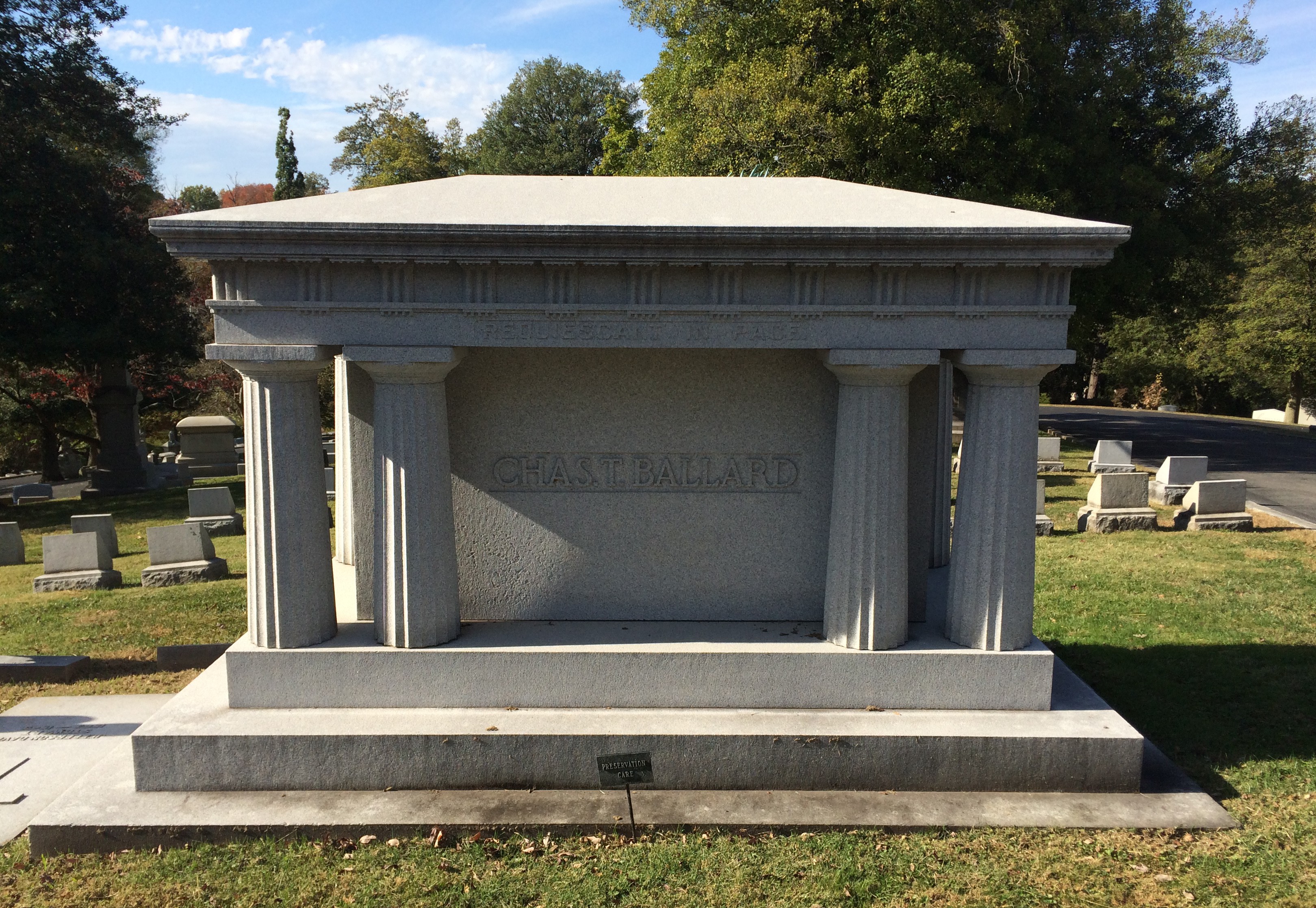
The Death of Mr. William Ballard of Hampton, Virginia, in 1784.

While randomly searching the newspapers available on the website Newspapers.com, we stumbled upon a news item describing the untimely demise of a Mr. William Ballard of Norfolk, Virginia, appearing in The Philadelphia Packet of Thursday, 11 March 1784 (p. 2), which, for ease of reading, given the antiquated typeface, we have transcribed below.  The paragraph has been broken into several parts for ease of reading.  A link at the end takes you to an image of the original.

By a gentleman from Northampton county, we are informed, that several vessels have been wrecked on the coast during this intense weather, amongst which he mentions a brig from Dublin, with goods and servants, intended for Philadelphia; several of the people died with the severity of the weather, but they had got great part of the goods on shore, which were to be sold at public sale.  A schooner from Martinique was likewise lost, and some of her people perished. A large French ship from the same port, was drove ashore in the snow storm which happened on Monday the 19th of January last, and ten of the people were frozen to death.

On board of this ship was Mr. William Ballard, a noted pilot belonging to Hampton; he piloted out a French ship some considerable time since, and the wind blowing very hard, could not be put on shore, and was carried to France, from whence he got to Martinique, where he was recommended to the captain of this ship as a good pilot, and shipped himself in her to come home; but on being off our capes when the snow storm came on, the ship struck on the Middle Ground and sprung a leak; he advised the captain to run her ashore, which was done, but the captain feeling himself and crew in danger of being drowned, he struck Mr. Ballard on the head with a spy glass, and afterwards had him stripped naked and killed him with the pump brake.

This is reported by a young Scotch sailor who was on board, and brought over Mr. Ballard’s watch to Norfolk with him, which his relations knew.  They have taken the young Scottish sailor over to the Eastern shore, to enquire more particularly about the murder, that it may be brought to light.

He has been confused (by this compiler) with William Ballard Sr of Hampton (c.1721-1782), whose will was probated 28 February 1782 and 9 November 1782. The William Ballard who met his end on the wrong end of a spy glass is probably the William Ballard whose estate was probated in 1785 in Elizabeth City County.  The will (if there was one) is lost, but there is an entry in the Elizabeth City County Order Book of 1784-1788, which is indexed in the online records of the Library of Virginia (Order Book 1784-1788 (Reel 19). A number of Ballards residing in Elizabeth City County had connections to several members of the Tarrent family, and we have confirmation of William’s relationship with the Tarrant family in the 1783 will of Carter Tarrant.  A William Ballard (very likely this one) was named executor of the will, which was dated 28 July 1783; note that this is after the death of William Servant Ballard.  A codicil to the will dated 15 October 1784 recites “Whereas my friend William Ballard has died,” and names alternate executors.

Will of Carter Tarrant (abstract).  Dated 28 July 1783.  Legatees: wife Mary; son Leonard; son Francis; daughter Jane Talbot; daughter Mary Carlton; daughter Kitty, debt due me from the estate of John Riddlehurst.  Executors friend William Ballard and son Francis Tarrant.  Witnesses: Elizabeth Brough, Ann Brough, Robert Brough.   Codicil dated 15 October 1784: Whereas my friend William Ballard has died, executors wife Mary, friend Robert Brough and son Francis Tarrant.  Witnesses: Elizabeth Brough, Ann Brough, Sally Wilson.  Recorded 28 October 1784.  Original Will.  Blanch Adams Chapman, Wills and Administrations of Elizabeth City County, Virginia 1688-1800 (Baltimore: Genealogical Publishing Company, 2008) p. 92.

The will of Carter’s sister Elizabeth Tarrant helps us better understand the Tarrant family.

Will of Elizabeth Tarrant (abstract).  Dated 13 January 1778.  Legatees: niece Jane Seaton, daughter of my sister Ann Seaton; niece Priscilla Mitchell, daughter of Mary Carlton; sister Jane Talbott; sister Catherine Tarrant; brother Francis Tarrant; to my relation Mary the daughter of Nicholas Powell.  Witnesses: Moss Armistead, William Ballard, Jr.  Original Will.  Chapman, p. 92.

Mary Tarrant’s will includes her nephews Servant and John Ballard (probably brothers, but we don’t really know).  Note that she is not named in either of the Tarrant wills above; she was probably a cousin.

Will of Mary Tarrant (abstract).  Dated 1790.  Legatees: Frances Bayley; nephew William Bayley, a bond due me from James Latimer; nephew Charles Bayley, a bond due me from Miles King, Esq., nephew Thomas Bayley; if a claim due me from the United States Government be recovered to be divided between my nephews Servant and John Ballard and niece Rebecca Baker.  Executors: George Wray and John Ashton Wray.  Witnesses: Pascow Herbert, William King, Samuel Healey.  Recorded 22 April 1796, Book 1787-1800, p. 297.  Original Will.  Chapman, p. 92.

Who was this Mary Tarrant whose sister married a Ballard?  She figures in a handful of documents; on 25 February 1786 she witnessed the will of Moss Wallace Armistead, with John Ashton Wray and Francis Riddlehurst (Chapman, p. 6); we should note that a William Ballard in November 1761 proved the nuncupative will of John Riddlehurst, in which he leaves his whole estate to his brother Francis Riddlehurst (Chapman, p. 74). Indeed, a Mary Tarrant is named granddaughter in the will of Francis Riddlehurst, which also includes Carter Tarrant as a witness.

Will of Francis Riddlehurst (abstract).  Dated 16 October 1756.  Legatees: wife Ann; son Francis; son John; son Richard; grandson Francis Bright; grandson William Powel; daughter Ann; granddaughter Mary Tarrant.  Executors wife Ann and sons Francis and John Riddlehurst.  Witnesses: Thomas Tabb, Carter Tarrant and Thomas Tabb.  Estate appraised by Joseph Selden, James Wallace, James Naylor and William Latimore.  Recorded 7 December 1756, Order Book 1755-1760, p. 84 (Chapman, p. 74).

The will of the younger Francis Riddlehurst might be of some interest.  The Mary Carlton named here may be daughter of Carter Tarrant.

Will of Francis Riddlehurst (abstract).  Dated 7 May 1796.  Legatees: Francis Riddlehurst Bright, son of Robert and Mary Bright at twenty-one; with reversion of bequest to his brother John Bright; reversion to Frances Tarrants then eldest son; to Ann Toomer, daughter of Thomas Butts and wife Ann, as long as she remains a widow; to Susanna Selden, wife of Samuel Selden; to Hannah Drew, the widow of William Drew; rest of my estate to be equally divided between Samuel Selden, Priscilla Johnson and Mary Carleton.  Executors: George Hope, Sr. and Pasccow Herbert.  Witnesses: Wilson C. Wallace, I. Hardeman, James Cunningham.  Codicil in which a provision is made to fulfill a contract with William Armistead, Sr.  Samuel Selden qualified as Executor.  Book 1787-1800, p. 311.  Original Will.  Chapman, p. 74.

Mary Tarrant also witnessed the will of Ann Moore, which names Ann Moore’s sister Mary Ballard.

Will of Ann Moore (abstract).  Dated 27 December 1767.  Legatees: sister Lucy Loyall; nephew Lewis Meredith; niece Jenny Barron, reversion of bequest to her son Archibald Bordland; sister Mary Ballard; niece Sarah Webb; sister Sarah Cowper; sister Elizabeth Jeggitts; to Anne Armistead, the daughter of James Armistead the money he owes me.  Executors: Lewis Meredith and Lucy Loyall.  Witnesses: James Cunningham, Mary Tarrant.  Book 1763-1771, p. 187.  Original Will.  Lewis Meredith qualified, security, Roe Cowper.   Chapman, p. 61.

The 1747 will of Ann Roe, Ann Moore’s mother, proves the name of Mary (Roe) Ballard.

Will of Ann Roe (abstract).  Dated 31 October 1747.  Legatees: daughter Grisel; daughter Mary Ballard; daughter Ann Moore; daughter Sarah Cooper; daughter Elizabeth Merriday; daughter Catherine Boutwell; daughter Margaret Merriday; daughter Ellenner Mitchel; daughter Luce Loyal.  Executors: Mr. John Moore and Abraham Cooper.  Witnesses: Robert Brough, John Bennett.  Abraham Cooper qualified, security, Samuel Jones and Adam Boutwell.  Book 1737-1749, p. 292.  Chapman, pp. 76-77.

What’s to be made of this?  Where does this William “fit?” He is not the son of John Ballard of Yorktown, whose son William was born 31 October 1743 and who by 1770 had removed to the Borough of Norfolk, according to a deed record in York County. On 21 July 1760 when he was 16 years of age, he placed himself apprentice to David Jameson of York “to be instructed in the art of merchandize and book keeping until he arrives at the age of 2[ ]…”  We find confirmation that William, son of John of Yorktown was still living in 1785 when his mother Elizabeth Ballard wrote her will in Norfolk (see The Will of Elizabeth Ballard of Norfolk, Virginia (1785)) This William proved to be a merchant like his father, not a sailor, for we find an announcement of his death in the Norfolk Gazette and Public Ledger on 20 March 1812.

Much more likely he was the son of one of Francis Ballard‘s other sons — Servant or Francis.  Very likely Servant Ballard, the eldest son of Francis Ballard.  The 1792 conveyance by a Servant Ballard of 100 acres in Warwick County is likely a son or grandson of Servant (son of Francis), and could be the same Servant named in the 1790 will of Mary Tarrant with his likely brother John Ballard.  Francis’ son Servant or Francis (or a grandson) must have married a sister of Mary Tarrant.  Perhaps the Order Book that documents William’s probate in 1785 could provide the answer.   See The Pennsylvania Packet, 11 March 1784, p. 2

Revolutionary War Pension Application of Thomas Ballard of Lancaster District, South Carolina (1751-1843).

Below is a transcription of the American Revolutionary War Pension application of Thomas Ballard, a son of John Ballard of Albemarle County, Virginia (c.1719-1779).  It contains a wealth of information about his service during that war, and his travels from Virginia to South Carolina and Georgia, and names his children.

Pension Application of Thomas Ballard, File No. S20283

Georgia, Gwinnett County: Inferior Court December Term 1832

Personally appeared in open court it being a court of record, now sitting, Thomas Ballard a resident of said County of Gwinnett and State aforesaid aged Eighty years who being first duly
sworn according to law doth on his oath make the following declaration in order to attain the benefit of the Act of Congress passed June 7th, 1832.

That he entered the service of the United States under the following named officers and served as herein stated, to wit: That he entered the service in the State of South Carolina the part
which is now called Kershaw District. That he was then Captain of a militia company and that he together with his Company was called into service by Colonel Kimbrel [Frederick Kimball] as volunteers. That he was then by Colonel Kimbrel brevetted Captain of said Company that he was in Major Thompson’s Battalion & Colonel Kimbrel’s Regiment that during this service he was with General Marion [Francis Marion] six weeks when his company was relieved and allowed to return home. That this service was during the year 1780 & 1781. That this was a
three months Tour but that he was relieved & allowed to return home a few days before the Term of service expired. That afterwards in the year 1781 the Company which he commanded was again called into Service under the Command of Major Thompson in General Henderson’s [William Henderson’s] division for a three months Service. That he was stationed at Captain Young’s house in the State of South Carolina in the fork of edisto River [Edisto River] and was engaged during this Service in skirmishes with the Tories and at the end of the Service he returned home. That he did not receive a written discharge in either of the above mentioned Services because he did not concede them at that time necessary. That his brevet has been lost or mislaid. That the two several tours of duty were served in the State of South Carolina and that he has no documentary Evidence nor does he know of anyone now living except Michael Branham, who can establish the same. That since the revolutionary war he has resided first in South Carolina Kershaw District from thence he removed to Gwinnett County in Georgia where he now resides that he was born in the State of Virginia in March 1751. He hereby relinquishes every claim whatever to a pension or annuity except the present and declares that his name is not on the pension Old of the agency of any State.

Sworn to & subscribed this tenth day December 1832 in open Court.
Attest: S/ Wm Maltbie, Clk

S/ Thos. Ballard

[p 40: Hosea Camp, a clergyman, and John F Martin gave the standard supporting affidavit.]

[p 41]
Georgia Gwinnett County:

Before me, a Justice of the Peace for said County came in person Michael Branham and being sworn on oath saith that he served six months under the command of Thomas Ballard in the revolutionary war – who was a Captain of the Militia of Kershaw District in the State of South Carolina – and further states that said six months service is mentioned and correctly stated in the within declaration.

Sworn to & subscribed before me this 10th December 1832
S/ John Clower, JP S/ Michael Branham, X his mark

[p 44]
State of South Carolina Fairfield District

Personally appeared before me Henry Moore of the State & District aforesaid and being sworn as the Law Directs says on oath that he was introduced to a Captain Ballard either before or shortly after the fall of Charleston but it is so long since that he cannot fully identify him at this late period. Further that he thinks the forgoing certificate of Mr. John Clanton entitled to undoubted credit this 9th September 1838

S/ William Moore, QU S/ Henry Moore1 Capt Lt. of Artillery
Regt. So. Carolina

[p 43]
State of South Carolina Kershaw District:

Before me appeared John Clanton of said District after being Duly Sworn as the Law Directs made oath that he became acquainted [with] Thomas Ballard in the year 1780 and in the year 1781 we served together a tower [tour] in the service in behalf of the Liberty of the State and US we joined the whigs at a place called the foreholes [Four Holes] in South Carolina. Thomas Ballard was a Captain and Commanded the Company called the Bever Creek Company of said District. I Father [further] state that I was his Cook for his mess. I believe him to be as good a whig as the State had at that time according to the opportunities he had to show it.

Sworn to before me this 3 July 1839
S/ Elijah Sill, J. Q. S/ John Clanton, X his mark
[p 47]
South Carolina Lancaster District

Personally came before me John Trousdale aged seventy-one years last March & after being duly sworn, maketh oath & saith that in & about the year 1781 the fall of the year he became acquainted with Colonel Thomas Ballard, who was then Thomas Ballard, & had the character of a good & valiant Whig in the revolutionary Army, in & about the neighborhood of Hangrock [?] & Beaver Creek Kershaw District South Carolina in which neighborhood & place both deponent & Thomas Ballard resided – shortly afterwards Thomas Ballard was called Captain of the Beaver Creek Militia Company Kershaw District South Carolina & generally received opinion of that time & up to this day was that Thomas Ballard was an officer a Captain in the revolutionary war & bore the character at that day & since of a brave & courageous defender of the liberties of his country – deponent has known Colonel Ballard from about 1781 2 [“to”] 1821 at which last period he removed to Georgia where he remained until 1838 & at this time is living in Lancaster District South Carolina.

Sworn to & subscribed before me 5 November 1839
S/ J. H. Witherspoon, Junior Q.W. E. Off. S/ John Trusdel

[p 48]
South Carolina Lancaster district

Personally came before me Thomas Mackey Senior age 77 years last February & maketh oath & saith that during the revolutionary war he this deponent was a private in Colonel Kimbrell Regiment, previous Colonel Marshall, & that he knew Thomas Ballard, that he was attached to said Regiment & commanded as Captain in the Beaver Creek Company Kershaw District South Carolina, deponent can’t say positively how long Thomas Ballard & this deponent remained in the same Regiment, his impression is that the Company Thomas Ballard commanded was sent out on a scouting party & this deponent & the company he was attached to was ordered to Purysburg, deponent served three months & is satisfied that Thomas Ballard was also out during that tour of three months, he verily believes that Thomas Ballard served much longer, he was always regarded a true & Brave Whig, & rendered [indecipherable word] services to his Country during the revolutionary struggle.

Sworn to & subscribed before me 6 November 1839
S/ J. W. Witherspoon, Junior, Q. W. E. Off S/ Thos. Macke

[p 10]
South Carolina, Lancaster District

On this Sixth day of November A.D. 1839 personally appeared in open Court before the Court of General Sessions & Common Pleas now sitting, Thomas Ballard, a resident of the State & District aforesaid aged eighty-nine years who being first duly sworn according to law doth on his oath make the following declaration in order to obtain the benefit of the Act of Congress passed June 7th, 1832. — viz. That he entered the service as a militia man (Volunteer) in Captain William Nettles company (militia) in Colonel John Marshall’s Regiment (militia) in the year 1780 about six or eight months before Gates defeat near Camden [Battle of Camden, August 15-16, 1780], at the time of Gates defeat he was with General Sumter [Thomas Sumter] as a Volunteer afterwards in the spring of 1781 he received a commission to Command the Beaver Creek Company Kershaw District South Carolina from Colonel Kimbrell who then had the Command of Colonel Marshall’s Regiment Colonel Marshall having gone to Virginia served under Colonel Kimbrell & General Marion three months as Captain in Santee Swamp near McCord’s ferry South Carolina was in pursuit of the British & caused them to evacuate Bigham [sic, Biggin] Church [July 16-17, 1781] & fire the same was at the Battle of Hobkirk Hill [April 25, 1781] near Camden South Carolina between General Greene & Lord Rawdon, he afterwards returned with his company & remained at home for about three months, he then as Captain & with his Company returned to the service and Joined the Whigs at the “Fore Holes” [sic, Four Holes] thinks a Colonel Henderson had Command & continued with him three months in the fork of Edisto River watching the movements of certain forces in that neighborhood he & his Company then returned home, don’t recollect what has become of his discharge, or whether he received one, his Commission has been mislaid it was signed by Colonel Kimbrell.

Sworn to open Court the day & date above mentioned
S/ S/ Beckham, Clk S/ Thos. Ballard
[J. P. Thompson, a clergyman, and Samuel B. Hammond gave the standard supporting affidavit.]

[p 13]
Interrogatories

1. Where & in what year were you borned?
Answer 1751 

2. Have you any record of your age, if so where is it?
Answer – Have none 

3. Where were you living when called into service, where have you lived since the revolutionary war, & where do you now live?
Answer – When called into service lived in Kershaw District South Carolina moved to Georgia in 1821 – returned to South Carolina Lancaster District in April 1838 

4 – How were you called into service, were you drafted did you Volunteer or were you a substitute, if a substitute for whom?
Answer – Called into service as a militia man

5th State the names of some of the Regular Officers who were with the troops where you served, such Continental & militia Regiments age you can recollect, & the General circumstances of
your Service.
Answer – Was in Colonel Kimbles Regiment Nettles Company, was at Bingham Church [sic] when it was fired by the British – was at a Battle at Hobkirk Hill near Camden South Carolina 

6. Did you ever receive a discharge from the service, if so, by whom was it given & what has become of it?
Answer – don’t recollect that he received a discharge. 

7th did you ever receive a Commission, if so, by whom was it signed & what has become of it?
Answer – had a Commission Received it from Colonel Kimbrel don’t know what became of it 

S/ Thos. Ballard

[p 15]
State of South Carolina, Lancaster District

Personally appeared before me James H. Witherspoon Jr Judge of the Court of Ordinary Lancaster District Colonel Thomas Ballard Senior of the said District & State, aged ninety years, 7 March next, who being duly sworn maketh oath & saith, that he was born in the County of Albemarle & State of Virginia 7 March 1751 & resided there until the year 1789 [sic, 1779?], when he removed to South Carolina, Craven County now the district of Kershaw where he resided & lived until the year 1818, when he removed to Georgia when at County & resided & built there until the year 1838, when he removed back to South Carolina Lancaster District, where he now resides. This deponent further states that shortly after he removed to South Carolina to wit in the fall & winter of 1779 & 1780 he entered the service of his country under Captain William who was attached to Colonel Marshall’s Regiment, the deponent was out & engaged in said service at various times, principally in scouting & routing certain Tories who were then lurking in Kershaw district, he was then residing in Captain William’ beat, and as a militia man was called out sometime in December 1779 & was engaged & out in service until May 1780, whenever the Company was on duty, the duty of this Company at that time was principally the routing & keeping in check the Tories in the district — deponent further saith that sometime in August or September 1780 he went on a visit to Virginia, that while there, he heard that a great many Tories had assembled near the Brushy Mountains in North Carolina he then volunteered under Colonel Bryce Martin in Henry County Virginia to march against them after marching several days under him the Regiment was dismissed by Colonel Martin upon learning that the Tories had left & abandoned that place. This deponent then returned to South Carolina Kershaw District where his family were still residing. He was there afterwards engaged in various services, but not regularly — until he was present & assisted in taking Rudgeleys [Rugeley’s] Fort [December 4, 1780]. In March or April 1781 this deponent received a Captain’s Commission from Colonel Kimbrell to command the Beaver Creek Company in Kershaw District. He then marched his Company to Camden & was at the Battle of Hobkirk Hill near Camden, he then afterwards with his Company under Colonel Kimbrell marched & joined general Marion near Biggin Church, deponent as Captain served under General Marion three months — in this State — and afterwards marched his Company to Edisto & there remained three months to the best of his recollection — deponent has either lost or misplaced his commission, he cannot now find it — deponent in conclusion states, that to the best of his recollection, he served six months as a militia man under Captain Nettles, ready to perform duty whenever called upon – – is perfectly satisfied that as Captain he was three months under General Marion in active service — and also three months in the fork of Edisto & was upon duty as Captain — altogether six months — besides other duties & services — deponent further saith that he has never received any compensation for said services either from the State or the United States.

Sworn to & subscribed Before me 19 January 1841
S/ James H. Witherspoon, Jr., Judge of Court Ordinary

Lancaster District S/ Thos. Ballard

[p 34: Original of a bill of sale dated April 5, 1820 by which Thomas Ballard conveyed to Elizabeth Thompson for $800 one Negro woman by the name of Rody aged 19 or 20 and her
child Charrity [sic, Charity].]

[p 18: On February 25, 1847, Col. Thomas P. Ballard, 47, son of Capt. Thomas Ballard on behalf and the other children of Capt. Thomas Ballard, to wit, Susanna Caston & Mary Russell sought
to recover the pension he said was due his father.

[p 51]
Comptroller General’s Office Columbia South Carolina October 30th 1846

Book W
Indent 165 Issued 9th of August 1785 to Captain Thomas Ballard for 156 pounds 17 shillings
1 ½ D 4 366 days duty in 1780, 1781 & 1782 as per account audited
Principal £156.17.1 ½D Annl. Int. £10.19.7D
Book W
Account 165 Captain Thomas Ballard
For 288 days duty under Colonel Frederick Kimball in General Sumter’s Brigade at 60 shillings per day – 40 days under Colonel Frederick Kimball at 60 shillings per day – 38 days under Colonel Kimbrell at 60 shillings per day in all 366 days
Sterling £156.17.1 ½ D.

I certify the above to be a true copy from the Records in this office
For Comptroller General
S/ J. Aug. Black

[Veteran died at the residence of Mrs. Susanna Caston in Lancaster District SC on December 28, 1843]

[Veteran was pensioned at the rate of $240.66 per annum commencing March 4th, 1831 and terminating December 28, 1843 upon his death. His pension was granted for 12 months and one
day service as a Captain in the South Carolina service.]

Robert Ballard of Mecklenburg County, Virginia and Baltimore, Maryland (c.1742-1793).

This post is compelled by a desire to correct a great injustice.  John Bennett Boddie’s inaccurate research has resulted in many researchers overlooking the contributions of this Robert Ballard, a Lieutenant Colonel in the Continental Line during the American Revolution.  In his Southside Virginia Families (1955) Boddie placed this Robert Ballard (who removed to Baltimore, Maryland and married Rebecca Plowman) as a grandson of John Ballard of Yorktown (1700-1745), when in fact he came from Mecklenburg County, Virginia, as proven by his own correspondence with President George Washington, which is quoted in full below, and the records of that county.

His descent has yet to be traced by this researcher; we know he left a number of sons and a daughter.  There is still much, much work to do with this line.

The compiler is indebted to Brenda Ballard Pflaum for many of the abstracts that follow below – thank you.

Robert Ballard, the son of John Ballard of Mecklenburg County, Virginia, was born c. 1742, died before 7 August 1793 in Baltimore, Maryland.  Robert Ballard was three times sworn Sheriff of Lunenburg county: Order Book 1763-64, p. 99; 1764-65, p. 164; 1766-69, p. 133.

On 14 February 1767 he witnessed a deed between Robert Cunningham and John Goode in Mecklenburg county (14 February 1767. Robert Cunningham John Goode; £160 for 370 acres on east side of Cox Creek; Spittle Pulley’s lower corner at mouth of branch; Lewis Parkham, Robert Ballard and Samuel Oldham witnessed. Mecklenburg Co. Va. Deeds Vol. 1, 1765-1768, p. 466.)

On 13 July 1767 he witnessed a deed between his brother John Ballard Jr and George Jefferson.  (George Jefferson of St. James Parish to John Ballard Jr; £135 for 400 acres in St. James Parish, on the branches of Miles’ Creek; Ruffins line; part of a tract he bought of Henry Delony. Signed. William Holloway, Robert Ballard and Thomas Farrar witnessed.  Mecklenburg Co. Va. Deed Book 1, 1765-1768. p. 453.)

7 March 1772 Robert Ballard, Isaac Holmes, Reuben Morgan, Thomas Taylor Jr, and John Ballard Sr, are bound to John Tabb for £5,000. Agreed that Robert Ballard shall keep 1/3 of Tabb’s fees as clerk, and keep all papers and records. Robert Ballard and John Tabb signed agreement, and others all signed bond agreement. Witnessed by John and William Lucas and William Duncan. Recorded on 13 April 1772 Mecklenburg Co. Va. Deeds, Vol. 3 (1771-1773), p. 336.  LDS Film # 0032533

24 September 1773, Accounts of sales of estate of Dennis Lark: John Ballard Jr  bought corn and a cart: William Ballard bought wheat: Robert Ballard bought corn. Vol. 1, p. 171. (Mecklenberg Co. Va. Wills, Estates, Probates, Inventories and Sales, Vol. 1 (1765-1782), p. 171.   Film # 0032518.

On 12 September 1774, Robert Ballard purchased 150 acres on Huey’s Mill Creek from Joshua Mabry, but the next year sold to Robert Burgon of Granville, North Carolina.  He must have removed to James City county, for in the latter transaction he is identified as “Robert Ballard of James City”, and the deed was witnessed by John Ballard, Jr, Joseph Speed, Edward Garland and Bennett Goode (12 September 1774. Joshua Mabry to Robert Ballard; £40 for 150 acres on Huey’s mill creek, at Hughey’s and James Blanto’s lines. Isaac Holmes witnessed. Mecklenburg Co. Va. Deeds, 1774, p. 326).

On 8 May 1775 he participated in a meeting of freeholders of Mecklenburg County to elect a committee  of safety pursuant to a resolution of the Continental Congress “the better to secure a due observation of the association entered by the said congress.”  The members included John Speed, Bennett Goode, William Lucas, Henry Speed, Francis Ruffin, Lewis Burwell, Robert Burton, Edmund Taylor, Clevieous Coleman, Thacker Burwell, Sir Peton Skipwith, Joseph Speed, John Tabb, John Jones, William Leigh, Robert Ballard, Samuel Hopkins, Jr. and John Ballard, Jr.  John Speed, Esq. was chosen chairman, and Mr. Isaac Holmes clerk.  The Virginia Gazette, 1 June 1775 p. 1, Col. 1.

Virginia Gazette,  20 October 1775, p. 2, col. 2. Contains reports of military activity related to troops of Lord Dunmore. Reference is made to “two companies of regulars…commanded by Capt. (Robert) Ballard of Mecklenburg and Capt. Fleming of Goochland

He resigned as clerk of Mecklenburg County, Virginia in 1775 to command a company in the 1st Virginia Regiment.  He noted this fact in a letter to President George Washington dated 1 January 1789:

My Attachment and Love for my Country have been uniformly ardent and sincere, and though I presume not to claim equal distinction with many other Officers who had the Honor of serving under your Excellency’s Command, yet I humbly hope even my services will not be wholly forgotten. Early in the late glorious Struggle for Peace, Liberty and Safety, sacraficing as well pecuniary as other Considerations, I steppd forth a Volenteer to oppose the Depredations of Lord Dunmore, near Williamsburg; after which I received an appointment to command a Company in the First Regiment raised in Virginia, which I speedily recruited and marched to Camp—resigning at the same time the Clerkship of Mecklenburg County, a lucrative place which I purchased of John Tabb Esqr. the then Clerk after serving five years

After resigning as clerk of Mecklenburg County and joining the Continental Army, he was likely stationed in Williamsburg in James City County when he sold the 150 acres on Huey’s Mill Creek (5 December 1775. “Robert Ballard of James City” to Robert Burton of Granville NC; £100 for 150 acres on Huey’s mill creek. Witnessed by John Ballard Jr, Joseph Speed, Edward Garland and Bennett Goode. Recorded 11 March 1776. Mecklenburg Co. Va. Deeds, Vol. 4 (1773-1776), p. 507).

On 5 July 1776 Robert Ballard published in The Virginia Gazette (page 2, col. 2) a notice addressing rumors that were being spread about him; this included corroboration from one of his colleagues:

It is with real concern I find an injurious report has been spread through the country, nearly affecting my reputation as an officer and man of honour.  As I am conscious of my own rectitude, I am always ready and willing to have a review of any part o fmy military conduct; and, on this occasion, shall lay before the publick the following certificate, which I hope will sufficiently refute the charge that has been alledged against me.

ROBERT BALLARD.

____________

Whereas a report has been propogated, much to the prejudice of capt. Robert Ballard, that he has made use of the soldiers money under his command, and is indebted to them for their wages, tot he mount of 6 or 700l.  I take this method to inform the public, that such reports are entirely false and groundless, as it appears, upon examination, that capt. Ballard has punctually paid his soldiers, and now has their receipts in full, with a balance in his favour, and that they are well satisfied in every particular with him.

FRANK EPPES, Lieutenant-colonel of the first regiment.

Money — rather, the lack of it, appears to have been a constant struggle, for on 26 September [1776] he wrote to General George Washington from Fort Constitution (now Fort Lee) in New Jersey, asking permission to sell his commission to Lt. John Pettrus in order to pursue “a Captaincy of Marines in an armed Vessell that is now fitting out in Virginia.” The reason for his request, he says, “is not from any dislike to the service, or for want of zeal to the glorious cause, but from experience [I] find that I cannot afford to stay in the Service, being naturally of an extravagant turn & not fortune sufficient to support that Dignity that is observ’d in our Camp” (DNA:PCC, item 152).

Congress took no action on Ballard’s request, and on 22 March 1777 he was promoted to major of the 1st Virginia Regiment (see General Orders, that date, DLC:GW). In October 1777 Ballard became the regiment’s lieutenant colonel and commanded a garrison on the Delaware River (see GW to Ballard, 25 Oct. 1777, DLC:GW). Ballard transferred to the 4th Virginia Regiment in September 1778, and he resigned his commission the following July.

The Virginia Gazette, 21 February 1777, p. 3, col. 1. Adam Jones and Dudley Ballard, late of Capt, Ballard’s company of minutemen from Mecklenburg…are ordered to wait on the commanding officer at Williamsburg immediately. On failure, they will be treated as deserters. –-Samuel Cobb, lieut.

The Virginia Gazette, 7 March 1777, p. 2, col 2.  (Supplement). In regard to the meeting of the officers of the 1st Virginia regiment…announcing the meeting must be rescheduled due to many of the men having smallpox. —Robert BALLARD

The Virginia Gazette, 14 March 1777, p. 3, col. 3, March 4, 1777. “Ralph Cobbs, Edward Cook, Richard Worsham, John McCarter, John Thompson, Matthew Durham, Johnathan Terrell, John McNeal and Gideon Patterson of my company who enlisted as privates in the continental services last August had a furlough given them of ten days, after which time they were to rejoin the company then on the march for General Washington’s army. And, as I have not heard from either of the above mentioned…I deem them deserters and will give a reward of ten dollars for each…” —Robert BALLARD

5 May 1777 John Ballard Jr. to Richard Watts of King William £250 for 116 acres on Miles creek at Dennis Lark’s line to Reedy branch to Willis’s line. Witnessed by Noah Dortch, Mary Watts, Robert Ballard, Ebenezer and Elizabeth Marcharg. Mecklenburg Co. Va. Deeds, Vol. 5 (1777-1779), p. 49.  LDS Film # 0032534

The Virginia Gazette, 17 July 1778, p. 3, col. 1. “Baltimore, July 3, 1778. I have instructions from his Excellency General Washington to call together all the Captains and subalterns of the 1st, 5th, and 9th Virginia regiments who are now in Virginia or any (unreadable) whatever. They are therefore directed to meet me in the city of Williamsburg on Monday the (unreadable) when farther orders will be given.” —Robert BALLARD, Lieut. Col.

16 April 1780. Bills of lading for goods shipped by Gov. Hill aboard the Nelson (dated 5 Oct 1780). The goods are consigned to Howe & Harrison. Mr. Robert Ballard and Messrs. Newton & Kelly, all of Virginia. [reference needed]

On 13 July 1780 Robert Ballard married Rebecca Plowman of Baltimore.  He noted in his letter of 30 May to George Washington that not only his own funds had vanished in the Baltimore lots speculation but £1,600 belonging to his wife.   In the Maryland General Assembly sesson of 3 November 1783 to 26 December, a bill was introduced to authorize him to administer the estate of Jonathan Plowman, late of Baltimore County, deceased, “unadministered by Rebecca Plowman and David Arnold, his executors.”   Laws of Maryland, Made Since MDCCLXIII [1763] (Annapolis: Frederick Green, Printer, MDCCLXXXVII [1787]).

1 December 1784.  Articles of Agreement between Henry Delony, gentleman and Robert Ballard, a merchant of Baltimore, MD and John Ballard of Lunenberg. Delony agrees to rent to them for 7 years, 5 months and 15 days, that is until 15 May 1792, a 5 acre tract with houses, which was land of David Dortch, deceased, and leased to Dinwidie and Company? With annual rent of £50. All signed.  Mecklenburg Co. Va. Deeds, Vol. 6 (1779-1786), p. 470.  LDS Film # 0032534

In his letter of 1 January 1789, Robert Ballard asked President George Washington to oblige him with a government appointment in reward for his service to his country, after noting his financial misadventures:

During the infatuation which generally prevailed in this Town for purchasing Lots, I was unfortunately drawn in to speculate to my distruction, and by one ill-fated step, I lost all I had acquired, which hath left me, with a Wife and a number of small Children, destitute of the means of a comfortable support.  Thus circumstanced, Sir, if I might venture to name the Office I should prefer, I would solicit the Clerkship of the Federal Court, as I flatter myself my past Experience would enable me to discharge its Duties with propriety. If I should be so fortunate as to meet your Excellency’s Patronage on this occasion, I shall consider it the happiest Event of my Life, and my Children may live to thank their generous Benefactor. I fear your Excellency will think me premature in thus early addressing you on this subject—but I trust my necesstous situation will plead my excuse.

I will no further obtrude on your Excellency’s Time than to add the anxious hope that my true Federal Principles will have some Influence with the Friends of the Federal Constitution, and that I am with the greatest Deference Your Excellency’s Most Obet hum. Servt

In August 1789 President George Washington named Ballard surveyor of the port of Baltimore, and in 1791 Ballard also obtained the office of inspector of that port.  His correspondence with General — then President — George Washington and James Madison appears below, verbatim (with notes) as it appears in a database of the National Archives, Founders Online.

Robert Ballard died before 7 August 1793 in Baltimore, Maryland.  His death is noted in a letter from David Plunket to George Washington bearing that date, in which he wrote: “The office of Surveyor of this Port haveing become vacant by the death of Colonel Ballard, I take the liberty of recommending to your consideration in the appointment to be made, Mr John H. Purviance son of the late Mr Samuel Purviance of this town—” (Letter to George Washington from David Plunket, 7 August 1793).

An action by his executor to collect a debt for the estate of Robert Ballard appears in the records of Person County, North Carolina:  Jacob Vanhook Sheriff to William Dickens of Granville Co. (to satisfy judgment brought by Robert Burton administrator of Robert Ballard, decd. Against Anthony Brown) for £410 lbs, 3 negroes (Ephraim, George, Ben), 290 ac. on Tar River adj. Samual Bumpass. 26 Sept. 1800. Ackn. in open court.

Robert Ballard and Rebecca Plowman had issue [note: this has not been verified or traced]: [The 1790 Baltimore Census shows five sons and one daughter; another as yet unverified record shows five children.

***

Correspondence Between Robert Ballard & The Founders of the Republic

From George Washington to John Hancock

Head Qrs Heights of Harlem Septr 30th 1776

Sir

Since I had the honor of addressing you last nothing of importance has transpired,1 tho from some movements yesterday on the part of the Enemy it would seem as if something was Intended.

The inclosed memorial from Lieut. Colo. Sheppard of the 4th Regiment,2 I beg leave to submit to the consideration of Congress, and shall only add that I could wish they would promote him to the Command of the Regiment and send him a Commission, being a good and valuable Officer and especially as the vacancy is of a pretty long standing and I have [not]3 had nor has he, any Intelligence from Colo. Learned himself who had the command and who obtained a discharge on account of his indisposition, of his designs to return.4 I have also inclosed a Letter from Captn Ballard which Congress will please to determine on, the Subject being new and not within my authority.5 I have the Honor to be Sir Your Most Obedt St

Go: Washington

P.S. A Commission was sent for Colo. Learned, which is now in my Hands, having received no application or heard from him since It came.

LS, in Robert Hanson Harrison’s writing, DNA:PCC, item 152; LB, DLC:GW; copy,DNA:PCC, item 169; Varick transcript, DLC:GW. Congress read this letter and its enclosures on 2 Oct. (JCC, 5:838).

2. GW means the 3d Continental Regiment.

3. The word “not” is inserted above the line at this place in the text in both theLB and Varick transcript by some person or persons other than the copyists who wrote those documents.

4. Lt. Col. William Shepard in his petition to GW of 28 Sept. asks permission to resign his commission, because, he says, “when he views the Regiment to which he belongs, which has been destitute of a Chief Col. for almost six months and not filled, and other Regiments, vacant, but a few hours before they are filled by advancements from their own Corps, Your Petitioner is convinced, that he is judged by the wise and prudent Rulers of the States (whom he will honour and esteem) not to be an Officer worthy of promotion, or the most flagrant injustice is done him” (DNA:PCC, item 152). Congress on 2 Oct. promoted Shepard to colonel of the 3d Continental Regiment ranking from 4 May 1776 when it was calculated that Col. Ebenezer Learned’s command of the regiment ceased (ibid., 839; see also Hancock to GW, 4 Oct.).

5. Robert Ballard (d. 1793), who resigned as clerk of Mecklenburg County, Va., in 1775 to command a company in the 1st Virginia Regiment, wrote GW on 26 Sept. from Fort Constitution (Fort Lee), N.J., asking permission to sell his commission to Lt. John Pettrus in order to pursue “a Captaincy of Marines in an armed Vessell that is now fitting out in Virginia.” The reason for his request, he says, “is not from any dislike to the service, or for want of zeal to the glorious cause, but from experience [I] find that I cannot afford to stay in the Service, being naturally of an extravagant turn & not fortune sufficient to support that Dignity that is observ’d in our Camp” (DNA:PCC, item 152). Congress took no action on Ballard’s request, and on 22 Mar. 1777 he was promoted to major of the 1st Virginia Regiment (seeGeneral Orders, that date, DLC:GW). In October 1777 Ballard became the regiment’s lieutenant colonel and commanded a garrison on the Delaware River (see GW to Ballard, 25 Oct. 1777, DLC:GW). Ballard transferred to the 4th Virginia Regiment in September 1778, and he resigned his commission the following July. In August 1789 GW named Ballard surveyor of the port of Baltimore, and in 1791 Ballard also obtained the office of inspector of that port.

From Major Robert Ballard to George Washington

2 OClock Red Bank [N.J.] Octr 23. 1777

Sir

I am just Arrivd at this place on command from Fort Mifflin, and finding that Colo. Green & the Commodore was sending by express to your Excellency the Glorious Event of last Evening and this Morning,1 think proper to give you the particulars from our Garrison. This Morning at half after Six OClock the enemy from Province Island began a very heavy fire from their Bomb Batteries and about an hour after, was Joind by their fleet which kept up on us incessantly ’till after 12 OClock, Our Battery in Consort with the Commodores Fleet playing on them the whole time, in short we Ply’d them with 18 & 32 lb. Shots so closely that they I believe began to give Ground, however they ran a Sixty four Gun Ship and a Twenty Gun Frigate a ground & after fruitless attempts in vain to get them off, they set fire to them both, to our no small Satisfaction as it was out of the Power of our Fleet to take them.2 We sustain’d no Damage except a Capt. & 1 private slightly wounded.

Our Garrison shew’d a firmness & Resolution becoming brave Men, & I dont doubt will acquit themselves with honor. The Fleet are making down again fast, as low as Billingsport. I am doubtfull we shall want Ammunition for our Cannon & 32 lb. Ball as the quantity on hand will not I am certain last us more than one Days hot fire. Small Cartridges from No. 17 to 20 are absolutely wanting. It wou’d be too much to loose a place of so much Importance for the want of War like Implements, which I haven’t a doubt may easily be <had—>3 the Sizes for our Cannon of Cartridges 18 & 8 lbs. Cartridge paper will not be Amiss. The foregoing are Circumstances which I know at least Strike Colo. Smith & I do not doubt the Baron also. I hope to hear welcome news from your Quarters before long, in mean time every exertion of the Garrison of Fort Mifflin in Opposition to the Enemies fleet will be strictly attended to. We had the upper part of one of our block houses blown up to day. I expect this night or tomorrow night the Enemy will for the last make an Effort to Storm our fort. I have the honor to be Your Excellencys most Obedt Servant

Robert Ballard

ALS, DLC:GW; copy, enclosed in GW to Hancock, 24 Oct. 1777, DNA:PCC, item 152; copy, DNA:PCC, item 169.

Congress ordered the publication of a partial version of this letter, which consists of the first paragraph (except the phrase “to our no small Satisfaction as it was out of the Power of our Fleet to take them”) and the first two sentences of the second paragraph (see the Maryland Journal, and Baltimore Advertiser, 18 Nov. 1777).

1. See the letters that John Hazelwood and Samuel Ward, Jr., wrote to GW on this date.

2. Several ships of the British fleet moved up the Delaware River on 22 Oct. to support the Hessian attack on Fort Mercer by engaging the American fleet and Fort Mifflin. Late that afternoon as the British ships maneuvered in the channel to approach the upper chevaux-de-frise near Fort Mifflin, the 18–gun Merlin and the 64–gun Augusta ran aground. On the morning of 23 Oct. the British attempted to refloat both ships, but they were hampered severely in their efforts by American galleys, floating batteries, and fire ships. About eleven o’clock the Augusta caught fire by some undetermined means, and about a half hour later the British deliberately set fire to the Merlin to prevent its capture. The Augusta’s powder magazine blew up about two o’clock in the afternoon, and the Merlin exploded about half an hour later (see the journals of the Roebuck, Camilla, and Pearl, 23 Oct. 1777, in Naval Documents, 10:246, 248, 250–51, and the courts-martial of Capt. Francis Reynolds and Comdr. Samuel Reeve, 26 Nov. 1777, ibid., 603–10). Capt. John Montresor says in his journal entry for 23 Oct. that before the explosion of the Augusta “many of the seamen jumped overboard apprehending it, some were taken up by our ships [and] boats, but the Chaplain, one Lieutenant and 60 men perished in the water” (Scull, Montresor Journals, 470; see also Muenchhausen, At General Howe’s Side, 41).

3. This word, which is mutilated on the manuscript of the ALS, is taken from the copy enclosed in GW’s letter to Hancock of 24 October.

To Major Robert Ballard from George Washington

Head Quarters [Whitpain Township, Pa.] Octor 25th 1777.

Sir

I received your favor of the 23d Inst. and am obliged by the intelligence it contains. The conduct of your Garrison has equaled my most sanguine expectations, and merit my warmest acknowledgements & thanks. Be assured no exertions of mine shall be wanting to give you every support in my power; ammunition is now on its way to the Forts, and a supply of that article shall not be wanting, when possible for me to procure it. I am &c.

G. W——n

Copy, in Richard Kidder Meade’s writing, DLC:GW; Varick transcript, DLC:GW.


From Major Robert Ballard to George Washington

Woodberry [N.J.] 15th Novr 1777

Sir

This will be presented by Capt. Moss who waits on your Excellency for leave to Resign he has made me acquainted with the necessity of being with his family. I am Sensible the Service will loose a good Officer, but as the urgency of his business demands his Attention at home, I have given him my Approbation to go. Capt. Boykin is under the same predicament & waits on your Excellency.1 I have Honor to be Your Excellencys Most Obedt Sert

Robert Ballard
Majr Comt of the 1st V. Rt

ALS, DNA: RG 93, manuscript file no. 31305.

1. John Moss (c.1743–1809), who was commissioned a first lieutenant in the 1st Virginia Regiment on 22 Feb. 1776, was promoted to captain on 15 Sept. 1776 and resigned from the Continental army on 18 Nov. 1777. Francis Boykin (1754–1805) was made a second lieutenant in the 1st Virginia on 30 Sept. 1775, and he was promoted to first lieutenant on 30 Aug. 1776 and to captain in 1777. Boykin did not leave the service at this time.

To Lieutenant Colonel Robert Ballard from George Washington

Head Quarters Valley Forge 18th June 1778

Sir

Having recd information that the State of Virginia have determined to fill their Regiments by Recruits, I have directed the 1st 5th and 9th Regiments to be incorporated for the present, and the supernumerary Officers to proceed to Virginia to superintend the recruiting Service. You are therefore to proceed, with such supernumerary Officers, to Virginia, and, upon your arrival there, wait upon His Excellency the Governor and take your instructions from him. You are to look upon the Officers from Genl Muhlenbergs Brigade as under your particular direction, and you are to designate them to such parts of the Country as they are best acquainted with. You are to desire them, from time to time, to make you returns of their progress, which returns you are to make regularly to me. The sooner the Recruits are marched to Camp, after they are inlisted, the better; and you are therefore to send them forward in Squads, under the Care of Officers; as fast as they can be collected. I lately issued an order, which was published in the Virginia papers, calling upon all Officers in that line, not absent upon command, to repair to their Regiments immediately.1 But you may, under the present circumstances, detain all those of the 1st 5th and 9th to assist in recruiting.2 I am &c.

Df, in Tench Tilghman’s writing, DLC:GW; Varick transcript, DLC:GW.

1. On 12 June, Alexander Purdie’s Virginia Gazette (Williamsburg) published the following notice of 29 May, signed “By his Excellency’s command” by Alexander Hamilton: “The Commander in Chief positively requires all officers absent from the camp, belonging to the troops of the state of Virginia, except those who are detained on publick service by His Excellency the Governour of that state, or any general officer of the same, or those who have furloughs not yet expired, immediately to join their respective corps.”

From Lieutenant Colonel Robert Ballard to George Washington

Williamsburg [Va.] July 24th 1778

Sir

Agreeable to your instructions I waited on Governor Henry, on Monday the 20th Inst., expecting to receive from him an Order for recruiting Money &c.,1 The Governor inform’d me he did not know at that time what to do in the matter, as 10 Gentlemen were already employed for to recruit men to fill up the Virginia Regts, but he woud consult the Council on the Occasion; the result of which, was, that the whole of us (meaning the Officers of Gl Muhlenbergs Brigade) was immediately to set out in search of Security for the Money intended to be given us. I was to provide Security for the whole of the Money, & take Security of each Officer for the respective sums given them, at my risque.

I convened the Officers and inform’d them of the Governor & Councils Instructions. They (for very cogent reasons in my Opinion) unanimously objected to the instructions, alledging that after marching 3 or 4 hundred Miles on foot, and having met me agreeable to my Appointment, and then, to set out again in persuit of Security on foot, was an obligation too hard to comply with, and what was not expected by you, nor was it a practice in your Army to go after Security when Ordered on the like business. besides the Officers say they do not know where to provide security, and it is unnecessarily drawing reflections on them; for, if they cannot procure security, the publick is directly aquainted thereof.

As to my part, I conceive it totally out of my power to obtain security for 20 or 30 thousand pounds on the principal of runing the risque of the Money given to each Officer, especially as the Council refus’d to undertake to refund their expences; indeed I thought it unjust to ask a friend to become my security on those terms. I acquainted the Governor & Council of the mode adopted in your Army when Officers were sent out to recruit: And if they chose to Issue Money to me and wou’d receive each Officers rect to whom I delivered money, & place to my Credit I wou’d undertake it with all my heart, but they possitively refused; on which I altogether refus’d to attempt Security.

The Governor and Council affected much Surprize when inform’d of the Number of Officers Sent to Virginia to recruit, and pretended that those 10 Gentn which they had employed was Sufficient for the undertaking.2 Those employed were Gentn who had been living at home enjoying themselves in peace and plenty, taking the advantage of the times to accumulate wealth, to whom very considerably Wages was given; when your Officers who had experienced every hardship at the risque of Life & fortune, for the protection and ease of those in private life, was refus’d any extra pay for their necessary expences. I fear we have an ungrateful publick.

The Officers who march’d under my Command to this place <are> much distressed for want of Money, several of whom I was oblig’d to advance Money, to get them home, I made the Governor & Council acquainted thereof, & beg’d they wou’d Order two or three Months pay to each, ’till I cou’d acquaint you, but I was put off with a kind of a recommendation to any Continental Pay Master I might meet with; at the same time they knew there was no Money in the Military Chest here. I never was so trifled with, by Gentn, in all my life. The Officers beg’d me to request your Excellencys favor in Ordering them pay here, if to remain any time.

I flatter myself my conduct will meet with your Excellencys Approbation. Any Commands Your Excellency may please to communicate shall to the utmost of my power be attended to. I have the Honor to be Your Excellencys Most Obt Sevt

Robt Ballard

P. S. Colo. H. Recheson is here, & meets with the Same fate with me.3

ALS, DLC:GW.

1. For Ballard’s instructions, see GW’s letter to him of 18 June.

2. “An act for recruiting the continental army” passed at the May 1778 session of the Virginia legislature authorized the governor “with the advice of the council … to appoint from time to time such and so many recruiting officers in this state as in their judgment shall be requisite” (Hening, 9:454). On 10 July the Virginia council appointed “Francis Smith & Alexander Baugh of Chesterfield; John Lewis of Pittsylvania; Elisha White & Thomas Richardson of Hanover; John White of Louisa; Daniel Barksdale of Caroline; John Holcombe of Prince Edward; William Allen of James City; and Alexander Cummins of Bedford” to fill the positions ( Va. State Council Journals , 2:164).

3. The journals of the Virginia council do not record decisions about recruiting for Muhlenberg’s and Woodford’s brigades by Ballard and Lt. Col. Holt Richeson, but on 24 July the council considered a request by recruiters from Scott’s brigade and decided “that the recruiting Officers already appointed under the late Act of the Assembly would probably succeed better than any of the said Officers—it is judged unnecessary to issue the Warrants they desired” (ibid., 2:172).

George Washington to
Lieutenant Colonel Robert Ballard1

West Point, July 30, 1779. Accepts Ballard’s resignation.

Df, in writing of H, George Washington Papers, Library of Congress.

1. Ballard was a lieutenant colonel of the Fourth Virginia Regiment.

From Robert Ballard to George Washington

Baltimore January 1st 1789

Sir,

I flatter myself the period is not far distant when we shall see the new Government in motion, and your Excellency elected President of the United States by the unanimous Voice of their grateful Citizens. I entreat your forgiveness in thus early soliciting an appointment under the new Constitution. I have been urged to the measure by a sad reverse of Fortune, and emboldened by the Idea of your disposition, to relieve the sufferings of the unfortunate soldier.

My Attachment and Love for my Country have been uniformly ardent and sincere, and though I presume not to claim equal distinction with many other Officers who had the Honor of serving under your Excellency’s Command, yet I humbly hope even my services will not be wholly forgotten. Early in the late glorious Struggle for Peace, Liberty and Safety, sacraficing as well pecuniary as other Considerations, I steppd forth a Volenteer to oppose the Depredations of Lord Dunmore, near Williamsburg; after which I received an appointment to command a Company in the First Regiment raised in Virginia, which I speedily recruited and marched to Camp—resigning at the same time the Clerkship of Mecklenburg County, a lucrative place which I purchased of John Tabb Esqr. the then Clerk after serving five years.1

During the infatuation which generally prevailed in this Town for purchasing Lots, I was unfortunately drawn in to speculate to my distruction, and by one ill-fated step, I lost all I had acquired, which hath left me, with a Wife and a number of small Children, destitute of the means of a comfortable support.2 Thus circumstanced, Sir, if I might venture to name the Office I should prefer, I would solicit the Clerkship of the Federal Court, as I flatter myself my past Experience would enable me to discharge its Duties with propriety. If I should be so fortunate as to meet your Excellency’s Patronage on this occasion, I shall consider it the happiest Event of my Life, and my Children may live to thank their generous Benefactor. I fear your Excellency will think me premature in thus early addressing you on this subject—but I trust my necesstous situation will plead my excuse.

I will no further obtrude on your Excellency’s Time than to add the anxious hope that my true Federal Principles will have some Influence with the Friends of the Federal Constitution,3 and that I am with the greatest Deference Your Excellency’s Most Obet hum. Servt

Robert Ballard

Robert Ballard (d. 1793) served with the Virginia forces in the Continental army during the Revolution, rising to the rank of colonel before his resignation in 1779. GW wrote a noncommittal reply to this letter from Mount Vernon on 2 Mar. (GW to Thomas Barclay, 2 Mar. 1789, note 1). Ballard renewed his application for a clerkship in the federal court on 30 May, and on 25 June he wrote GW of his willingness to accept an appointment as surveyor of the port of Baltimore if a clerkship was not available. In August 1789 Ballard received the appointment as surveyor and in 1791 assumed the duties of inspector of the port as well. For his complaints that he was not adequately compensated for either post, see Ballard to GW, 4 Sept. 1791.

1. In his letter of 30 May Ballard added this summary of his Revolutionary career: “It was my fortune to be on the heights of Haarlem—the White Plains—the celebrated retreat through Jersey, and the memorable enterprize of Trenton—Here I received Orders from Lord Sterling major General for the day to march the captured Troops off the field. I was next at Brandywine—and shared in the defence of Fort Mifflin till the last day of that Seige, as well as in all the hardships of the Winter at Valey Forge” (DLC:GW).

2. On 13 July 1780 Ballard married Rebecca Plowman of Baltimore. He noted in his letter of 30 May that not only his own funds had vanished in the Baltimore lots speculation but £1,600 belonging to his wife.

3. Three prominent Baltimore federalists attested to Ballard’s “Federalist Principles.” James McHenry wrote to GW on 17 April that the appointment of Ballard, among other candidates, would “give great joy to the federalists of this town.” McHenry also indicated that he was persuaded “that he [Ballard] is competent to the business of the office, and . . . that he will execute it faithfully.” Samuel Smith affirmed on 24 June that Ballard’s appointment “will give Satisfaction to almost all the respectable Merchants in this Town—but especially to all those who have been the friends of the present Government,” and on 5 July Otho Holland Williams wrote GW that Ballard “has generally (I believe uniformly) acted, with the friends to order, and good Government.” All of these letters are in DLC:GW.

***

4 August 1789.  The Senate confirmed president Washington’s nomination of Ballard as surveyor for the Port of Baltimore.

From Robert Ballard to James Madison

Baltimore Mar. 5th 1789

Sir

I am very sory that I had not the pleasure of seeing you in Baltimore on your way to Congress.

The Inclosed, will I hope excuse the liberty of Addressing a Gentlemen on business of a Public Nature, to whom I am not known.1 On receiving Mr McHenry’s Note to you I purposed to follow you, and Mr Lee, as far as Mr Scarrets Tavern, but Mrs Ballards indisposition prevented. Sir, to be as brief as possible I am very depended, indeed, Poor—and want the aid of friends, to Assist me in obtaining an Office under the new Government, that will yield a support to a large family, that have been brought up to ease. At a time when my Country wanted the assistance of its Citizens, I turned out a Volenteer to oppose Lord Dunmore near Williamsburg; and afterwards appointed to a Company in the first Regiment raised in Virginia, which I speedely recruited and Marched to Camp, sacrificing as well pecuniary as other considerations. Under these impressions I place faith in the gratitude of my Countrymen to give a return of service.

The Office that I at present contemplate, is the Clerkship of the Federal Court, as I flatter myself my long experience in that business, would enable me to execute its duties with propriety—having injoyed the Office of Clerk to Mecklenburg County Court, several years; after serving five Years apprentiship; which Office I relinquished when I went into the Army. It will be very important to me if I am so happy as to meet your patronage and Interest on this occasion.2 As it is my intention to be in New York very soon, I will not comment any further on my Necessitous situation, only to thank you to present my respects to Mr Lee, and will esteem myself greatly obliged for his friendship and Interest on this my day of Trial. I have not the Honor of being acquainted with Mr Lee—but am on terms of friendly intimacy with Coll Henry Lee his Brother, from whom I received the other day a pleasing letter on this business. I have wrote you much hurried, and am with all deference Sir Your Ob Servant

Robert Ballard

RC (DLC). Addressed by Ballard. Docketed by JM.

1. Ballard enclosed James McHenry’s letter to JM of 5 Mar.

2. Ballard received an appointment in the customs service as surveyor at Baltimore (DHFC, II, 15, 20, 495).

From Robert Ballard to James Madison

Baltimore [ca. 1 February 1790]

Sir

The Secretary of the Treasury has wrote the Officers of this Port, for the exact Sum, each Officer has received, up to the first of January.1

I hope the Secretary is of Opinion that our Fees are too small and that he will lay a Statement thereof before Congress, for Their Consideration.

I have estimated on a frugal Plan the Sum I must expend for the Support of my Family, and find it will considerably exceed the Sum my Fees produces, for the same time—a circumstance I am persuaded the Rulers of my Country will not permit.

The Attention I am necessarely obliged to pay to the Inspectors, Weigher, Measurer, Guager, and measuring the Vessells, ascertaining the Tonnage and recording it, obliges me to Keep a Clerk, and such a One as requires large Wages.

The Nature of my Office makes me acqu[a]inted with most of the Masters of Vessells, as well Coasters as Foreigners. They all agree that the Officers Fees are so trifling that they scarcely feel them, and the Coasting Gentlemen laugh at us, and tell me: I do their Business for nothing, which is really the case! For Instance, a Boston Vessel arrives with a Cargo of Onions Potatoes &ca: &ca. that fills a Manifest, as long as my Arm, which I am to record, examine the Vessel, receive the Inspector’s Report and compare it with the Manifest, and enter it in my Book, agreeing or disagreeing, as the case may be—for all this trouble, I do not receive on an average more than 18. Cents. Vessells from the adjoining States I receive nothing from, Or the Vessells trading up this extensive Bay. And Sir, I will venture to say:They are the Vessells that will attempt smuggling. I am obliged to search and attend them. Surely then the Labourer is worthy of Hire. Another Piece of Service is particularly hard on the Surveyor: He is obliged to measure and ascertain the Tonnage of all foreign Vessells, record the same, and transmit a copy thereof to the Collector, for all Which trouble, he does not receive One Farthing. I have it from a Number of Masters of Vessells, that in the Ports of England they demand and receive Four Dollars and a half; for every American Vessel the Surveyor measures.

The Surveyor incurs a heavy Expence for Books, Paper, and blank Manifests. I have already wrote Two Rheams of writing Paper. And I calculate my Expences for Stationary and Printers Bills, at nothing less than Thirty Pounds per Year. The Law does not secure a Return of this Money. There are other Circumstances to shew that the Surveyor has not an adequete proportion of Fees for Services he must render, if he regards his Duty, and his Country’s Good. I have at an early period discovered a Zealous Attachment for the Wellfare of my Country. I have been unfortunate, and am honoured With a Commission by Our Truly Honourable and Worthy President. The Office on my part shall be executed with Fidelity.

I trust Sir, from Your own Observations, and what little Light I may have thrown on the Subject, that You will rather Coincide with me, that the Ratio of Fees to the Surveyor, are unequal to the Services he must perform. In that case permit me Sir, to sollicit Your Patronage and Aid, With each branch of the Legislature for further Allowances in Fees.2Inclosed I will take the Liberty of discribing what I think at Least the Surveyor deserves.

The Collector of this Port is very anxious, that each Officer shou’d collect his own Fees. I am sattisfied it should be so, provided the Law secures the Officers in such a Manner, that they may not be deprived of their Fees.

Knowing the goodness of your heart, to act and explain on all occasions for the best, I have taken the liberty to address you on this subject. Sir, I cannot l<ive> on the present fees—my family accustomed to live well must be stinted. I am sure the Proportion of fees I have laid to each sized Vessell, cannot be objected to by any Owner.

One Case more I will suggest. A Vessell arrives from a Forreign Port, the Surveyor performs all his Duty of receiving a Manifest recording it, examines the Vessell, Measures her, Ascertains Tonage, records it also, & passes a Certificate to the Collector, & receivesonly five Shillings. The Collector & Naval Officer Divide Five Dollars besides Perquisite fees. I am with great respect Yr Hb. Servt

Robert Ballard

From Robert Ballard to James Madison

Balt. Decr. 25th. 1790

Sir

Through some of my friends in Congress, I hope application is made for a further allowance in fees to the surveyor at Entry of Vessells under One Hundred Tons burthen, and for an allowance in fees from the Coasting Vessells. Vizt.

Vessells from a Forreign Ports with Dutiable Goods

All under 70 Tons, Two Dollars

All above 70 Tons, Three Dollars


From 60 to 100 Tons are generally the Sized Vessells which trade to the West Indies, and they require more duty to be performed by the Surveyor than a Vessell of 200 Tons laden with dry Goods. Scarcely any one of them but what have Goods to be Weighed Measured and Gauged—every Hhd. of Rum of each Cargo must be proved by the Surveyor, and Six different quallities to be Ascertained and Certified by him to the Collector—and perhaps all those things come to five or six different Consi[g]nees. Surely then One Dollar & a half is not addequate to the trouble.

To the Surveyor on Coasting Vessells.

from 15 Tons to 30 Tons One Quarter’ Dollar
from 30 to 60 half a Dollar
All above 60 Tons three quarters’ Dollar.

(Pilate Boats to be excepted)

Sir, It is generously believed that through the Medium of Small Vessell’s will all the Smugling business be attempted. I am oblig’d to search the whole of them and receive little or no compensation for my trouble.

The sums as above Proportioned, are so small that they would not be objected to, and are by no means less than what the surveyor of right ought to have.

Hopeing for your Aid & interference in this business, I am with the most perfect Respect sir Your most Obedt. Servt.

Robert Ballard
surveyor of Port’ Balt.

P. S. I am sorry to trouble my friends in Congress, but my poverty, and fees falling short of maintaining my family, obliges me to call on them. My utmost exertions have and shall be applyed for the interest of the Revenue.

R. Bd.

From Robert Ballard to George Washington

Balt[imore] April 3d 1791.

Sir

I discover by the Act of Congress for laying an Additional duty on Forriegn Spirits and Spirits Distilled in the U.S.—and that your Excellency & the Supervisor are to make appointments for carrying into effect the Services the Act requires to be performed. and furthermore that your Exellency may appoint such Officers of the Custom’s as may seem Proper to you. I am therefore humbly to sollicit your Exellency’s favor in granting and giving me the appointment of superintending and performing the duties for the Port of Baltimore agreeable to Law.1

I have not had time to peruse the Law with strict attention, but I observe that the duties to be performed, will come more immediately under the Observation of the surveyor in Sea Port Town’s, than any other Person; he, being constantly employed on the Water & Wharfs. If Sir, I have read the Law right, the Supervisor makes appointments for the home made Spirits. In this Town at present there are only two both immediately on the Water; by each I pass in my Barge four times a day—the Duty to be performed there like wise come natural and easy for the Surveyor, and at the same time, save the Additional expence of another Boat and hands. Your kindness in giving me the Surveyors Place for this District will make a lasting impression on my mind, and I hope to merit by my works the good opinion of your Excellency. I beg to observe that altho<’> I am pleased with the Office your Excellency has intrusted to my care, yet the Emoluments fall short of maintaining my family. My only wishnow is to live to maintain my house full of Boys, give them an Education and make them usefull Citizens. I have the Honor to be with the greatest respect Your Excellency’s Most Obedt hum. Servt

Robert Ballard

ALS, DLC:GW.

1. Robert Ballard, whom GW had previously named surveyor for the port of Baltimore, was appointed excise inspector during the recess of Congress. His appointment was confirmed by the Senate on 8 Mar. 1792 (Executive Journal, 104, 111). For Ballard’s later complaints about the inadequacy of his compensation, seehis letter to GW, 4 Sept. 1791.

From Robert Ballard to George Washington

Baltimore Septemr 4th 1791

Sir

I must once more take the liberty of trespassing on your time with a few lines, which respects the compensation to be allowed me for my services as Inspector of the Revenue.1The Supervisor in his Circular Letter to me, says that, “as it was supposed that the Office would add but little trouble to the Office of Surveyor, no particular compensation is allotted.” I cannot find any part of the Law which warrants such an opinion—and I am sure that in exercising the duty, I find the entire service falls on me. Mr Gale performs not any duty other than that of furnishing me with blank Cerficates, and semiquarterly a Copy of my proceedings. I am, sir, to acknowledge the very great obligation I owe you for your goodness in bestowing this second kind favor on me; and permit me to assure your Excellency, that I shall observe the most watchful attention in the exercise of my duty—but sir, if Mr Gales Opinion prevails, that is to say, I do all the duty, and he receive all the pay, then I am more than ruined. My fees arising from my Surveyors Office is far short of maintenance, and nothing but the kind indulgence of my Creditors prevents me from Suits. The duty of an Inspector of the Revenue, is very arduous, and the office important & respectable—at present I keep only one Clerk who does nothing but write in the Office; to him I give £100 per Year. In the Spring when the Crops of Spirit comes in, I must have an additional Clerk. It is a melancholy reflection where my whole time and service is yielded to the Public to know that the emoluments allowed, falls considerably short of Support: especially as I am growing old & have a large family to maintain and educate—and that is all I now look up to.

I have, may it please your Excellency, been thus particular, well knowing that when any case comes fairly before you that the strictest justice will be done, I must furthermore add that the Ex<mutilated> business falls considerably heavy on my other duty, without any reward for it. The Gauger and Weigher are paid for their share of that duty, and nothing is allowed to the Surveyor.2 I have the Honor to be with the greatest respect Your Excellency’s most Obedt humble Servt

Robert Ballard

ALS, DNA: RG 59, Miscellaneous Letters.

1. On 3 April Robert Ballard, surveyor for the port of Baltimore, solicited from GW the post of excise inspector for the port. He apparently already assumed his duties under Maryland district supervisor George Gale, although his appointment, together with that of the other inspectors, was not confirmed until mid-March 1792 (Executive Journal, 111).

2. Tobias Lear informed Ballard on 7 Sept. that he first should have brought the matter to the attention of Secretary of the Treasury Alexander Hamilton: “As it is impossible for the President to attend to the minutiae of business which may be communicated by Individuals, he wishes always to receive such information as may be proper to come before him, relating to the several Departments, thro’ the heads of the Departments to which the business properly belongs. Upon this view of the matter the President is persuaded, Sir, that you will not consider his declining to reply to the subject of your letter, at this time, as a singular case; for he observes the same conduct on all occasions of this nature” (DNA: RG 59, Miscellaneous Letters). Lear forwarded to Hamilton Ballard’s letter along with a similar one Boston collector Benjamin Lincoln wrote Lear (Lear to Hamilton, 7 Sept. 1791, DLC:GW; see also GW to Lincoln, 14 Aug., n.3, and Hamilton to Ballard, 17 Oct. [letter-not-found entry], in Syrett, Hamilton Papers, 9:401).

From Robert Ballard to James Madison

Baltimore April 1st 1792

Sir

I had a long while impatiently waited to see the Secretary of the Treasurys report on the mode of compensation to the Officers of Revenue. Since that report was made, I cannot see by the debates, that the Honble. Congress, have acted on it.1 To speak of myself, my fees as Surveyor last year did not exceed £300—out of that sum, I have to pay for House rent & Clerks hire, £175. From last December to the Middle of March I did not receive a fee, being blocked up by the ice. I see nothing before me but inevitable ruin, if the Honble. Congress does not do something for us, before they close the Session.

Since I was honored w[i]th the Commission of Surveyor, my fees fall short of support upwards of Four hundred Pounds, which money is now owing to the Merchants and Tradesmen here: and if the Surveyors fees are not raised, and a generous compensation given to the Inspectors of the Revenue; (whose Arduous service is well known) I then know my fate. My Creditors will distress me; the consequence, will be I must go to Goal. My Commissions (the only things I have to look up to) taken from me, thereby beggaring my Wife and a house full of fine Boys, whose education is my greatest wish.

I have not the pleasure of being personally known to you, yet I have taken the liberty of addressing you on this subject, being fully persuaded that it is your Wish, the Officers of the Customs should be amply compensated; and that your aid in bringing forward the business before the Session is over, will not be wanting. I have the Honor to be with great respect, Sir, Your most Obedt. Servt.

Robert Ballard

RC (DLC). Addressed by Ballard. Docketed by JM.

1. Hamilton urged the House of Representatives to increase the compensation for revenue officers in his “Report on the Difficulties in the Execution of the Act Laying Duties on Distilled Spirits” of 5 Mar. An act which became law on 8 May increased the compensation to officers in many ports but for the collectors at Baltimore provided only that one-fourth of their expenses would be paid by the district naval officer (Syrett and Cooke, Papers of Hamilton, XI, 77, 104–6; U.S. Statutes at Large, I, 274–75).

Re-visiting William Ballard of James City & Charles City County: An Alternate View

"Map from the Confederate Engineer Bureau in Richmond, Va. General J.F. Gilmer, Chief Engineer[.] Presented to the Virginia Historical Society by his only daughter, Mrs. J.F. Minis, Sav[ana]h, Ga."--Note on map. (1863)
“Map from the Confederate Engineer Bureau in Richmond, Va. General J.F. Gilmer, Chief Engineer[.] Presented to the Virginia Historical Society by his only daughter, Mrs. J.F. Minis, Sav[ana]h, Ga.”–Note on map. (1863)
It’s a bit ironic that James Branch Cabell includes in an acknowledgment in his The Majors and Their Marriages (Richmond: W.C. Hill, 1915) an apology to Philip Alexander Bruce, on whose monumental Institutional History, Economic History and Social Life of Virginia during the seventeenth century.  He apologized because

To the last-named three histories in particular the compiler stands so deep in debt that it seems hideously ungracious to point out in Mr. Bruce’s account of the Stephens-Harrison duel, as given on page 245 of the Social History, a curious misprint, whereby the wrong participant is killed; but, thus embalmed in a work of such perdurable worth, the error is of grave weight to all descendants of Captain Richard Stephens, since it untimeously bereaves them of their progenitor an awkwardly long while before his marriage.  Yet — be it repeated, — it is only the splendor and finality of Mr. Bruce’s achievement which lends importance to any mistake therein, such as elsewhere might be trivial.

We find this ironic because Mr. Cabell’s work is the foundation of every Ballard genealogy, and as a consequence has the “splendor and finality” he wrote of one hundred years ago. In an effort to understand the descent of the Ballards who resided in Charles City County and their progeny, this compiler has been studying the record books, especially wills and deeds book covering the years 1725 to 1731.  This book was unknown to Cabell; it was carried off during the War Between the States, remained in private hands, and returned to Virginia in the early 1970s. There are several records Cabell would no doubt have included in his book.  For example, the will of a William Loyd of Westover Parish (dated 16 December 1724), who devised property to John Major and Sarah, the wife of John Major; this observation borders on speculation and would require additional study, but perhaps this Sarah was the sister of William Loyd.  Another, and more importantly to readers of this blog, is the will of Elizabeth Ballard of Westover Parish (dated 22 May 1726).  Elizabeth and her children have no place in Cabell’s narrative; conscientious researchers acknowledge it but don’t know what to do with it; others simply ignore it. For the reasons outlined below, this compiler believes that Elizabeth Ballard was probably the wife of William Ballard, the youngest son of Thomas Ballard of James City.

William Ballard of James City, then Charles City County

Very little is known of William Ballard, the youngest son of Thomas Ballard of James City county. We assume that he was born after 1668, given the bequest made to all of the children of Thomas Ballard except William by Robert Baldrey in his will dated 1 May 1668  and recorded 30 December 1676 in York county.1 He is probably the William Ballard who witnessed a deed on 11 October 1686 between family friend Henry Blagrave of New Kent county and John Gowry of Stafford Parish, Stafford county, for the right to 600 acres in Stafford granted by patent to Capt. David Mansell “my late grandfather,” being a patent dated 6 October 1654. The language of the acknowledgment indicates that it was executed in New Kent county.2  Please note that a person 14 years old or older could serve as a witness in Colonial Virginia. He figured in the York records shortly after his father’s death, in a suit he brought against James Harrison, William Ballard being then described as “assignee of Benj: Goodrich, Attorney of Alice Ballard, Exorx Coll: Tho. Ballard, dec’ed”: this suit, begun at a court held 24 September 1691, was dismissed at a court held 24 November 1691, the defendant making oath the debt had been paid through Jerome Ham.3 Most significantly, two records place him as residing in James City County. A William Ballard appears in a Militia list for James City county dated 27 March 1702 preserved at the Public Record Office at London, England.4 And he is probably the William Ballard who in 1704 had 300 acres in James City York county, as shown in the Quit Rent Roll of that year.5 Since he resided in James City county, then sadly the bulk of his public life likely took place in what are now known as “burned” counties whose records have been destroyed, such as James City and Charles City, among regrettably many others. We note that his association with Benjamin Goodrich continues, for on 24 April 1708, William Ballard witnessed a deed recorded in Essex county between Benjamin Goodrich of James City county, Gent. to Wm. Aylett6 of St. John’s Parish, King William Co., Gent., for £10 Sterling, “all his interest in a tract granted to Jos. Goodrich & ‘one Price & Ball’ [probably “Jno Price & Batt”] by patent, in Essex Co.”7  William Aylett is known to have been a cousin by marriage, having married Sibella Caynehoe (1628-1674), the widow of Matthew Hubbard whose second husband was Jerome Ham. There is also mention of a William Ballard in a deed recorded among the records of Charles City County, suggesting he had acquired land there as an investment sometime after 1667 (the date the property was acquired by Charles Roan, who took a patent for it that year8), and a William Ballard who is named in a deed that recites the chain of title. The transaction between Archibald Blair and Benjamin Willard is dated 31 December 1728 and recorded in Charles City county:

Deed dated 31 December 1728 from Archibald Blair to Benjamin Willard, for £130, 200 acres on Kittawan Creek in Weynoke Parish, bounded by land now or late of Edward Turner & William Arronger, being a moiety of 400 acres purchased by Thomas Gregory & William Ballard of Charles Roan, Gent., & divided by line running from mouth of Mapscoe Creek. Witnesses: Jno. Edloe, Richd. Grinsell. Recorded 1 January 1728.9

Since one had to be at least 21 years of age to purchase land, that transaction was probably after 1695, since no mention of an order to record the deed appears in the extant Order Books.  The transaction was certainly prior to 1724, which is the date the Inventory of Thomas Gregory was recorded in the Charles City County records. The reader should be well acquainted with the will of Elizabeth Ballard (now included in our page on William Ballard of Charles City County) that was recorded among the records of Charles City county in 1726. Her associations (Henry Soane, the Duke family, etc.) indicate that she was a member of one of the more illustrious families of the county, and the uncanny similarity of the forenames of her children named in the will: Thomas, Francis, Rebecca, Anna, John, Elizabeth, William, Martha — suggests close kinship with Thomas Ballard of James City county and his son, Thomas of York county. This compiler has searched the extant records of Charles City county and found no mention of any Ballards prior to 1725. These are the resources consulted: Abstracts by Beverly Fleet, Virginia Colonial Abstracts, Vol. III (Baltimore: Genealogical Publishing Co., Inc., 1988)

  • Court Orders, 1655-1658
  • Court Orders, 1658-1661
  • Court Orders, 1661-1664
  • Court Orders and Fragments, 1664-1696

Abstracts by Benjamin B. Weisiger, III:

  • Charles City County, Virginia Court Orders 1687-1695, with fragment of Court Order Book, 1680 (Athens, Ga.: Iberian Publishing Co., 1980)
  • Charles City County, Virginia Colonial Records, 1725-1731 (Athens, Ga.: Iberian Publishing Co., 1984)
  • Charles City County, Virginia Records 1737-1774 (Athens, Ga.: Iberian Publishing Co., 1986)

The Edward Pleasants Valentine Papers (Richmond: The Valentine Museum, 1927)

Boundary Change Between James City and Charles City

And we should note that there was a boundary adjustment between James City county and Charles City county, where a part of James City was added to Charles City in 1721. William Waller Hening lists the following legislation in his Statutes at Large:10

An Act for enlarging Charles City County; and for consolidating those parts of the Parishes of Westover and Weynoake, on the North side James River, and that part of Wallingford Parish, on the Westside Chicohominy River. An Act to divide those parts of the Parishes of Westover and Weynoake, which lie on the South side James River, from those parts of the said Parishes which  lie on the North side the said River; and for uniting Westover and Weynoake Parishes; on the South side James River, to Martin Brandon Parish, in the County of Prince George; and for erecting a Chapel in Bristol Parish, in the said County.

Noted antiquary Lyon G. Tyler put it this way: “It took in the portion of Wallingford Parish west of the Chickahominy River (the Sandy Point region previously in James City County”). Morgan Poitiaux Robinson, Virginia Counties: Those Resulting from Virginia Legislation (Baltimore: Genealogical Publishing Company, 1992) p. 78 (a reprint of the Bulletin of the Virginia State Library, Volume 9 (January, April and July 1916). Wallingford Parish existed from 1643 to 1721. Acts in 1643 increased the area of Wallingford Parish to include all of James City County west of the Chickahominy, as well as considerable territory east of it. According to Charles Francis Cocke in Parish Lines: Diocese of Southern Virginia (Richmond: Library of Virginia, 1964, p. 61), David Jones’ Creek, now Kennon’s Creek in Charles City county, was the western boundary of James City county. With the Act of 1720, the following year the boundary between Charles City and James City counties became the Chickahominy river. Other families associated with the Ballards in Charles City in the 1720s appear in the Quit Rent Roll of 1704 under the list for James City county:

  • Henry Soane, 750 acres
  • Henry Duke. Jr. 1,000 acres
  • Henry Duke, Esq. 2,986 acres
  • Benja Goodrich, 1,650 acres
  • Henry Blankes, 650 acres
  • William Broadnax, 1,683 acres

See Louis des Cognets, Jr, English Duplicates of Lost Virginia Records (Baltimore: Genealogical Publishing Company, Inc., 1958) pp. 172-77. It appears that all of their property fell into Charles City County with the boundary adjustment with James City County in 1721.  Curiously, there is an entry in James City for a Thomas Ballard owning 100 acres.  We are inclined to think this Thomas is William’s son.  Curiously, there is no enumeration for Ballards anywhere else in the colony.

Ann Ballard Talman and her Descendants

In an earlier post we recounted a tradition that came down from a descendant of the Henry Talman named J. Staunton Moore, who writing in 1903 describes how his ancestor, Captain Henry Talman, came to Virginia in the 1720s and married Ann Ballard, the daughter of William Ballard of Ballardsville, a grandson of Thomas Ballard of James City county. His account strains credibility with the assertion that Ann’s father was was a lieutenant in the American Revolution — if she married Henry Talman in the 1720s (as Mr. Moore himself states), then William would have been in his 70s (at least) in 1781. Incidentally, The Virginia Gazette reports that Captain Henry Talman died at his house in New Kent County “a few days ago” in the edition published 7 December 1769, not in London in 1775, as reported by Mr Moore and repeated by William Armstrong Crozier in his Virginia Heraldica (1908). The birth of the children of Henry Talman and Ann Ballard is recorded in the register of Saint Peter’s Parish, New Kent:

  • Martha dau of Henry & Ann Talman born 16th March 1733 – bapt 16th June
  • Rebeckah dau of Henry & Ann Talman born 2 April, bapt 12th June 1737
  • Henry son of Henry & Ann Talman born 26 Dec bapt 8th April 1739

But while family traditions may evolve over time, at their heart is a kernel of truth.

Where was Ballardsville?

Mr. Moore includes in his account a letter from an Isaac H. Christian, who writes of how William Ballard of Ballardsville fought in the Revolution, and that his (unnamed) father owned the property after the death of Ballard. This statement is deceptive, implying that Mr. Christain’s father purchased it from William Ballard’s heirs. A quick Internet search reveals that one online genealogy reports that Isaac H. Christian was born 25 May 1831 at Ballardsville. His parents were James Hendricks Christian (1794-1873) and Susan Brown Hill (she died 1857).  Apparently Susan Brown Hill inherited the place from her father, Isaac Hill (see below), then the property passed throught he Christian family.

The Christian’s land holdings in the vicinity of Blanks Crossroads are evident in this map we found in the collection of the Library of Congress. Note that the land is due north of Kennon’s Landing and what is now called Kennon’s Creek (but identified here as Swanneck Creek), and would have been part of James City County in the early 1700s. Screen Shot 2014-10-11 at 4.37.31 PM In this detail of the map above, note also some of the neighboring family names associated with this branch of the Ballard family surrounding Blanks Crossroads, which we know was in the vicinity of Ballardsville: Clopton, Major, Marrable. Who did James Hendricks Christian purchase Ballardsville from? Most likely it was from the heirs of the Thomas Ballard of Charles City county who died without issue in 1804 (this is something we would like to verify). Thomas’ will speaks wistfully of the graves of his ancestors on his land: 13 August 1804. Will of Thomas Ballard of Charles City County, Parish of Westover.

Just debts shall be paid. The family burying place now on my land shall remain solved and free for the internment of the family & their connections. That is to say a sufficiency ground for that purpose and for no further disposel. This I do for through the respect and duty I owe my ancestors and family and hope the same may be remembered by those who may ever consider it.

The will names brothers John Ballard, Francis D. Ballard, sisters Elizabeth Fontain relect of Moses Fontain, Sarah Fountain wife of Abraham Fontain and Lucy Eppes, wife of Peter Epppes. Executor: John Ballard, Wyatt Walker, John Firth. Witnesses: Wm. Graves, Ed. M. Williams, Furnea Southall. Recorded 20 September 1804.11

An unverified online genealogy of the descendants of James Blanks notes that a Thomas Blanks (c.1766-1808) married Mary _____, and that “Thomas is listed in the Charles City County, Virginia census in 1787 as a taxpayer, which indicates he was probably born before 1766.  His will indicates he was the owner of the Tavern, purchased from Thomas Ballard, marked on the County Map as Blanks Tavern (Charles City County WB-2, p. 14).  Thomas [Blanks] is believed to have died in 1808, since his wife is the property tax payer in 1809.”  One of the children of Thomas and Mary Blanks is Mary Ballard Blanks, suggesting a familial connection.

Conclusion

This leads us to the conclusion that William Ballard, son of Thomas Ballard of James City county, married Elizabeth, whose sister Sarah married Henry Soane (incidentally, Henry’s estate was probated by what appears to be a second wife, Rebecca Hubbard Soane — the Hubbards being Ballard relations); they resided in that part of James City county that became part of Charles City county in 1721, and it is their descendants who are described in Cabell’s The Majors and their Marriages, which, while well researched, like so many other publications of this sort (including this one) contains errors.

Since first publishing this post, we contacted the Charles City County County Family History Center and asked if there were a family plot at the property.  We were told that unfortunately, no — what was there was plowed over about 50 or 60 years ago, and “the only information I was able to gather from locals when I made inquiries about 20 years ago was that it may have been located in the field on the east side of the drive.  We have a newspaper clipping from the 1970s about a tombstone (Bocock) that was found in a barn at Ballardsville.”

A follow-up question about whether the original house still stood on the property resulted in this reply: “There was a turn of the century dwelling on the property that was torn down about seven years ago.  Isaac Hill acquired Ballardsville in 1811 and may have built what was described as an elegant home.  His daughter Susan married James H. Christian.  I believe the property then passed to Rev. Christian’s daughter America who married Dr. Pryor Richardson.  America died in 1885 and the author of her obituary (in 1885) stated that he had been at the Richardson’s elegant home the night it took fire and burned to ashes.”

The vast majority of Ballard researchers accept the proposition that this William Ballard is the son of Thomas Ballard of James City county and resided in the Northern Neck with his wife Philadelphia, and produced that line of Ballards that included families of relatively modest means that emanated from Caroline county — some Quaker, some not.  We discount this theory because (1) there is a stark lack of connection with the known family associations of the Ballard siblings, such as the Soane, Hubbard and Goodrich families.; (2) the assumption that this family wedded to the Virginia establishment would convert to Quakerism makes little sense, absent compelling evidence to the contrary. On William’s death, whatever real property he owned would have been devised or passed to his eldest son, so it is likely that the Thomas Ballard who married Mary Dancy is his eldest son, and Thomas’ son Thomas (who left an estate valued at £723, a not inconsiderable sum).

This leaves us with three unresolved issues:

1. Accounting for what happened to Thomas Ballard, son of Thomas of York County. To date we’ve relied on Cabell’s conclusion that he must have been bound out to John Major according to the terms of his father’s will (the will is silent on this), which is what he assumed brought Thomas to Charles City County. Hopefully the solution to that problem will be the subject of a future post.  He could very well be the answer to another vexing question — the ancestry of a Thomas Ballard who lived in Stafford County in the early 1700s.

2. The full name of the Ballard killed at Charles City during the American Revolution on 8 January 1781.  To date, we have been unable to find additional documentation that may shed light on this event and provide the name of the soldier killed; so far, only applications to patriotic societies by Talman descendants have turned up.

3. Cabell names two daughters of Thomas of Charles City, Elizabeth Ann (who he identified as marrying Henry Talman; subsequent genealogies call her “Ann Elizabeth” in an effort to reconcile the two), and Mary Ballard, who married John Major.  We’d like to confirm what is known about them. Meanwhile, we have been re-ordering the genealogy contained herein to reflect this conclusion.

Endnotes:

1. Recorded York Co. Va. Deeds, Orders Wills 1672-76. 2. Deed recorded 9 December 1686, Stafford Co. Deed Book D, Part 1, pp. 19-19a. Sarah, wife of Henry, relinquishes dower; Mrs Mary Mansell relinquishes right, and her signature is acknowledged by John Waugh, attorney for Henry Blagrave. This is most likely the same Henry Blagrave, II who was a devisee in the will of William’s nephew, Matthew Ballard. See notes on the Blagrave family appearing in Allied Families. Note also that among the Minutes of the Council and the General Court there appears an interesting order: “Mr Thomas Ballard, on the behalfe of Mr David Mansell moved this board that the word Thomas in a former order of this Court might be made John about land deserted by Jno. Suggett; it is ordered that Mansell’s . . . to Mr Ballard be recorded.” H.R. McIlwaine, Minutes of the Council and General Court of Colonial Virginia (Richmond: Virginia State Library, 1924) (Richmond: Virginia State Library, 1924) p. 225. This indicates that Thomas Ballard had acquired land from David Mansell. 3. James Branch Cabell, The Majors and Their Marriages (Richmond: W.C. Hill Printing Co., 1915) p. 101. “24 November 1691. Mr William Ballard, asignee of Benjamin Goodrich, attorney of Mrs Alice Ballard, exor. Of Coll. Thomas Ballard, dec’d., plaintiff vs. James Harrison, deft. Having brught an action of debt against James Harrison, the suit is dismissed with cost, the deft. having made oath that the debt was paid to Mr Jerom Ham by order of ye said Thomas Ballard.” York Co. Va. Deeds, Orders, Wills No. 9, Part 1, p. 35. 4. The list includes Benjamin Goodrich, Francis Dancy and Henry Soane, Jr,; the latter two are known to be Ballard relations. Public Record Office, File No. C.O.5/1312, in Lloyd DeWitt Bockstruck, Virginia’s Colonial Soldiers (Baltimore: Genealogical Publishing Co., 1988) p. 216. 5. The Quit Rent Roll of 1704-1705 was ordered by Governor Francis Nicholson; a copy was sent to the Board of Trade and is preserved in the Public Record Office in London. It was published as an Appendix to The Planters of Colonial Virginia (1922) by Thomas J. Wertenbaker, and reprinted in his compilation of three earlier works, The Shaping of Colonial Virginia (New York: Russell & Russell, 1958) p. 211. The same Roll lists Thomas Ballard as owning 100 acres in James City county. It should be noted that the Quit Rent Roll of 1704 does not include the names of property owners residing in the Northern Neck, for they paid their Quit Rents to the Proprietor of the Northern Neck, not the Crown. 6. It should be noted that William Aylett was the third husband of Sibella, the widow of Matthew Hubbard of York county, making William Aylett and William Ballard cousins by marriage (William’s brother Thomas Jr having married Katherine Hubbard, the daughter of John Hubbard in 1684. The Jerome Ham referenced in Note 3 was Sibella’s second husband). See Cabell, pp. 68-70. 7. Deed dated 24 April 1708, recorded 28 April 1708, Essex Co. Va. Deeds & Wills No. 13, p. 197. “One Price & Ball” is probably an incorrect interpretation of difficult handwriting, and needs investigating. An earlier deed dated 8 December 1703 between “Benjamin Goodrich of James City county, Gent., to William Aylett, Gent., of King William county, for £22, 200 acres in Essex Co., part of a tract taken up by Joseph Goodrich, William Batt, and Jno. Price, adjoins Mr John Lightfoot’s land, and Mr Edward Chilton’s land – this 200 acres, commonly called Mt Maple and sold to the said Joseph Goodrich on February 2, 1691 by John Clark, then of Rappahannock county, and is now vested in Benjamin Goodrich by act of law, as heir of the said Joseph Goodrich, sometime since deceased.” Recorded 10 December 1703, Essex Co. Va. Records, 1703-1706, p. 132. This last document requires some explanation. The founder of the Goodrich family, Colonel Thomas Goodrich, acquired land in Old Rappahannock county that later became part of Essex county when that county was created. In his will dated 15 March 1678/9, recorded 3 April 1679, he left large bequests of land to each of his children. To his eldest son Benjamin, he left “200 acres of land on the river side which I bought of Clement Thresh and one-half the difident of land I now live on with all the profits, commodities and emoluments thereto belonging” (this being about 3,000 acres). The other children received 400 to 1,000 acres of land, and the rest of his estate went to his wife, Anne. Sweeney’s Wills of Rappahannock County, pp. 76-77. Benjamin Goodrich resided in James City county, where he was listed as a Justice there on 6 April 1685. He also served the James City county Militia, and was Sheriff on 3 March 1692, for on that date in the Calendar of State Papers appears a communication by the House of Burgesses to his Excellency, the Governor, “that they had been informed by Captain Benjamin Goodrich, Sheriff of James City county that he had been commanded to provide an officer to attend the House.” The will of Benjamin Goodrich has been lost, but we know he had one because his wife, Alice, having married Edward Sorrell, appears in several documents as his Executrix, for on 27 April 1695 there was an acknowledgment in the General Court a deed for some land to John Griffin, which was also recorded in the Essex Co. Va. Wills & Deeds, 1702-04, Book 11, p. 2. We also know that at least one son survived him, for a Benjamin Goodrich, Jr appears in the Quit Rent Rolls of 1704 as possessing 1,650 acres in James City county, and whose death is noted in The Secret Diary of William Byrd as having occurred on 29 April 1710: “April 30, 1710 Colonel Duke told me that Ben Goodrich died at night and was well that morning 2 days since.” Benjamin Goodrich was the heir-at-law of his brother, Joseph Goodrich. Another deed dated 1703 from Benjamin Goodrich to William Aylett of King and Queen county was for land that was part of a tract bequeathed by Col. Thomas Goodrich to his son, Joseph, who by his will bequeathed it to his son, Danby Goodrich. Danby Goodrich died in his minority and the land reverted to Benjamin Goodrich as Joseph’s heir. Source: an online posting by Charles Hughes Hamlin, The Goodrich Family of Virginia. 8. Charles Roan’s patent is dated 7 August 1667, for 401 acres upon the North side of Kittawan Creek in Charles City County.  Patent Book No. 6, 1666-1678 (pt.1 & 2 p.1-692) p. 109. 9. Charles City Co. Va. Wills & Deeds, 1725-31, p. 220. 10. Hening’s Laws of Virginia, November 1720 – 7th George I. pp. 94-95. 11. Charles City Co. Va. Will Book 1787-1808, p. 605.

Talman of New Kent and the Ballards of Charles City County in Virginia.

It makes for difficult reading, but an old out of print book called Reminiscences: Letters, Poetry and Miscellanies, by J. Staunton Moore (Richmond: O.E. Flanhart Printing Company, 1903) includes information on the Ballards of Charles City County, Virginia that evades placement.  Bits of information contained therein found its way into print in various publications (namely The William & Mary College Quarterly Historical Magazine, Vol. III, No. 2, and The Cuthberts: Barons of Castle Hill & Their Descendants in South Carolina and Georgia (1908), but these reminiscences appear to be the first.

Be forewarned that some of what is included here is “information” that has confused the record rather than helped it, but there may be buried within nuggets that could shed light on the confused ancestry of the Ballards of Charles City county.

We’ll excerpt the relevant parts here:

The only branch that has multiplied, increased, and brought forth much fuit is the one transplanted to America — Captain Henry Talman. …

Captain Henry Talman, our ancestor, was a sea captain, and owned two ships that he plied between Virginia and Bristol, in which he made occasional trips after his marriage.  I have a bill of lading, bearing his autograph, in 1737-’38, of his ship “Vigo.”  He came to Virginia about 1720 or ’25 and married Ann Ballard, of Ballardsville, Charles City county.  She was a daughter of William Ballard, who was a grandson of Colonel Thomas Ballard, who was a member and Speaker of the House of Burgesses, and a member of the Council of Virginia; in 1678, colonel of militia, and a prominent citizen of York county.  Colonel Thomas Ballard was the son of William Ballard, who came to Virginia in 1635, who was descended from Thomas Ballard, (his mother was the daughter of Thomas Welch,) who was a herald of King Edward IV … [in 1903, researchers believed a William Ballard came to Virginia in 1635 then moved on to Massachusetts and founded the Ballard branch there, which we now know is incorrect].

I have a copy of the Ballard coat of arms.  Thomas and John P. Ballard, who kept the Ballard House, in Richmond before the war, are from the same stock.  Ann Ballard’s father was a lieutenant of the artillery in the Revolution, and was killed at Charles City Courthouse in 1781 by Tarleton’s troops, after the sacking and burning of Richmond.  My friend, Judge Isaac H. Christian, of Charles City county, whose father owned Ballardsville after the death of Ballard, writes me, under date 11th May 1895, as follows:

Mr J.S. Moore:

My Dear Sir, — Yours received.  William Ballard, of Ballardsville, my father’s old home, where I was raised, was the only man of two or three hundred stationed at this point (Charles City Courthouse) when Tarleton made his fight, who made any fight at all — the rest were all taken prisoners or fled away in a panic.  Ballard was stationed in the tavern, and fought with his sabre a dozen or more British dragoons, who cut him to pieces, and his blood stained the floor for over half a century, when the tavern was burned down.  Your honorable ancestor is worthy to be remembered among the undying heroes of any age.  The troops here were surprised by a ruse of the enemy.  I am

Very truly and sincerely yours,

Isaac H. Christian.

The dark spot on the floor of the tavern, where his life-blood ebbed out, was known as “Ballard’s blood,” until the old tavern was burned.  Lossing’s “Field Book of the Revolution” also mentions the death of Ballard at the old courthouse.  Captain Henry Talman had three children, who lived to maturity: William, who married Elizabeth Hewlett, and two daughters; one married Bacon, the other Hewlett.  William and Elizabeth Hewlett Talman had six children.  Austin and John, who married and have issue now living in Virginia and elsewhere; Patsy, who married Boolington; Hannah married Turpin, and moved to Augusta, Ga., and has descendants now living there….

Captain Henry Talman, after his marriage to Miss Ballard, settled in New Kent county, near the X roads about twenty miles from Richmond, and built him a fine home, the bricks for which he brought over from England in one of his vessels.  The house was burned many years ago, but the place still goes by the name of “Talman’s.”  I have in my possession the old oval-shaped black walnut table that Captain Talman brought from England, and that stood in the dining room, and was given me by our grandmother when I was about fifteen; but with the understanding it was to remain at the old place as long as Uncle Josiah lived.  He died this year, and I have just gotten the table, which I prize very highly.  I also own a gold sleeve button that Captain Talman once wore.  Captain Talman died in 1781, and is buried at “Talman’s,” New Kent county. . . .

Benson John Lossing’s Pictorial Field Book of the American Revolution (New York: Harper Brothers, 1850) does mention Ballard, but does not provide a first name, stating simply “Two of the militiamen (Deane and Ballard) were killed.  One of them was slain upon the landing at the head of the stairs, while fleeing to the chamber for safety.  The spot was pointed out to me, where, until within a few years, the stains of the victims blood might be seen.”  (Lossing, p. 238).

Mr. Moore used this service to support his application to the Sons of the American Revolution, among whose records this account appears verbatim.  The source of the information on the Revolutionary War service of this Ballard (other than the first name “William”) is likely the Revolutionary War Pension Application of Jones Gill, which follows below.

We are presented with inconsistencies, however, for this William Ballard (assuming this account is substantially correct) does not fit the narrative we have constructed.  The drama of the event is the sort of thing to faithfully pass down in a family, so we have little reason to doubt it.  We also know from the study of family history how generations can be conflated.  This William, for example, would be the right age to be a son of William Ballard of Mecklenburg county, but that would not fit with Mr. Moore’s assertion that he was a grandson of Thomas Ballard of James City county (and sadly Mr Moore fails to give William’s father’s name). It also does not explain how he would have been in possession of a plantation called “Ballardsville.”  Some researchers assert that this was not a William Ballard, but a Thomas Ballard who died at this tavern, and that he was the son of the Thomas Ballard III who married Mary Dancy.

Its also very interesting that the will of Elizabeth Ballard of Charles City County names an Ann Talman as a daughter, which indicates a family connection to the Talmans going back generations.

Perhaps the key is to identify which family actually owned Ballardsville, and take it back from there.  The name still resonates in Charles City county, for it appears in the county’s description of County Historical Markers.  We’ve put in bold the family names closely associated with the Charles City Ballard families.

BLANKS CROSSROADS:
This intersection of the Old Main Road , or Ridegpath, and the road from Soanes Bridge to Kennons, derives its name from an eighteenth-century tavern owned by the Blanks family. Blanks tavern was one of a few licensed ordinaries in colonial Charles City County . Other landmarks have included an Oldfield school, Manoah Baptist Church (1848-1933) and the first Methodist Meeting House (est. 1791), also known as Charles City Chapel. Prominent area homes have included Ballardsville and Sunnyside, the home of Charles City County physician Dr. Gideon Christian. Soldiers Rest, the home of Revolutionary War soldier “Fighting Joe Christian,” was also located in this vicinity. Area resident Lemuel E. Babcock was Charles City County ‘s delegate to the Constitutional Convention of 1867 and William Page, a freedman, became a major landowner here in the years after the Civil War.

We aren’t satisfied with this yet, and the digging continues.

***

Pension Application of Jones Gill S10185 VA

Transcribed and annotated by C. Leon Harris.

State of Virginia } S.S

County of Amherst }

On this 19th day of June 1834 personally appeared in open court, before the court of Amherst county now sitting Jones Gill a resident of the county of Nelson and State aforesaid aged 70 years, who being sworn according to Law, doth on his oath make the following declaration, in order to obtain the benefit of the act of Congress passed June 7th  1832.

That he enterd the service of the United States, under the following named officers, and served as herein stated: That some time in the year 1780 having attained to the age of 16 years he was placed upon the muster roll in the county of Charles City Virginia, that being the county of his nativity and shortly thereafter was drafted into the service for a tour of six months under the command of Capt Seth Stubblefield and was stationed and served at differant points, at one time at Fort Hood on James River [in Prince George County] at another at Sandy Point but the greater part of the time at Morven Hills [sic: Malvern Hill 15 mi SE of Richmond] where he was discharged after serving out his tour of six months as aforesaid

That after returning home to Charles City and remaining there but a short time, he was again drafted into the service under the same company officers for a tour of three months, and was stationed and performed duty pretty much in the same places as he did the first, during this second tour, like the first nothing of note occurred, but marches, counter marches, alarms and watching except upon one occasion whilst he was stationed at Charles City Court House the emenys forces led by Col Tarlton at the head of some cavalry [sic: Lt. Col. Banastre Tarleton’s Legion; but see endnote] and routed us killing four of our men viz McKinney, Dean, Mosher, Ballard, one of our party was drowned in a mill pond in attempting to escape, and the centinal who was surprised by them was taken prisoner, this tour was performed as well as the first in the character of a private soldier and continued three months

That after this period and some time in the year 1781 he was again drafted into the sevice from the same county as a private soldier and placed under the same company officers, when he was marched from point to point to watch the movements of the enemy who were in our watters and it was the purpose of our forces to prevent their marauding excursions into the country, that the forces to which he was attached was thus employed in the James and York Rivers until the enemy retired to York Town [1 Aug 1781] and that part was invested by the combined american & french army, when he was discharged the service after serving five months and before the surrender of that part [surrender of Cornwallis at Yorktown, 19 Oct 1781]

That he served in the whole three Tours aforesaid fourteen months in the character of a private soldier and to the best of his recollection Major Hardiman [sic: Henry Hardman] & Col Munford [William Green Munford R16697] during all the tours his field officers and Genl Thomas Nelson his general officer, some time Genl Lafayette and at York Town whilst he was there Genl Washington

That he recollects seeing many officers both french and american at York Town, but he does not now recollect names. That he has no documentary evidence, and that he knows of no living person whose testimony he can procure who can testify to his service

He hereby relinquishes every claim whatever to a pension or annuity except the present, and declares that his name is not on the pension roll of the agency of any State

Interrogarorys propounded by the Court

1 st

. Where and in what year were you born?

answer I was born in the county of Charles City Va as I was informed by my parents and was sixteen years of age some time in the year 1780, but do not know the year in which I was born.

2d

. Have you any record of your age, and if so where is it?

answer I have no record of my age, but have understood that my age was recorded in Charles City County Clerks office and accidently destroyed by fire with the office after the close of the war of the Revolution

3d

. Where were you living when called into service, where have you lived since the Revolutionary War, and where do you now live?

answer I was living in the county of Charles City when called into service, have lived in the countys of Charles City Buckingham, Nelson and Amherst since the close of the Revolution, and do now reside in the county of Nelson adjoining to Amherst and near the county line & a part of the tract of land upon which I reside lies in Amherst

4th

. How were you called into service; were you drafted, did you volunteer or were you a substitute, and if a substitute, for whom?

answer I was drafted each Tour.

5th

. State the names of some of the Regular officers, who were with the troops where you served; such continental and melitia Regts as you can recollect and the general circumstances of your service.

Answer I recollect seeing Genl [Anthony] Wayne and other regular officers at York Town but cannot recollect names or corps and refer to my declaration for the general circumstances of my service.

6th

. Did you ever receive a written discharge from the service, and if so by whom was it given and what has become of it.

answer I never did receive a written discharge from service to the best of my recollection nor do I believe it was usual in those days to give such to Militia – if I ever did receive such they are lost

7th

. State the names of persons to whom you are known in your present neighborhood and who can testify as to your character for veracity and their belief of your sevices as a soldier of the Revolution.

Answer There is no clergyman residing immediately in my neighborhood, but I refer to William M Waller Esqr and Capt Jeremiah Yager who I expect will so testify in my behalf

Amherst County to wit

The affidavit of Jones Gill of lawful age taken before me a Justice of the peace in and for the county aforesaid. The affiant being first duly sworn according to law saith, that he is informed by letters from the office of the Commissioner of Pensions that his claim to a pension under his declaration made in the county aforesaid and transmitted to that office during the last year the said declaration being under the act of Congress of the 7 June 1832, has been rejected or suspended at the said office, because in his said declaration, he declared for two tours of service each beyond the term of six [sic: three] months that

is one tour for six months & the other for five besides another tour included in the said declaration, that in explanation of the said two first named tours objected to at the Pension office, (because as he understands it is said, that it was unusual in those days except on extraordinary occasions to draft the militia of this state for a longer period than three months at a time,) he states that at the time he performed the said service as declared for in his declaration aforesaid, it was the custom to draft for but three months at a time, but that in his case arising from the invasion of the state, in his immediate neighborhood he was detained the time as stated by him, that is six months at one time & five months at another, he was informed that he would be credited for a tour for each three months, he was in service.

That he has recently been informed by John Thompson Jr of this county that in the correspondence of the late Thomas Jefferson published since his death, that he gives an account of the descent of Col Tarlton with a corps of cavalry upon a party of our Troops in the year 1781 stationed at Charles City Court House, is mentioned by Mr Jefferson [see endnote], and is also mentioned by this affiant in his said declaration, in which he the affiant gives the names of the killed on our side on that occasion, this affiant states that until recently informed of this by the said Thompson during the last winter, say some time in January last, that he did not know that there any where existed any corroborative testimony to establish the truth of his said claim, and that not being a reading man (although not unletterd) he had never seen nor heard of, nor to this day has not seen the book styled the memor & correspondence of Thomas Jefferson, in which the said evidence is said to be found. That being poor and needy if the department will not pay him for his full services, he is willing to take what by the rules of the office they may award him.

Subscribed & sworn to before me this 13 March 1835

NOTES:

A letter by John Thompson, Jr. in the file indicates that the following is the passage referring to the attack thought to be by Tarleton: “One of the evenings during their encampment at Westover & Berkeley their Light horse surprized a party of about 100 or 150 Militia at Charles City Courthouse killed & wounded 4. & took as has been generally said about 7 or 8.” (Gov. Jefferson of Virginia to the Delegates of the State, Richmond, 18 Jan 1781.) Since Tarleton did not arrive in Virginia until April 1781, his legion could not have been the ones referred to in the letter as “their Light horse.” In fact, Jefferson’s letter refers to an attack on the night of 8 Jan 1781 by Lt. Col. John Graves Simcoe and 40 mounted rangers under the command of Gen. Benedict Arnold.

Gill was pensioned for only nine months service.

The Will of Addison M. Ballard of Oldham County, Kentucky (1799-1879).

Addison M. Ballard, a son of James Ballard of Spotsylvania County, Virginia died unmarried and without issue, but his will, transcribed below, provides interesting insight into his time and character.

Addison M. Ballard was born 17 October 1799 in Spotsylvania county, Kentucky and died 26 July 1879 at the town of LaGrange in Oldham county, Kentucky.  A diary that he kept from 1839 to 1853 resides among the records of the Kentucky Historical Society.

Will of Addison M. Ballard of Oldham County, Kentucky

I, Addison M. Ballard, according to family records was born on the 19th of October 1799 in Spotsylvania County, Virginia, near Fredericksburg, but was of Henry County, Kentucky, where I have resided since February 1831.  Being now May the 12th 1870 in good health, of sound mind & disposing memory do make this my last will & testament: should I not think proper hereafter to alter it, as follows:

1. So soon after my death, as convenient, I desire to be buried in a metallic coffin, at the graveyard where my brother Thomas M. Ballard wife & some of the family are now buried (B.J. Ballard now owning the premises).

2nd. I desire my Executor (hereinafter mentioned) to pay my burial expenses out of what money I may leave on hand, if none held out of what he may first collect out of my estate, and also to pay off all my just debts of which there are but few, & should I live much longer, I think there will be none to pay.

3. I give & bequeath to Benjm. J. Ballard the old James Ballard place commencing from the Southern corner between me thrice running east, to a stone, in the line between me & P. Harwood nearly opposite Harwood’s graveyard, bounded East by Harwood’s by the Taylor or B.J. Motes farm, W by the Come’s or Day’s place & Spot Houseworth & N by B.J. Ballard & the place whereon I lived see deed from Bland & Jas. T. Ballard & B. Rounder & Absalom Matthews for the same.

4. I give & bequeath to James B. Ballard the place whereon I now live, from the old James Ballard place given to B.J. Ballard & bounded by B.J. Ballard Bland W. Ballard & J. Riley on the west – north by R. W. Vance, crossing the creek in various places – E. by Harrods creek. On condition that W. A. Smith & Pendleton Harmon & J.B. Ballard will in a reasonable length of time, deed to Bland W. Ballard the place whereon he now lives of about 100 acres. Should James B. Ballard fail or refuse to deed to B.W. Ballard his place there & in that — I give & bequeath to Bland W. Ballard the northern portion of my farm of about 104 acres purchased of R. W. Vance. See deed for same.  And I give to B.J. Ballard the place of whereon I now live between the old Ballard place and the Vance purchase – see deed from C.M. Ballard & wife & deed from Father to Ca — & me brother Thomas – a tract in that each I give and bequeath to James B. Ballard the old Ballard place I first gave to B.J. Ballard.

5. I desire my Executor to sell away the Braunam place for the best price he can get, but not for less than $10,000, also my house & lot in Newcastle, but not for less than $2,000. Both places have cost me more than I propose to take. Should said property not be sold under three years I wish my Executor to advertise the same & sell for the best price he can get, to which account I desire sufficiency of cash out of my notes to be added to make $18,000 Eighteen Thousand Dollars – one sixth of which viz $3,000 I give to my Brother, Flavious Josephus Ballard, now of Stafford Cty, Va. – his Post office is Falmouth 1/6 viz $3,000 I give to J. O. Ballard, A. C. Ballard & W.J. Ballard, children of C.M. Ballard dec’d – 1/6 viz $3,000 I give to Isabella E. Hicks wife of L.B. Hicks, Margret W. Ballard Cordelia Ballard & Demetra Ballard the children of John Ballard decd to be equally divided between them.  1/6 viz $3,000 to be equally divided among my brother Collatinus Ballard’s children of Huntsville Texas I know not their names.  1/6 viz $3,000 I give to Mary Jane Anderson wife of R.S. Anderson.  1/6 the balance of $3,000 I desire my Executor to loan out for the benefit of my sister Mary Augusta Burton & let her have the interest on it annually so long as she may live & at her death having no children I wish the principal & accrued interest after her death divided between b.W. Ballard who is to have 2/3 of it and B.J. Ballard 1/3 the balance.

[6. omitted] I give to Isabella E. Hicks the house & lot including Dr. Berry’s shop, provided she will take her sisters & take good care of them & to help do so I giver her sisters Margaret, Cordelia & Demetra Ballard the house & lot where J.E. Alsop is now living.  All I the town of La Grange & wish my Executor to act as guardian for the 3 minor children until they become of age or marry, but should Isabella E. Hicks fail or refuse to take her 3 sisters above named then I wish the house where she is living sold & the proceeds divided among her sisters.

7. I give to L.H. Ballard the house & lot known as Garglay House west of the Keynen Farm.

8. I own 2/3 in the Thos Wells House & lot, LaGrange I give to A.C. Ballard.

9. I have a deed dated 27 Apl 1857 made to – money advanced viz $226.24 by Joshua Pruitt & wife Eliza lying on little fallen timber in Henry Cty Ky – I agreed to let him release the excess & deed it to his wife – he paid $100 Jany 15, 1858 & April 22, 1858 he also paid $57.75 & holds my notes for the same. And should he give the notes up & secure to my estate $70 I desire my Executor to deed the place to his wife. Should I not do it before I die. It is less than what is due me.

10. I own some stock in the laGrange & Shelbyville Turnpike Road & have paid one half of my subscription $100 being yet due as calls may be made. Also I signed a note with some five others at the last court in LaGrange to a man by the name of Bell for $770 due in 12 months my portion of that will have to be paid when due. Should I die before I settle the above I wish my Executor to settle the above and I give my interest in Road to A.C. Ballard.

11. I desire my Executor to leave out five hundred dollars for the benefit of J.J. Ballard’s daughter —- —- [two lines; apparently he did not know her name] of Texas until she marries or becoming of age.  I wish the same divided between J.T., A.C. & W.J. Ballard.

12. I give & bequeath to A.C. Ballard two horses ten sheep, two hogs, our two horse & one single horse plough he to have the selection.

13. I give & bequeath to Margaret W. Ballard Cordelia & Demetra Ballard one bedstead, bedding etc they to have the selection, the balance of bedsteads beds etc. I give to A.C. Ballard.

13 [repeated].  I give & bequeath to J.B., B.W. & B.J. Ballard all the rest of my household & kitchen furniture.  My stock of every description farming utensils, except my small wagon which I give to A.C. Ballard with all necessary gear etc. necessary for running the same.

Should any of my connections attempt to break or upset my will, I divest them from any interest in my estate & the said ??? to be divide among those to home I have desired, and I humbly appoint S.E. DeHarm my Executor.  Should he die or refuse to act I appoint R.W. Vance or J.T. Ballard.  This is written by myself & need no witness.

Signed: A.M. Ballard

N.B.

14. After devising the above to my connections, I think it nothing but just to aid my colored friends of African descent who have remained with me & who have helped me to make what I now have. Therefore I give & bequeath to my old servant Bob Eady the place whereon he now lives, known as Fort Pickins, all except what I sold to James Jett south of the road about 2 or 3 acres. I wish the line to run from a White oak north of his house nearly East to the line between me & Doyl.  I also give to him my horse Pomfre which he now has & wish my Executor to pay him out of my estate fifty dollars.

15. I give & bequeath to my old servant Sarah all that portion from what I have given Bob Edy with the Dayl line to Spot Honsworth North & R. Button W. by R. Button & what Edgar Tomes (colored) now owns –  so long as she may live & after her death I give the same to Edgar Haines (colored).

16. The balance of the place bounded North & East by Spot Housworth & South by E. Dayl I give & bequeath to Jimmy Davis (colored) that I have raised.

17. I also give to my old servant Sarah the sum of five hundred dollars.

18. I give to Edgar, Bill, Barney & Jarard one hundred dollars each.  I also give my old George (colored) one hundred dollars which I wish my Executor to loan out until he becomes of age – he can pay him the interest annually to clothe him etc.

19. I understand my cousin James Ballard deceased left a daughter named maria Ballard now living with Miss Wilford in Fredericksburg Va – she wishes to qualify herself for a tutoress – I desire my Executor to advance her five hundred dollars, but should she die before receiving it I give the same to my brother F.J. Ballard of Stafford Cty Va.

20. I give to James B. Ballard my blacksmiths tools now here.

21. I have two sets of blacksmith tools in LaGrange at the Buchanan Shop – one set I give to Bland W. Ballard, the other to B.J. Ballard should I not sell them.

22. I give to B.W. Ballard my Encyclopedia of 13 volumes, the rest of my books he J.B. & B.J. Ballard can divide among themselves.

23. I think after the expenses of of winding up my estate so far as devises are thus far made there will be something left, all of which I give to J.B., B.W. & B.J. Ballard to be equally divided among them.  But should times change or I be unfortunate before my death I wish my Executor to make a pro rata division so far as devises are concerned in money matters, but the disposition of my land I wish to stand & as before stated should any of my connections attempt to break or upset my will I divest him or her of any interest in my estate.   And I hereby as before appoint S.E. DeHaven my Executor.  Should he die or refuse to act I appoint R.W. Vance my Executor & should he die or refuse to act I appoint John T. Ballard of Shelby Cty Ky my Executor.   This is all written by myself and requires no witnesses.

Signed:  Addison M. Ballard

[a codicil follows]

I, Addison M. Ballard do hereby make the following alterations to my will dated May 12, 1870, viz:

1st.  Instead of being buried on B.J. Ballard’s place as instructed in the 1st clause of said will I direct my Executor to buy a lot in the cemetery at LaGrange, have the same well enclosed and bury me in said lot.

2. I hereby revoke the bequest of the house & lot in LaGrange Ky made to Isabella E. Hicks set forth in the 6th clause of said will.  I will and direct that said house & lot shall be sold and conveyed by my Executor as the Bramman place house & lot in Newcastle are directed to be sold and the proceeds disposed of in the same manner.  If the Brauman place be sold for $10,000 before the expiration of three years after my death then my Executor will at once sell the house & lot in LaGrange and also the house & lot in Newcastle, Ky.

3rd. I do also revoke the bequest to L.H. Ballard of the Gaslay House made in the 7th clause of said will.  This house has been sold & conveyed by me since such will was written.

4. I do also revoke the bequest made in the 8th clause of said will to A.C. Ballard of my interest in the Wells house & lot in LaGrange.  I direct my Executor to sell said house & lot & dispose of same as directed in the residuary clause of my will.

5. I do hereby revoke the 9th clause of said will as the business has all been settled by me.

6. I do hereby revoke the 10th clause of said will in which I devise my stock in the LaGrange & Shelbyville T.R.R. Co. to A.C. Ballard as I have since bought said road and sold it to Turney.

7. I do hereby revoke the 12th clause of said will in which I devise to A.C. Ballard two horses ten sheep etc as I have sold off all this stock.

8. I hereby revoke the 13th clause of said will in which I give three beds except Demetre Merriweather and I will & bequeath to her my new set of chamber furniture including bed bedsteads & bedclothes belonging to same – bureaus, wash stand & cradle stand & 4 chairs.  Except the walnut writing desk

9. I do hereby revoke the 2-13th clause of said will in which I dispose of the balance of my household & kitchen furniture stock etc.  I have three horses which I hereby give and bequeath to Rebecca Ballard wife of Bland Ballard.  I will and bequeath my riding mare “Dolly Vardell” to Bland W. Ballard.

10. I hereby revoke the 16th clause of said will in which I devise the balance of the “Fort Pickens’ Place to Jennie Davis (colored) and I do hereby devise the balance of such place (devised to said Jennie Davis) to Sarah Eddy her mother for life, and at her death to go to Ed Holmes (colored) and in lieu of such devise to said Jennie Davis above revoked i do hereby will and bequeath to her the two lots of land on the short line railroad conveyed to me by Jno McMahon & wife including the Spout Spring, bounded by the old Ballard place E. by Harowwds lands W T. R. Pinkston land & S by the railroad containing 16 or 18 acres & same on which she now lives.

11. I revoke the bequest made to Jarrard in the 18th clause of said will as he is dead and the hundred dollars devised to him I do hereby devise the same to Sarah Eaddy one of my old servants.

12. I do hereby revoke the 20th clause of said will of the blacksmith tools to J.B. Ballard as they have all been disposed of.

13. I do hereby revoke the 21st clause of said will and direct my Executor to sell all of such tools that may be found after my death.

14. I do hereby revoke the bequest made to Margaret, Cordelia & Demitra Ballard sisters of Isabella E. hicks made in the 6th clause of said will or the house & lot in which J.E. Alsop then lived and do hereby will and bequeath the same to Cordelia Callahan wife of John Callahan.

15. I do hereby will to L.H. Ballard my split bottomed armed chair & Mexican blanket and do hereby will her all she owes me by note or account & direct my Executor to deliver to her all evidences of her indebtedness to me.

16. I will to Bettie Russell wife of J.W. Russell thirty dollars, and also one red corn ??? ??? cow for her kindness to me in my illness.

17. I hereby release Jas. Davis, Bob Eaddy, Barney Eaddy & Will Thompson (all colored) of all they or either of them owe me by note or accoutn & direct my Executor to give up to each of them any evidences of debt I hold against them or either of them.

18. I do hereby will to W.J. Ballard a note I hold on him for a little over four hundred dollars.  This was given to me for judgments vs. J.W. Blakern and others, and he has never received anything therein & never will I reckon – and my Executor will deliver him said note & he is in no way to account therefor.

I will and desire that my Executor shall whenever he thinks best sell and convey all the rest & residue of my real or personal estate and after paying expenses & special bequests made herein dispose of the proceeds thereof as hereby before directed in the residuary clause of this will.

If Pat Turney wants on years indulgence on his indebtedness to me, on account of the Turnpike road, I direct my Executors to give him that much longer to make his payments as he has been unfortunate in having the bridge wash away and the road much injured by heavy rains.

Signed: A.M. Ballard

Signed in the presence of July 10th, 1789 Alexander Duncan, Martin Decass

Proved August 18, 1789 by oaths of S.E. DeHaven, Alexander Duncan and Martin Decass.  Recorded Oldham Co. Ky. Will Book 6, p. 375-81

Will of Albert M. Ballard of Oldham County, Kentucky (1835).

Below is the last will and testament of Albert M. Ballard of Oldham County, Kentucky.  We don’t know much about him, and we aren’t sure of his relationship to the Thomas M. Ballard mentioned in the will, who may be Thomas Montague Ballard (1789-1865) of Oldham County.

The will devises property to his wife Harriet, who we know to be Harriet Louisa Button, the daughter of John Button of Oldham County, who also died in 1835.  An abstract of his will that was found online appears below.

Will of Albert M. Ballard of Oldham County, Kentucky (1835).

I, Albert M. Ballard of the County of Oldham and State of Kentucky being weak of body but of sound and disposing memory do make this my last will and testament in manner following, to wit:

First I give and bequeath to my wife Harriet Ballard three of my negro slaves, to wit: Linn, Kitty and Amanda and their future increase for and during the natural life of the said Harriet Ballard, and should the said Harriet marry after my decease and at her death leave lawful heirs of her body living at the time of her death then my will and desire is that said three negroes and their future increase shall go to and vest in the said heirs of the said Harriet Ballard, and in default of of such heirs of the body of the said Harriet living at the time of her death, then my will and desire is that said three negroes and their future increase shall go to and vest in all the children of Thomas M. Ballard that may be living at the time of my death, to be divided among the said children of the said Thomas M. Ballard in such manner and in such proportions as he the said Thomas M. Ballard may think proper.

Secondly I give and bequeath to the said Thomas M. Ballard my negro man Jeff with the understanding that this bequest is made in discharge of a debt of about $400 which I am owing to the said Thomas M. Ballard, on condition the said Thomas M. Ballard will take the said negro man Jeff in discharge of said debt and also pay to my wife the said Harriet Ballard $150 for said negro within one year from my death.

Thirdly I give and bequeath to the said children of the said Thomas M. Ballard that may be living at the time of my death all and singular my other negroes and slaves and their future increase to be divided among the said children of the said Thomas M. Ballard in such manner and proportions as he the said Thomas M. Ballard may think proper.

Fourthly I give and bequeath to my wife the said Harriet Ballard all and singular the other property I own either in ? or expectancy and all my right and credit of all descriptions and ? whatsoever and that is not before disposed of in this will, and

Lastly I do nominate and appoint the said Thomas M. Ballard sole Executor of this my last will and testament.  In witness whereof I have hereto set my hand and affix my seal this 17th day of September in the year of our Lord 1835.

Signed: A. M. Ballard

Signed in our presence who attested the same: Geo. Armstrong, W.S. H. Slater, F.B. Culver.

At a county court for the County of Oldham on the 19th day of October 1835, this writing purporting to be the last will and testament of Albert M. Ballard dec’d was presented in court and proved by the oaths of Geo. Armstrong and W.G.H. Slater, tow of the subscribing witnesses thereto and ordered to be recorded, which is done accordingly.  Attest: [illegible]

Recorded Oldham Co. Ky. Will Book 1, p. 417.

***

Will of John Button of Oldham County, Kentucky (1835).

In the name of God Amen I John Button of the County of Oldham and the State of Kentucky being weak in body but of sound mind…I give and bequeath to my beloved wife Frances Button for and during her natural life my mansion house and half of my farm and the following servants…and all my household and kitchen furniture, three head of my stock of horses to be by her chosen, five cows if she should want so many and ten head of sheep and twenty head of hogs to be also chosen by her…all the balance of my wordly estate …to be equally divided amongst my children except my son Leonard who is to have a $50.00 horse over and above the rest of my children which was given to him by his grandfather Leonard Young.  …I have a quarter section of land in the State of Missouri which I will and bequeath to either of my children who may first ? of it at the sum of $350.00 which is to be considered in the division of my estate…I give to my son James Button my tan yard and four acres of ground around the same so as to include the spring…I have heretofore given to my son Joel H. Button $700.00 & $100.00…I charge him for the rent of my tan yard and shop which he has had five years making in all $800.00 which sum is to be considered in the division of my estate…I have heretofore given to my son Henry Button $360.00 which in the division of my estate is to be considered as so much received by him; to my son Leonard Button I have heretofore given $200.00 which in the division of my estate is to be considered as that much received by him; to my son in law Albert M. Ballard who married my daughter Harriet Louisa I have heretofore given $100.00 which is to be considered in the division of my estate as so much rec’d by him…having full confidence in the honesty and ability of my sons Joel H. Button & Henry Button and my son in law Albert M. Ballard do hereby appoint them executors to this my last will and testament…3/15/1835

Wit: Thomas Button, Daniel Yager

Probated 5/18/1835.  Recorded Oldham Co. Ky. Will Book 1, p. 393.

The Will of James Ballard of Oldham County, Kentucky (1783-1841).

Poking around the web I came across an index of wills for Oldham County, Kentucky — none of which this writer has seen.  An email to the county clerk brought a swift reply, and copies were dispatched by post.  As time allows, I’ll transcribe and publish them.

James Ballard was a son of Bland Williams Ballard of Shelby County, Kentucky (1759-1853).

***

The Last Will and Testament of James Ballard of Oldham County, Kentucky.  Oldham County Ky. Will Book 2, p. 319.

I James Ballard of Oldham county being sick of body but of disposing mind do make this my last will and testament in manner following.

1st I desire that enough of my perishable property shall be sold to pay my burial expenses.

2nd I give to my beloved wife Elizabeth Ballard during her natural life my farm together with George Ann my negro girl and my negro boy Sam and at her death the said negro boy Sam I gave to my son Blan L. Ballard together with one half of my farm and the other half I give to my son James Thomas Ballard together with GeorgeAnn and her increase forever.

My negro man Squire and my negro woman Sarah must be hired our during the life time of my wife Elizabeth to pay my physicians for services rendered to me in my illness the balance to be used in the schooling of my son James Thomas Ballard & the support of my wife Elizabeth during her natural life.

I give to my daughter Elizabeth Williamson my negro boy Augustus during her natural life and at her death to go to the heirs of her body forever.

My negro boy Benjamin I give to my son Benjamin Ballard forever at the death of my wife my desire is that Squire Sarah and her future increase shall be sold & equally divided among all my children as soon as the business of John Shackleford shall be settled whatever may be derived therefrom I request it be equally divided among my above named children.

Lastly, I do hereby appoint my wife Elizabeth my sole Executrix.

N.B. I give to my son Benjamin Ballard my palomino filly.  Witness my hand and seal this 26th day of November 1841.  James Ballard

Witnesses: James Mount, John Ballard.


Kewntucky S.S. At a county court held for the county of Oldham on the 20th day of December 1841 a paper purporting to be the last will and testament of James Ballard dec’d was produced in court and proved to be such by the oaths of James Mount and John Ballard subscribing witnesses thereto and ordered to be recorded which is done accordingly.  Att Wm. D. Michell, Clk. by E. F. Waide

Deed from Servant Ballard to Isaac Avery, Warwick County, Virginia 1792

Deed from Servant Ballard

Poor Warwick.  The original shire of Warwick River County was created in 1634, and the name shortened to Warwick in 1643.  The county records were destroyed several times, but the most were lost as a consequence of the War Between the States.  The clerk’s office burned in 1864, and additional records burned in Richmond in 1865 where they had been moved for safekeeping.

Fortunately the Library of Virginia has been cataloging and publishing online records from “lost counties.”  Warwick was just added this year.  This post from “Out of the Box” describes the effort.

Over the years, portions of records pilfered from the courthouse during the War have found their way home when found in the collection of other repositories or among the papers of soldiers who served the Union during the War.  This deed is one such record, which helps tell the story of Servant Ballard, a son of Francis Ballard of Elizabeth City County and grandson of Thomas Ballard of James City County.

Having settled in Elizabeth City and Warwick and thus oriented toward the Atlantic Ocean, this particular branch of the family appears to have produced a seafaring people not concerned with the accumulation of land.  This deed conveys the 100 acres of land devised to Servant by his father, Francis, on Francis’ death in 1719/20.

There are two ways to interpret this document: (1.) Servant Ballard is conveying the property that was devised to him by his father’s will of 1718/19; or (2.) Given the time that has elapsed (73 years), this Servant Ballard may be the grandson of Francis, not the son; however we have not found evidence that Servant had married or produced children.  The fact that no wife joined in the transaction to convey a dower interest shows that if he had a wife, she pre-deceased him; and the fact that this legacy is being sold rather than devised to children suggests that Servant was childless, assuming this is the Servant Ballard born c. 1702.  Given the tendency of members of the family to live to advanced age, we are inclined to believe that this was the devisee of Francis Ballard.

It is also interesting to note that Servant is identified as “of Elizabeth City County,” not Warwick, so clearly he lived in that county on not on this parcel of land.

This indenture made and executed this 29 day of February anno domini one thousand seven hundred and ninety two between Servant Ballard of Elizabeth City County in the State of Virginia of the one part, and Isaac Avery of the County of Warwick of the other part …

That the said Servant Ballard for and in consideration of one hundred pounds current money of Virginia, in hand paid by the said Isaac Avery to the said Ballard, the receipt whereof he doth hereby acknowledge hath given, granted, bargained, sold, conveyed, confirmed and doth by these present give, grant, bargain and sell, convey and confirm unto the said Isaac Avery and his heirs and assigns forever, a certain tract or parcel of land in the said County of Warwick containing one hundred acres, bounded northwesterly on the lands of the said Isaac Avery, Southwesterly on the lands of Miles Carey, and Westwardly on James River.

To have and to hold (etc.) …

Servant Ballard

Signed and sealed in the presence of:

Samuel Thomas, Snr., Samuel Dubroe (sp?), Saml. Selden, Nancy, Dalley, John Flax (his mark); Jacob _________ (his mark)

Proved at Warwick Court July 12, 1792 by oaths of Samuel Thomas and John Flax; at a Court held Sept. 13, 1792 the same were further proved by oath of Samuel Dubroe (sp?) and ordered to be recorded. Signed: Miles Carey, Cl. Cur.

While seemingly a dead end, at least this helps fill a gap in the story of this branch of the Ballard family.

Could Bland Ballard’s Family be from Ireland?

Screen Shot 2013-10-20 at 2.47.48 PMIn the last week I received notice from Family Tree DNA of a number of close matches of men who tested to the 67-marker level.  None bore the Ballard surname, and all were for families in Ireland.  Some were close “in a genealogical timeframe,” which is a rather generous 24 generations.

I noticed some time ago that most of our matches (speaking for those who are exact matches in the States in Lineage Group I of the Ballard DNA Project) were in Ireland.  We made a mental note to study this in the future, and “bridging the pond” is the gold standard in this business, so in an idle moment we took some time to study this closer.  A handful in England, a couple in Scotland, but the majority are in the southwest quadrant of the island.

Family Tree DNA has a number of tools available to parse their data.  One of the more interesting is a “Matches Map” that shows the location of the earliest known ancestor of each person.  The caveat here is that this bit of data is self-reported by the participant, so there is the possibility that if their assumptions about their origins are incorrect (or the research flawed), there is no way to know and the data may be a bit off.  An increased volume of testing might help with that.

Family Tree DNA gives this explanation of the “Ancestral Origins” page:

The Y-DNA – Ancestral Origins page of your myFTDNA account lists the country of origin reported to us by the people that you match. This country of origin is meant to be the country your paternal ancestors came from before recent migrations to the Americas. However, some individuals instead enter their country of birth or that of a recent ancestor. You should treat these entries as “Unknown.”

Here is what the data shows for the 111-Marker and 67-Marker results:

yDNA 111-Marker:

One match in Wales, 7 steps removed.  Six additional matches who have unfortunately not placed themselves on the map.

yDNA 67-Marker:

Exact Matches: (2).  2 exact matches in the United States, both with the surname Ballard

[note: there are additional exact Ballard matches at the 37-, 25- and 12-Marker level. For useful genealogical information, the 37-Marker test is usually recommended, and at that level, I have three exact matches with the Ballard surname; two 1-step matches, one 3-step, and one 4-step match.]

2-step Matches: (0).  None

3-step Matches: (1) [green in the map above].  1 in Fornaght, County Cork, Ireland

4-step Matches: (6) [purple].  3 in Ireland, 3 in the United States (one a Ballard).

5-step Matches: (18) [lavender].  Of those reporting a location, 4 are in the United States, 1 in England, three in Wales, 2 in Scotland, 3 in Ireland

6-step Matches: (35) [brown].  Of those reporting a location, 12 in Ireland, 2 in Scotland, 13 in the United States, 1 in Norway

7-step Matches: (41) [gray].  7 in Ireland, 3 in Scotland, 1 in England, 11 in the United States.

What does this mean?  For the single 3-step match, the statistical inference is, assuming a common ancestor, one would have to go back 24 generations to make that determination with any certainty.  Results are similar for the 37-Marker group.

It’s curious that regardless of the “steps”, the majority of the matches are in Ireland, which to this writer suggests that the descendants of the progenitor of Lineage Group 1, if presumably of English origin, emigrated to Ireland and then (of course) to the United States.  Assuming a generation is 20 years, give or take, we are looking at a common ancestor of all these men was someone living in the early 1500s.  Representatives of the R1 haplogroup, of course, moved into the United Kingdom from the continent in waves tens of thousands of years ago; the progression from England to Ireland makes sense.

Research in Ireland

What resources are available to the family historian studying Ireland?  Poking around some public repositories we learned that a vast number of records of genealogical interest went up in flames in 1922.  Knowing that, perhaps the results in Ireland are a bit skewed because with a paucity of records family historians are trying whatever they can to sort out their lineages (it would be interesting to see statistics on the percentage population of a given country being tested).

Still, there are bits to go on, and a search of the indexes of the Public Record Office of Northern Ireland in Belfast turned up reference to a will of a Benjamin Ballard who died in 1715.   Why is this of interest?  The Anglo-American tradition of naming patterns, for one thing — Bland Ballard of Spotyslvania County, Virginia named a son Benjamin, who in turn gave a son the same name, while Bland’s son George named one of his sons Benjamin, and Bland’s son Bland Jr. named one of his sons Benjamin.

With Belfast not exactly easy for us to get to, we found a researcher there (PRONI publishes a list) who had a look at the document — but unfortunately, it did not provide much (as of this writing, we await the researcher’s report):

I am putting this in the post today but I think you will be disappointed it is only an extract – the document will have been destroyed.   Not much information –

T797 page 44 –

Number 160 – Will of Benjamin Ballard, only son of Wm. Ballard Alderman of Cork – sgd (signed) 7 April 1715 pr. (probate) 18 Feb 1715.

Speaks of his bro.-in-law, Swithin White of Rochfordstown, Co. Cork

Was there anything to learn from allied families?  Yes.

An online genealogy of Thomas Boles of Cork (b. 1608) states that his daughter Anne Boles married William White of Castle White, Rochforstown, county Cork.  Their son Swithin White married Anne Ballard, the daughter of Alderman William Ballard of Cork.

We learned a bit more about the family in two ancient law books available on Google, A Treatise on Leases for Lives, Renewable For Ever, by James Lyne, Esq. (Dublin: Hodges and Smith, College-Green (1837).   This treatise cited the case of Moore v. Dawson, which notes:

By indenture of 26th March, 1707, the defendant demised the lands of Moore Galbally, in the county of Tipperary, to William Ballard, his heirs and assigns, for the lives of Benjamin Ballard, (son of the said William), Swithin White, and Samuel Godfrey, and the survivor of them, at the yearly rent of £20, during the then wars with France and Spain …

In 1717, William Ballard, on the marriage of his daughter Elizabeth with one Walter Harris, did, by indenture, covenant to assign the said lease to the said Walter and Elizabeth and their heirs ; and, in pursuance of the said covenant, did, in August, 1717, assign the said lease to J. Wallis and one Harris, in trust for the said Walter and Elizabeth.

Benjamin Ballard, one of the cestui que vies, had died in 1715, and the said Walter Harris, being indebted to the plaintiff by bond conditioned for the payment of £150, assigned the said lease to the plaintiff, to secure the said sum ; but no fine was levied thereof.

The substance of the lawsuit and its results are of no genealogical consequence.  We’re grateful that it provides what it does, even though it isn’t much.  But what can we learn about the father, William Ballard, Alderman of Cork?

A study called The Laneways of Medieval Cork, by Gina Johnson (Cork: Cork City Council, 2002) describes three Ballard’s Lanes in that city.  Names of the lanes changed over time,  but she notes:

Several Ballards occur in the records from the 17th century onwards.  It isn’t clear which individual gave his name to this lane, but it might have been William Ballard who was a prominent citizen in mid- to late 17th century Cork.  William held the office of mayor twice, first in 1687, and then in 1690 when he was the first mayor to be elected after the Williamites regained control of the city from the Jacobites.  Ballard was one of only nine individuals to have served the office twice between 1656 and 1700.  A William Ballard, probably the same individual, was one of the church wardens of Christ Church in 1675.

Another source mentions that when William first held the office of mayor, King James II also appointed Ignatius Gold to serve with him.  This suggests William was either allied with the Williamites or was one of the Scots-Irish (though his election in 1690 leans towards Williamite).  Very briefly: the Williamites supported the protestant Prince William of Orange; the Jacobites supported the Catholic King James II in the conflict over who would be king of England, Scotland and Ireland.   The result of the war is that the Protestants dominated life in Ireland, which caused discord among the majority Catholic and Scots-Irish (Presbyterian) citizens, who were excluded from power and land ownership.  Wikipedia provides a good summary of the conflict.  Evidently James II did not trust a protestant William Ballard and appointed a Catholic to serve as mayor with him.  James was the last Catholic ruler of England Scotland and Ireland, who reigned from 1685 to 1688.

The Council Book of the Corporation of the City of Cork: From 1609 to 1643 and From 1690 to 1800, by Richard Caulfield (Guildford: J. Billings & Sons, 1876) repeatedly mentions William Ballard, Alderman.  A William Ballard also served as sheriff, though the date of service is not clear from the text.  However, an ancient text called The Cork Remembrancer by Anthony Edwards (1792) lists William Ballard as sheriff in 1679 (under Charles II), and notes his service as mayor in 1687 (under James II) and 1690 (under William and Mary).  The appendix in the same volume includes an enumeration of protestants that fled from King James II (and includes an inventory of the value of their estates), and lists William Ballard, “w. and 8 ch.” (“wife and eight children”).  One other record in The Council Book provides a clue: in one instance there is the listing of a William Ballard, Jr., Alderman, in 1694, so apparently father and son served simultaneously, and perhaps Benjamin is the son of William, Jr., which leaves a large number of William, Sr’s children unaccounted for.  We have not yet found a record of direct descendants other than the snippets listed above.

Speculation

We are certainly in the realm of speculation — but could this Benjamin Ballard be the father of Bland Ballard of Spotsylvania County, Virginia?  Since Benjamin died in 1715 and Bland is believed to have been born c. 1700, it is certainly possible.  Note that he was identified in the will fragment as “the only son of William Ballard …” so he likely had no brother to carry down his genetic heritage.

We’ve speculated earlier that his forename came from a marriage with a member of a Bland family.  Was such a union possible in Ireland?  Short answer – yes, for Sir Bernard Burke’s History of The Landed Gentry of Great Britain and Ireland (London: Harrison-Pall Mall, 1875) provides the lineage of Bland of Derriquin Castle:

This family claim to of Yorkshire origin.  The first who settlend in Ireland was the Ven. James Bland, archdeacon of Limerick [James was the son of John Bland of Sedburgh, Yorkshire, in what is now Cumbria; the registers of the parish church in Sedburgh contain numerous entries for assorted Blands; this can be studied online].  He m. Lucy, dau. of Sir Francis Brewster, lord-mayor of Dublin 1674-75, and was father of

Nathaniel Bland, LL.D., judge of the Prerogative Court of Dublin, and vicar-general of the diocese of Ardfert and Aghadae.  He m. 1st, Diana, only dau. of Nicholas Nemoys, and had by her a son,

James, his heir.

He m. 2ndly, Lucy, dau. of Francis Heaton, Esq., by whom he had issue.

Francis, father, by Catherine Mahony his wife, of Colonel James-Francis Bland, of Killarney, and of Frances, m. to the Rev. Robert Hewson

Nathaniel, m. Mary Mead, but had no issue.

George, m. Hannah Westrop, but had no issue.

Lucy, m. George Orpen, Esq., a military officer, distinguished at Minden, 4th son of the Rev. Thomas Orpen, of Killowen, co. Kerry.

Hester, m. to Robert Sinclair.

Dorothea, m. to Francis Crumpe, Esq., and had, with other issue, Nathaniel Crumpe of Randalls Park, in Surrey, who took the additional surname of Bland.

Another line, though not present as early as this one, resided in Queens’s County, Ireland.  Could a female Bland relation have accompanied James this to Ireland?  There is no way to know.  The Blands are a fertile and well-traveled lot and it appears no one has completely puzzled out the descent.  A fascinating resource available on Google Books is Collections for a History of the Ancient Family of Bland (London, 1826) by Nicholas Carlisle.  These are the same lines that produced the Bland families that invested in the Virginia Company and settled in Virginia in the 17th century, but that connection, though intriguing, is too remote to take seriously at the moment.

If anyone knows anything about this Benjamin Ballard of county Cork who died in 1715, I’d love to hear about it.

Postscript:

Shortly after finishing this post, I was contacted by a fellow researcher who noted our connection and invited me to participate in the R1b-CTS4466 Plus Project.  This project is working to define the parameters of the CTS4466 subclade, and is seeking to identify branches within it.  This particular subclade is called the “Irish Type II Subclade,” and features prominently in the south of Ireland.  Results of this test are expected in a few months.

An Interesting Discovery.

It’s tough to stay focused when researching family history.  With so many branches to study, and so many unanswered questions, it is difficult to pursue one “story” to its conclusion.  So one carries about — either in a notebook or in one’s head — a “tickler” file of things to look for if the time is ever found to do so.

An idle moment and a bit a serendipity resulted in the discovery of an astounding bit of information.  This concerns my immediate line — the descendants of Dowan Ballard of Franklin County (c.1825-1909).

Dowan’s son William Henry Ballard wrote down all he knew of his ancestry sometime about 1933, and in that narrative recounts how his father was once owned by “the Macklin family.”

Dowan Ballard, Sr. son of Bland Ballard (white) and his servant Flora was born in the year 1820 at Ghent Ky.  At an early age he was sold to the Macklin family at Stamping Ground in Scott Co., Ky., in 1848.  Later he was sold by the Macklins to Dr. Ben Duvall in Franklin Co., Ky., near the forks of Elkhorn Creek and remained a slave in this family until the Emancipation was proclaimed in 1863.

He was married 3 times during his life.  The first wife died shortly after their marriage and no children were born to them on the Macklin farm.  The second wife bore him two sons John William and Flournoy and she died from burns received when the cabin on the Duvall farm where they were living burned down.

The prospect of finding a record of the sale from Bland Ballard to “the Macklin family” is tantalizing.  No Macklin family records have found their way to any public repository, so a search began for descendants of that family.

We know that the family descends from a Hugh Macklin, who settled in Kentucky in 1798.  Hugh Macklin had two sons, Alexander and John; Alexander became a wealthy hog farmer, while John cultivated wheat and became successful miller active in the New Orleans trade; both resided in Franklin County, Kentucky.   We also know that Dowan was owned by John Macklin, because there is an entry in the Franklin County, Kentucky Vital Statistics (1852) that records the death of “Flourney”:

August 1852 – FLOURNEY – 4 – black male – single – laborer – resident of Franklin County, Ky – born Franklin County, Ky – slave of John Macklin – died, Franklin County, Ky – cause of death – Typhoid flux.

We found a biography of John Macklin Stevenson, a descendant of John Macklin in History of Kentucky (Chicago and New York: American Historical Society, 1922) Vol. 4, pp. 605-606, that provides a valuable clue, which we quote here in part:

John Macklin Stevenson.  Of a pioneer Kentucky ancestry John Macklin Stevenson has for many years been one of the prominent lawyers of the Winchester bar, and has achieved success in other fields of enterprise, both business and politics.

His paternal grandparents, James and Mary (Darnaby) Stevenson, were natives of the historic community around Bryant Station, Kentucky, where the Stevensons and Darnabys settled on coming from Spottsylvania County, Virginia, about 1785. …

His son, Rev. Thomas J. Stevenson married Anna Macklin, daughter of John and Elizabeth (Black) Macklin … Mrs. Anna Stevenson still lives in Geogetown [in 1922] and owns the old Macklin farm which was acquired by her grandfather Hugh Macklin in 1798 and has been continuously in the family possession ever since.  Her father, John Macklin, was an active business man and large landowner, and John Macklin Stevenson was born on the old Macklin homestead in Franklin County, January 12, 1873.  On this farm John Macklin operated a mill on the banks of Elkhorn Creek, and made large quantities of flour for the New Orleans trade.  Mrs. Stevenson, the mother of the subject of this sketch, spends much of her time on the farm, operates it, and has shown special qualities as an able business woman.  She has two children, John M. and Mary M., , the latter unmarried and living at home…

John Macklin Stevenson married at Winchester in 1899 Miss Linna Witherspoon, the daughter of N. Holly Witherspoon.  They had four sons: Holly Witherspoon Stevenson, Thomas Johnson Stevenson, Frank Webb Stevenson and John Macklin Stevenson, Jr.

Given that the original Macklin homestead passed down from Hugh Macklin to John Macklin, then to the Stevenson family by the marriage of Anna Macklin to Thomas J. Stevenson, then it stands to reason that perhaps some family papers survive among the belongings of these Stevenson descendants.  Web searches found obituaries showing that two of these sons removed to Hartford, Connecticut, where they had successful careers in law and insurance; both obituaries mention a surviving relative residing in Winchester, Kentucky.

By way of Facebook, we found an email for this descendant, whose identity is not being disclosed because we do not have permission to do so.  We wrote a note explaining what we were looking for; she replied that she could offer no promises but would do some searching of her mother’s things.  A couple of days later I received this note:

I still can’t believe it, but I found the Bible yesterday afternoon.  It is a Macklin family Bible, and the following names are listed–this is my interpretation because some of the letters are hard to determine.   Flurnoy Matry’s child born April 5th, 1849 and Harriet’s child Dowen born March 22, 1852.  I am not sure about the name Matry…it may be Matsy.  I am still studying the letters, and I plan to send you photos of these listings.

So here we have a vital statistics of Flournoy’s short life:  Born 5 April 1849 in Franklin County, Kentucky, son of Dowan Ballard and Matry/Matsy [after seeing copies, I concur on the interpretation as “Matsy’], all slaves of John Macklin of Franklin County, Kentucky; died August 1852, the cause of death being “typhoid flux,” and rather sadly (and ludicrously) identified as a single laborer.

The second entry is more problematic, with several possibilities: (1) This Harriet is yet another consort/wife, previously unknown; perhaps the birth of a child was unknown even to him; (2) Dowan’s son bearing his name is not the son of Matlida Bartlett, but the son of this Harriet; or (3) there is no familial relationship whatsoever — but the name “Dowan” is not common, and its recurrence in this instance is compelling.

William Henry Ballard records that the mother of Flournoy Ballard and John William Ballard died in a fire in their cabin at the Macklin farm; most likely he took up with another woman before his marriage to Matilda Bartlett in 1854.  Matilda was a slave owned by Dr. James R. Butler, whose farm adjoined that of Dr. Benjamin Duvall.  This suggests that Dowan was sold to Dr. Duvall sometime between 1852 and 1854.  This conclusion is, at best, speculative, but this is amazing information to have nevertheless.  This isn’t our direct line, but this additional data helps confirm what we learned from one other primary record (i.e., the 1852 Kentucky Vital Statistics).   And it is likely that this information appears no where else.

Our special thanks go to our guardian angel in Winchester, Kentucky who safeguarded and preserved this dusty old book, and generously shared the information found there.  Thank you.

Progress?

Progress, of the best kind, is comparatively slow. Great results cannot be achieved at once; and we must be satisfied to advance in life as we walk, step by step.

–Samuel Smiles (1812-1904)

Anyone beginning the study of family history might be overwhelmed by the possibilities, with so much published, so many records to go through, and seemingly endless possibilities.  But what is the goal?  Filling in blanks on a chart as far back as one can go?  Some take that approach, often with a religious fervor.  Others are self-described “one namers” who devote themselves to a single line.  This certainly makes the adventure more manageable, but it leaves living descendants of some branches feeling neglected.

We follow the tact of the “one namers” and take solace in the fact that it mimics the pattern of the y-DNA results, and is probably the best way to corroborate the information gleaned from genetic testing.  So what “progress” has been made?

I started this post intending to highlight which pages were edited or added to, but after some reflection decided it was too tedious to recount, because minor tweaking goes on all over the place.  I’ll stick with the pledge to limit such announcements to major breakthroughs.  Perhaps most newsworthy is the fact that I did just upgrade to the 111-Marker test offered by Family Tree DNA, and to date no exact match has been found in the Ballard DNA project.  I do know that my exact match at the 67-Marker level has taken the upgrade, and those results are some weeks away.  With that information, we may be able to narrow the most recent common ancestor time frame with greater precision, which may help us sort out the relationships among and between the Ballards that settled in Buncombe county, North Carolina after the American Revolution, those that remained in Albemarle county, Virginia, and  those who removed to Kentucky.   Click here for a discussion of DNA test results in the Ballard DNA Surname Project to date.

I’ll reiterate a request: if you come to these pages seeking your family history, take what you want or need, but return the favor: please have a y-DNA test done on yourself (or, if female, your nearest male relative) and join the Ballard DNA Surname Project, especially if your family history is well documented and you have no doubts of your origins.  It could help many fellow researchers overcome those pesky “brick walls” that are so much a part of research in the Southern colonies, where record losses have made this avocation such a challenge.

An Impassioned Plea.

Most blogs are fairly dynamic, with timely, frequent updates.  You won’t find that here. This blog is a repository of over twenty years of research, and is now being published in this format in order to share the information with others interested in the history of some of the Ballard families of Virginia and Kentucky, and their descendants.

The focus of this particular work is to prove the ancestry of one branch of mixed-race descendants of the family.  This work is not a genealogy of all descendants of Thomas Ballard of James City County, Virginia, though in time it may evolve into one.  Anyone with an interest in genealogy knows that it is addictive, and the work never ends because there are always more relatives to discover with interesting stories to tell.

Since starting this work over twenty years ago, two developments have revolutionized genealogy research: (1) the Internet, which makes possible finding data with a few key strokes that in years past would take days — if not years — to uncover; and (2) DNA testing, which makes possible connections that otherwise could never be proven, and providing valuable leads for additional research.  Anyone who has attempted research in a “burned” county knows the frustration caused by the gaping chasm created by the loss of countless, invaluable records that simply cannot be replaced.  DNA testing can help fill those gaps.

On the other hand, the Internet has been the cause of much mischief, because while it allow the easy gathering of information, it also facilitates the gathering and dissemination of unreliable information.  The diligent researcher will check information gathered online against original records when possible.  On the other hand, the Internet has made possible genealogy services like Ancestry, which have revolutionized the field, making it both a blessing and a curse.

So here, then, is our impassioned plea — if you are a Ballard descendant, whether you are certain of your ancestry or not, have an inexpensive y-DNA test done (preferably the 37-Marker test), and join the Ballard DNA Project.  Those of us with confounding gaps in our family tree will benefit immensely, and those whose history is well documented will have confirmation of their lineage.  There are several companies providing DNA testing and one may shop around, but Family Tree DNA is a good place to start.

In the interest of privacy, information on the living is not included.  Comments, and more importantly, corrections to what appears here are strongly encouraged.  Notable developments in this research will be the highlight of future posts.